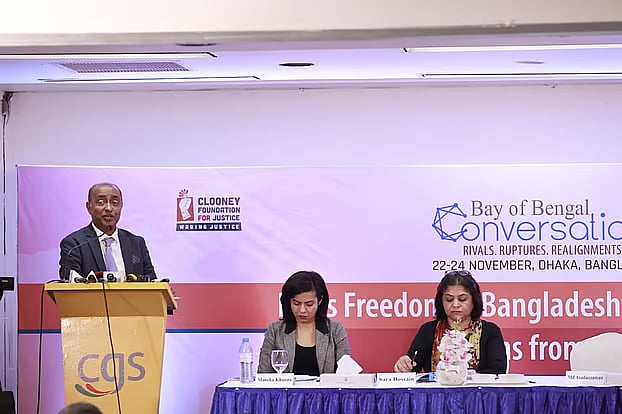
Bay of Bengal Conversation
So many provisions to repress journalists: Attorney general
Attorney general Md Asaduzzaman has said the country’s laws are far from being journalist-friendly.
“The state has left many avenues open to suppress journalists. As the saying goes, there are as many provisions in the law as there are stars in the sky. All these legal provisions are applied to control and suppress journalists,” Asaduzzaman said.
The attorney general made these remarks on Monday at a hotel in Dhaka during the third day of the three-day ‘Bay of Bengal Conversation 2025’ conference, organised by the Centre for Governance Studies (CGS).
He spoke in a session titled “Publishing Reports on the Digital Security Act: Key Lessons for the Future of Media Freedom in Bangladesh.”
Referring to various repressive laws from the British era to the post-independence period and their enforcement, he said, “Whoever comes to power always carries the mindset of suppressing journalists.”
Asaduzzaman added that the Digital Security Act enacted by the Awami League government, after repealing Section 57 of the ICT Act following consultations, was effectively a betrayal with all parties.
Citing examples of the misuse of such laws under previous governments, he said, “We demand the abolition of all these suppressive and oppressive laws, those that muzzle voices and stop journalists’ pens. We expect future political leaders to rethink these issues to ensure they do not return.”
He stressed that simply repealing the Digital Security Act would not guarantee journalists’ protection. “To change this trend, the state’s mindset must change,” he said.
Citing the Supreme Court’s handling of a Dinajpur minor’s case as an example, Asaduzzaman said that merely enacting or amending laws will not resolve the situation.
Expressing hope for a fearless culture in Bangladesh, he noted that since the current government came to power, enforced disappearances have not occurred, extrajudicial killings have significantly decreased, and the police have not filed any “secret” cases in the past 17 months.
He expressed optimism that the next elected government will move away from all suppressive laws and will not revert to policies like the Digital Security Act.
The session was moderated by CGS research associate Roman Uddin and featured further remarks from Supreme Court lawyer Sara Hossain, Dhaka University’s professor of Peace and Conflict Studies Sajjad Siddiqui, and Trial Watch senior programme manager Maneka Khanna.