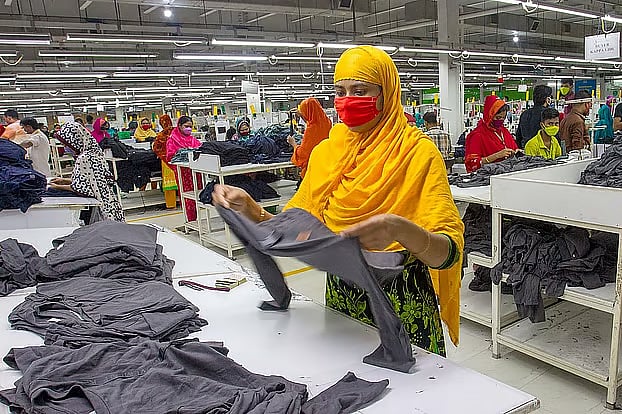
Readymade garment factories: Are physical and mental stress behind the ‘ghost’ scare?
Work was proceeding normally at the export-oriented garment factory Universal Menswear following the lunch break. Suddenly, a female worker on the third floor collapsed unconscious after screaming “ghost!”. Panic quickly swept through the factory.
Following the incident on the third floor, nearly 50 workers on the second floor also fell ill one after another. Management was forced to declare a holiday to bring the situation under control. When identical incidents recurred the following morning, the authorities were obliged to shut operations once again.
This incident took place on 22 August at Universal Menswear, an associate enterprise of the Ananta Group located in the Adamjee EPZ, Narayanganj.
However, this is far from an isolated event within the ready-made garment (RMG) sector. Over the past decade, at least 11 similar incidents occurred. Earlier, in 2008, widespread panic erupted across several factories—a figure higher than in any other single year.
Discussions with industry insiders reveal that in some instances, rumours spread of ghosts haunting the washrooms. Elsewhere, panic spread over alleged possession by jinn (spirits). In other cases, after one worker fell ill, several others rapidly showed similar symptoms. This raises a crucial question: Are ghosts genuinely appearing in garment factories, or is there any underlying cause?
An analysis of the events demonstrates that over the last decade, panic involving ghosts or spirits has predominantly affected relatively larger factories. Working conditions and related standards in these facilities are routinely monitored by representatives of international buyers.
When questioned about these occurrences, Nazma Akter, President of the Sommilito Garments Sramik Oikya Forum, observed that female garment workers suffer from significant physical and mental distress.
In August 2016, several workers fell ill after visiting the washrooms following lunch at the Deko Design factory in Narsinghapur, Ashulia. As word spread, ghost scare seized workers across various floors of the six-storey building, leaving dozens more unwell.
According to her, due to low wages, most are unable to afford nutritious meals for the majority of the month. Furthermore, many endure mental stress stemming from domestic hardship and frequently work despite underlying physical ailments.
Consequently, the sheer pressure of work leads to sudden illness on the factory floor, giving chance for opportunistic entities to spread panic, Nazma Akter added.
Incidents in a decade
Nearly 50 female workers fell ill at the AKH Dyeing and Knitting factory in the Rajfulbaria area of Savar on 1 February 2015, following rumours that an extended building section had been constructed over a cremation ground. The workers required primary medical treatment at hospitals for headaches, chest pain, and nausea, prompting management to declare a general holiday.
In August 2016, several workers fell ill after visiting the washrooms following lunch at the Deko Design factory in Narsinghapur, Ashulia. As word spread, ghost scare seized workers across various floors of the six-storey building, leaving dozens more unwell; 49 of them received primary care at a health centre. Panic recurred the following day, causing several others to fall ill.
On 24 December that year, a worker at the Utah Knitting and Dyeing factory in Gazipur became unwell. Rumours that the worker was possessed by spirits quickly spread, causing several others to fall ill with symptoms including abdominal pain, vomiting, and excessive salivation. Twenty-five affected workers were treated at Shahid Tajuddin Ahmad Medical College Hospital and local clinics.
Similarly, on 13 March last year, 10 to 15 workers at the SP Garments and Washing factory in Gazipur fell ill over rumours of a ghost in the washrooms, forcing management to suspend operations by 11:00 am. Four days later, spirit-related panic caused another 13 workers to fall ill; they were sent home after providing treatment at a local medical care.
An official from the company, speaking on condition of anonymity, revealed that medical examinations of the first two female workers revealed one had extremely high blood sugar, causing her to lose consciousness, whilst the second had been unwell prior to entering the factory.
On 19 March last year, a spirit scare led to nearly 50 workers falling ill at the Golden Refit Garments factory in Gazipur. Additionally, on 4 February this year, ghost scare at the North Hair Products factory in Dinajpur resulted in nine workers being admitted to Dinajpur Medical College Hospital.
A similar episode at Hoplun Apparels in the Gazipura area of Tongi last July left around 60 workers unwell. Following widespread panic, management hosted a Milad Mahfil (prayer gathering) once conditions normalised; the factory remained closed for two days.
In early May this year, two female workers became unconscious in a washroom at a Newage Group factory in Nischintapur, Ashulia. Jinn scare subsequently spread, leading to further illnesses over several days.
Management arranged a prayer session to dispel the spirits, yet several more workers fell ill immediately afterwards. Subsequently, an exorcist (tantrik) was brought in to perform rituals. In total, 172 workers received hospital treatment for weakness, blurred vision, and dizziness. They were granted several days of leave, and the factory was closed for two days before working conditions began to improve.
Addressing the issue, Asif Ibrahim, Vice Chairman of Newage Group, told Prothom Alo that production across their facility was disrupted for six to seven days in May.
Are ghosts confined to washrooms?
Many incidents of spirit- or ghost-induced panic originate in factory washrooms. Typically, an individual worker collapses or falls ill first, triggering rumours of ghosts or spirit possession, after which others rapidly exhibit similar symptoms. However, most recover promptly following basic medical treatment.
We transferred eight to nine affected workers to the BEPZA hospital, where they recovered within half an hour.Billal Hossain, General Manager of Universal Menswear, Adamjee EPZ, Narayanganj
The incident at the Newage Group factory also began in the washroom.
An official from the company, speaking on condition of anonymity, revealed that medical examinations of the first two female workers revealed one had extremely high blood sugar, causing her to lose consciousness, whilst the second had been unwell prior to entering the factory.
Conversely, the ghost scare at Universal Menswear last month did not originate in a washroom. Billal Hossain, General Manager of the factory, told Prothom Alo, “We transferred eight to nine affected workers to the BEPZA (Bangladesh Export Processing Zones Authority) hospital, where they recovered within half an hour.”
What’s behind the spectre?
The ready-made garment industry in Bangladesh took root in the early 1980s and expanded rapidly over the following decade. Babul Akhter, General Secretary of the Bangladesh Garment and Industrial Workers Federation, noted that ghost panic episodes have recurred since that early period.
According to Babul Akhter, these events stem primarily from three or four underlying factors: persistent frustration, malnutrition, and general physical frailty that causes workers to suffer dizziness and collapse in washrooms. Superstition and susceptibility to rumours also play a role, whilst interested quarters occasionally exploit worker illnesses for alternative motives.
Conversion disorders stem from underlying psychological stress as well as domestic and social conflict. When symptoms manifest, mental healthcare intervention is essential.Professor Helal Uddin Ahmed, Department of Psychiatry, Faridpur Medical College
The labour leader stressed the need for workplace counselling, dedicated rest areas for ill workers, heightened health awareness, and wages capable of ensuring a decent standard of living.
The current statutory minimum wage in the RMG sector stands at Tk12,500 per month, up from Tk8,000 prior to the implementation of the new pay scale in December 2023. Given low base pay, workers frequently rely on overtime to supplement their income, leading to physical and mental exhaustion.
When asked whether low wages prevent workers from meeting their daily caloric requirements, Mohammad Hatem, President of the Bangladesh Knitwear Manufacturers and Exporters Association (BKMEA), stated that factory helpers earn Tk14,000–15,000 monthly including overtime, whilst operators earn Tk17,000–18,000. Consequently, caloric intake should not be an issue.
He added that there is no objective evidence supporting ghost or spirit scares, framing them instead as purely psychological phenomena among workers.
Fear spreads, symptoms follow
On 18 June, over 100 workers fell ill at the Dressmen Limited factory in the Chandra area of Kaliakair, Gazipur. Shortly after drinking factory-supplied water upon starting their morning shift, several workers experienced vomiting, abdominal pain, dizziness, weakness, and respiratory distress. Panic quickly ensued, and the number of affected workers rose rapidly. Management subsequently dispatched the workers to the Kaliakair Upazila Health Complex and nearby private clinics.
Mashed Rumman Abdullah, a Director of the company, explained, “Both our organisation and our buyers had the water independently laboratory tested; no contamination was found. When one worker falls ill for any reason, the condition rapidly propagates among others. Furthermore, given past washroom-based ghost panics elsewhere, we have inscribed prayers in both Arabic and Bengali on our washroom entrances.”
Several factory owners suspect organised groups may be behind these incidents, targeting specific factories to induce panic and operational disruption. Some management figures allege deliberate sabotage intended to hamper production, though formal evidence supporting these claims remains elusive.
Addressing the issue, Mahmud Hasan Khan, President of the Bangladesh Garment Manufacturers and Exporters Association (BGMEA), told Prothom Alo, “Someone is undoubtedly behind these occurrences, though we have yet to identify them. Affected factories suffer substantial financial losses.”
He emphasised that ghosts do not exist in factories and called for widespread awareness campaigns to halt such episodes.
What’s the solution?
When asked, Professor Helal Uddin Ahmed of the Department of Psychiatry at Faridpur Medical College explained to Prothom Alo that symptoms such as dizziness, nausea, and abdominal distress without organic cause are clinically classified as conversion disorder. When these symptoms spread from one individual to others within a group, the condition is termed mass psychogenic illness (or epidemic hysteria). Such outbreaks commonly occur in schools, hostels, and factories.
Professor Ahmed added that individuals do not simulate these symptoms intentionally; conversion disorders stem from underlying psychological stress as well as domestic and social conflict.
According to him, when symptoms manifest, mental healthcare intervention is essential.
The primary preventative measure involves fostering mental health awareness among factory personnel, as structured psychological support is the sole effective remedy for improving the situation, he argued.