Govt to introduce new bills for enforced disappearances and other lapsed ordinances
The government has announced that, although the ordinances concerning the appointment of Supreme Court judges and the establishment of a separate secretariat have been repealed, it will introduce new bills in Parliament following consultations with relevant stakeholders.
At the same time, the government stated that it would conduct further scrutiny and subsequently introduce new bills concerning 16 ordinances—including those on the prevention of enforced disappearances, the Police Commission, and amendments to the Anti-Corruption Commission—that were not approved or rejected by Parliament within the stipulated timeframe.
However, no specific timeline has been provided regarding when these bills will be tabled.
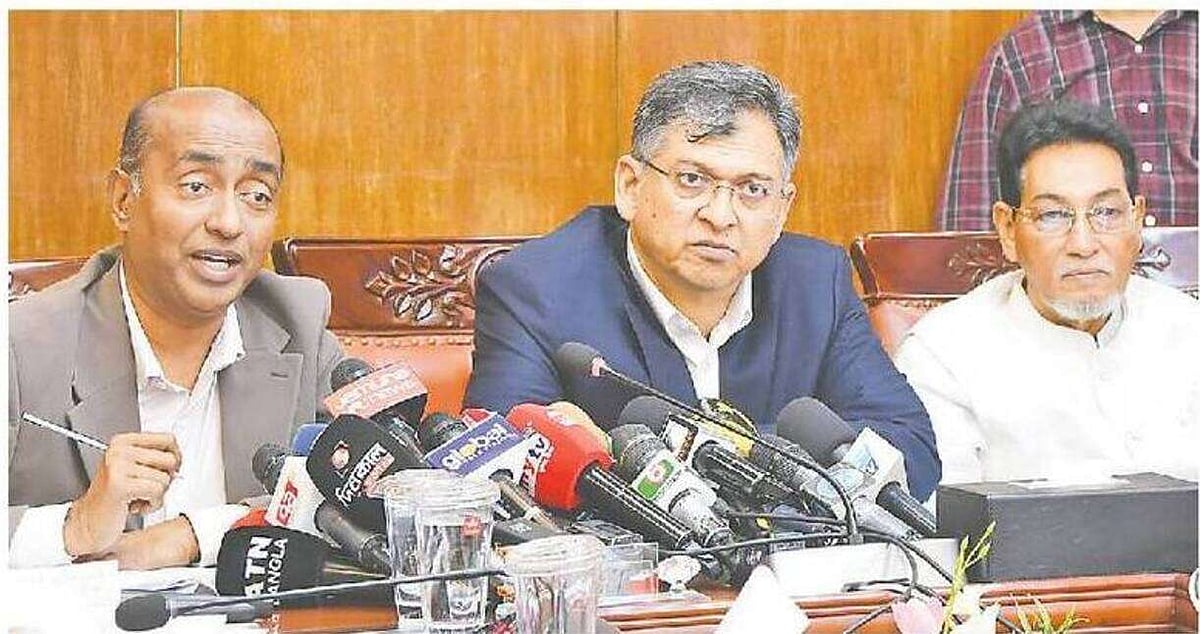
At a press conference held yesterday, Sunday, Home Minister Salahuddin Ahmed, Law Minister Asaduzzaman, and Chief Whip of the Jatiya Sangsad Nurul Islam outlined the government’s position. The briefing took place in the conference room of the Ministry of Home Affairs.
During the tenure of the interim government, a total of 133 ordinances were promulgated. In accordance with parliamentary procedure, these were presented at the first sitting of the first session of the 13th Parliament on 12 March.
The deadline for their approval or rejection was 10 April. Within this period, 16 ordinances were not introduced in the form of bills.
As a result, these ordinances have lapsed. Additionally, seven ordinances were annulled through repeal bills, while the remaining 110 ordinances were approved by Parliament, some in amended form.
A special parliamentary committee, comprising members from both the ruling party and the opposition, was formed to review the ordinances.
However, not all of the committee’s recommendations were followed in full during the approval process.
For instance, the committee had recommended that the "July mass uprising memorial museum ordinance" be approved without alteration.
Nevertheless, when amendments were introduced to the related bill on Friday, it led to prolonged debate between the ruling party and the opposition in Parliament.
The opposition staged a walkout that day, accusing the government of “political compromise and breach of trust” for failing to present several significant ordinances—including those on enforced disappearances and the Police Commission—in bill form.
Addressing the issue at the press conference, Salahuddin Ahmed stated that, under parliamentary norms, the opposition has the right to walk out.
However, he added that the opposition’s actions were based on inaccurate information in several instances, saying that they had “placed blame on the government on various matters.”
He further remarked, “The July memorial museum ordinance had a recommendation for approval in its original form. The bill was introduced accordingly. If a private member proposes an amendment and it appears reasonable to Parliament or the government, it may be adopted through a vote.”
He added that the opposition had still been given the opportunity to speak on the matter, and that the law minister had indicated in Parliament that the bill could be brought back later in a more refined form.
It is pertinent to note that any member of parliament may propose amendments to a bill. However, the acceptance of such amendments depends largely on the ruling party.
Initially, the relevant minister indicates whether they support the amendment, after which it is put to a vote. Given the ruling party’s majority, amendments are typically adopted if they choose to support them, often following prior party direction.
At the same press conference, Salahuddin Ahmed noted that the opposition had also raised concerns regarding certain ordinances.
He stated that the government intends to engage with stakeholders to further develop and refine key ordinances—including those on the prevention of enforced disappearances, the Human Rights Commission, the Supreme Court Secretariat, and the appointment of Supreme Court judges—before reintroducing them in the next parliamentary session.
He emphasised that inclusive consultation would strengthen these laws for the benefit of the nation.
Law Minister Asaduzzaman added that, of the 133 ordinances issued during the interim government’s tenure, the 16 not presented in Parliament require further examination, which is why they have not yet been tabled.
Rejecting allegations from certain quarters that the government has abandoned these ordinances, he stated that the principles of transparency and accountability are clearly articulated in the preambles of the proposed laws. He urged all concerned not to spread misinformation on the matter.
Judicial independence and the human rights commission
The special parliamentary committee recommended the repeal of four ordinances: the National Parliament Secretariat (Interim Special Provisions) Ordinance, the Supreme Court Judges Appointment Ordinance, the Supreme Court Secretariat Ordinance 2025, and the Supreme Court Secretariat (Amendment) Ordinance 2026. Parliament subsequently annulled these through the passage of repeal bills.
Conversely, regarding three ordinances related to the National Human Rights Commission, the committee recommended deferring their introduction as bills and instead conducting further scrutiny before presenting new legislation at a later stage.
However, Parliament repealed these ordinances and passed a bill reinstating the National Human Rights Commission Act of 2009.
Addressing the matter, Law Minister Asaduzzaman stated that the repeal bills concerning the National Human Rights Commission Ordinance, the Supreme Court Judges Appointment Ordinance, and the Supreme Court Secretariat Ordinance explicitly mention the need for further consultation and detailed review.
In response to a question from journalists regarding the distinction between the current situation and that of 2007–08—when a previous interim government issued several ordinances related to the judiciary and public matters that were later not approved by Parliament—Asaduzzaman referred to the statement of objects and reasons attached to the bills.
He said, “The point of difference is that the previous government did not introduce bills stating that further scrutiny was necessary. We have introduced bills and committed that we will undertake further examination and hold discussions with stakeholders before bringing them back.”
It is pertinent to note that every bill presented in Parliament includes a statement outlining its objectives and reasons, although this statement does not form part of the law itself.
Responding to a question on the judiciary, Home Minister Salahuddin Ahmed cited the Constitution and stated, “Judges are independent in conducting judicial proceedings. Has it been said that they are independent in any other matters? We want the independence of the judiciary. But if, in the context of the issues you are raising, the judiciary becomes super independent or sovereign, will that serve the interests of the state?”
He further remarked that there must be “harmonious co-operation” among the organs of the state, ensuring that none oversteps its boundaries. For this reason, he emphasised the need to enact “very balanced” laws concerning the Supreme Court Secretariat and the appointment of judges.
Referendum ‘Factum Valet’
As Parliament neither approved nor rejected the Referendum Ordinance within the stipulated time, it has lapsed. The opposition has threatened to launch a movement over the issue.
When asked for his reaction, Salahuddin Ahmed stated that it is a matter of “factum valet,” meaning something validated by the fact of its occurrence.
He explained that the ordinance had been promulgated, the referendum had taken place, and it carries legal validity.
Salahuddin Ahmed further stated that no future referendums will take place under this law. If a referendum is required in the future, it must be conducted in accordance with the Constitution or under separate legislation.
He added that once the Fourth Schedule of the Constitution validates most of the actions of the previous interim government—barring one or two exceptions—those actions will become legally valid.
However, he also emphasised that there is no scope for creating confusion regarding the referendum.
A writ petition has already been filed before the court challenging the validity of the referendum that has taken place, and the matter now depends on the court’s ruling.
Enforced disappearance ordinance
The enforced disappearance ordinance promulgated by the interim Government has already lapsed. The home minister and the law minister explained the reasons for not presenting it for approval.
Referring to his own experience as a victim of enforced disappearance, Home Minister Salahuddin Ahmed stated that, if the ordinance were passed in its current form, the victims themselves would face injustice.
He emphasised that the government intends to establish a commission on enforced disappearances in a manner that ensures both its effectiveness and the delivery of justice to victims.
He further remarked that, during the interim government’s tenure, certain individuals acted hastily in introducing the Human Rights Commission and Enforced Disappearance ordinances in an attempt to “provide” for themselves (secure positions).
However, he added that he did not wish to assign blame. He noted that a government with a tenure of only 18 months had sought to implement these measures, and therefore some shortcomings were inevitable.
He stated that a political government is now in place and has sufficient time to proceed carefully.
Through consultation, the government aims to ensure coherence among the laws relating to the Enforced Disappearance Commission, the Human Rights Commission, and the International Crimes Tribunal (ICT). He added that this process requires time.
Salahuddin Ahmed said, “We have spoken with these matters in mind. However, members of the opposition have politicised these issues, which is something we do not wish to do.”
On this matter, Law Minister Md Asaduzzaman stated that the law contains certain ambiguities regarding the definition of enforced disappearance and the judicial process, which could create legal complications in the future.
He also noted concerns regarding several provisions of the Human Rights Commission law, particularly the lack of clear guidance in relation to investigation, fines, and compensation. He indicated that a consultative meeting on the Human Rights Commission law may be held after mid-May.
Police commission
The special parliamentary committee had recommended passing the Police Commission Ordinance in an amended form; however, this did not take place, and the ordinance has now lapsed.
In response to journalists’ questions as to why the ordinance was not introduced in Parliament in line with the recommendation, Salahuddin Ahmed stated that the ordinance had neither created any posts nor involved any financial expenditure.
Therefore, there was no necessity to retain it immediately. He added that there is no obligation to present it during the current session and that it will be introduced in Parliament later in a revised form.
16 lapsed ordinances
Earlier, reports on Saturday indicated that 13 ordinances had not been introduced in the form of bills. However, the Ministry of Law clarified yesterday, Sunday that the total number is 16.
These include: the Referendum Ordinance; two ordinances relating to the prevention and remedy of enforced disappearance; the Anti-Corruption Commission (Amendment) Ordinance; the Police Commission Ordinance; the Civil Aviation (Amendment) Ordinance; the Bangladesh Travel Agency (Registration and Regulation) (Amendment) Ordinance; the Microfinance Bank Ordinance; the Private Educational Institutions Teachers and Employees Retirement Benefits (Amendment) Ordinance; two ordinances concerning revenue policy and revenue management; the Value Added Tax and Supplementary Duty (Second Amendment) Ordinance; the Customs (Amendment) Ordinance; the Income Tax (Amendment) Ordinance; the Private Educational Institutions Teachers and Employees Welfare Trust (Amendment) Ordinance; and the Right to Information (Amendment) Ordinance.