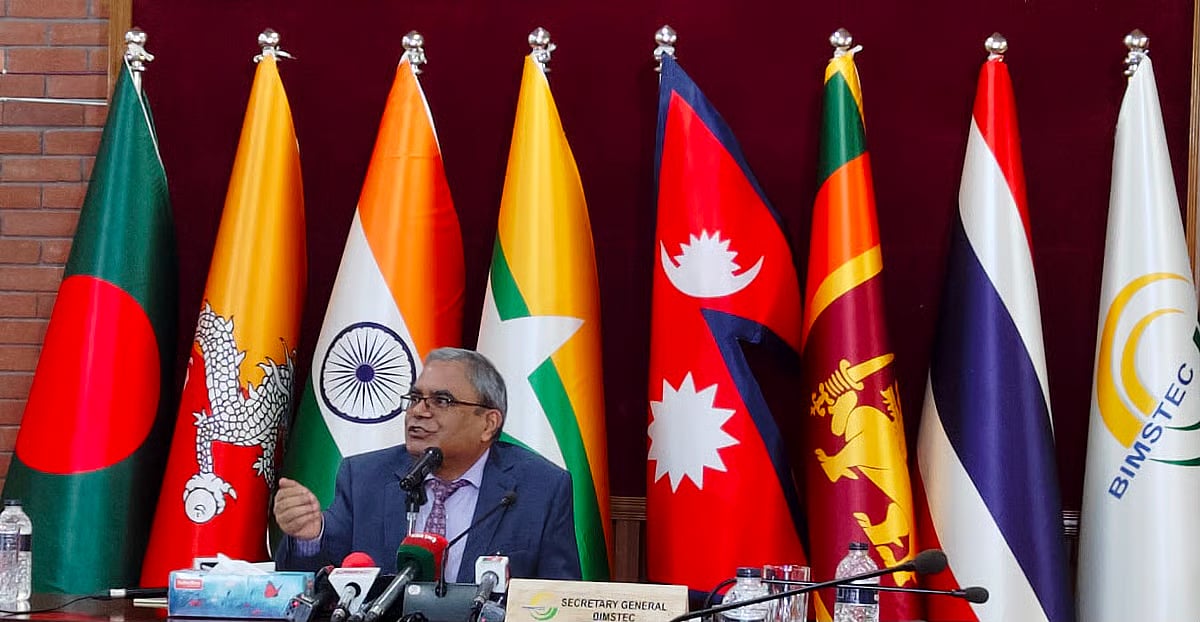
Why is Rohingya issue absent from BIMSTEC’s agenda, Secretary-General explains
The member states of the Bay of Bengal Initiative for Multi-Sectoral Technical and Economic Cooperation (BIMSTEC) collectively determine the organisation’s agenda through mutual consultation. As the Rohingya crisis is regarded as a “political issue”, it has not been included in BIMSTEC’s agenda.
BIMSTEC Secretary-General Indra Mani Pandey provided this explanation while responding to questions from journalists in Dhaka on Tuesday.
Indra Mani Pandey exchanged views with members of the Diplomatic Correspondents Association, Bangladesh (DCAB) at the BIMSTEC Secretariat in Gulshan, Dhaka at noon.
Asked whether BIMSTEC had undertaken any initiative to help resolve the Rohingya crisis, he said, “The member states sit together and decide on BIMSTEC’s agenda. Thus far, our agenda has not encompassed issues of a political nature. Accordingly, this matter falls within that category.”
The BIMSTEC Secretary-General also said that the organisation had been established to bring together South Asia and South-East Asia in pursuit of practical and tangible cooperation, particularly in the technical and economic spheres.
He noted that BIMSTEC continues to receive the necessary political support from its member states, while remaining focused on delivering visible cooperation and deliberately steering clear of political issues.
Earlier on Monday, Bangladesh’s State Minister for Foreign Affairs, Shama Obaed Islam urged the organisation to take effective initiatives to facilitate the repatriation of the Rohingya people to their homeland.
She said this at a seminar held at the BISS (Bangladesh Institute of International and Strategic Studies) auditorium in Dhaka, in the presence of the BIMSTEC Secretary-General.
A day after those remarks, the BIMSTEC Secretary-General explained why the Rohingya issue does not feature in the organisation’s activities.
Myanmar, one of BIMSTEC’s seven member states linking South Asia and South-East Asia, is the country of origin of the Rohingya refugees.
Since 2017, following widespread ethnic persecution and atrocities in Myanmar, more than 1.1 million Rohingya have fled to Bangladesh, where they are currently sheltered in refugee camps.
Bangladesh has consistently sought the support of the international community to ensure their safe and sustainable repatriation to Myanmar.