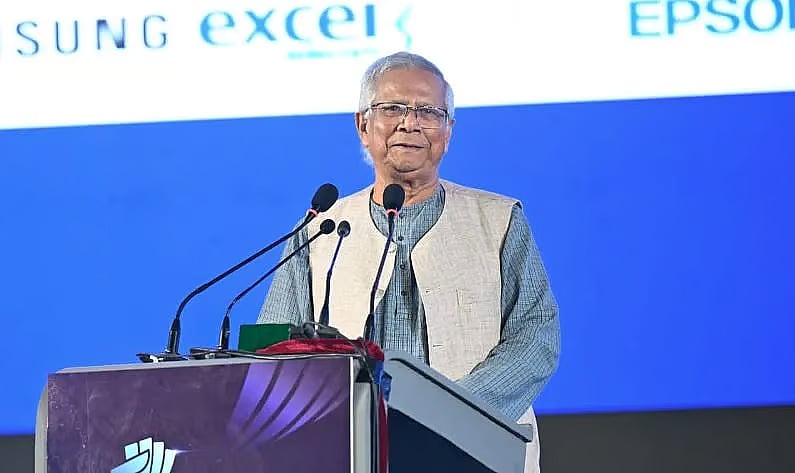
Govt employees should not remain in service for more than 5 yrs: Chief adviser
Chief adviser professor Muhammad Yunus has stated that government employees should not remain in government service for more than five years, as their thinking becomes fixed within a particular structure and they are unable to move beyond it.
He emphasised that new individuals who observe matters from outside should be brought into the system.
Professor Yunus made these remarks on Wednesday at the inauguration of the Digital Device and Innovation Expo and the unveiling of the website and logo of the ‘Bangladesh Innovation Challenge’, held at the Bangladesh–China Friendship Conference Centre in the capital.
Referring to the rapid pace of global change, Professor Yunus said that technological advancement is occurring so quickly that every institution and every policymaker is becoming irrelevant at an equally rapid rate.
However, individuals themselves are not changing. Therefore, those who have witnessed and understood these changes must be included.
He further stated that if individuals join the Ministry of Technology whose understanding of technology was formed 30 years ago, it is unrealistic to expect effective outcomes, as the world has changed entirely over three decades.
What they learned at that time remains all they possess today. This, he noted, is not their fault, as they did not have the opportunity to experience these changes.
Hence, those who are currently experiencing and understanding technological developments must be allowed to come forward. He said, policies must be continuously developed and implemented in line with people’s needs.
The chief adviser also remarked on the nature of government itself, saying that governments are becoming increasingly irrelevant, which he described as almost laughable.
He criticised the practice of bringing forward outdated rules and regulations, merely making amendments without addressing the core issues.
The fundamental framework, he said, remains rooted in policies inherited from the British colonial administration, with only superficial revisions applied.
The core problems remain unchanged. He questioned why it should be difficult to rebuild systems anew, observing that resistance to genuine reform is widespread and that similar tendencies exist among politicians.
Professor Yunus further stated that every institution should be rebuilt from the ground up every 10 years, as the world, its rules, regulations and objectives change significantly within that period, while institutions remain stagnant. These changes, he said, must be embraced.
He added that, “The inherent tendency of government is to cling to the old, whereas the role of technology is to dismantle outdated structures. In this conflict, technology must prevail; otherwise, opportunities for progress will be lost. Bangladesh should be leading, yet remains a follower, which is why, despite understanding technology, the country fails to secure its rightful place.”
Commenting critically, the chief adviser stated that, “Bangladesh has become a global leader in forgery, claiming that almost everything is counterfeit. Many countries do not accept Bangladeshi passports because of forged visas and passports. The country has become a factory of fraud. Bangladesh possesses intelligence and capability, but these are being used for harmful purposes."
At the event, special remarks were delivered by Faiz Ahmad Taiyeb, special assistant to the chief adviser on Posts, Telecommunications and Information Technology.
The programme was chaired by Shish Haider Chowdhury, secretary of the ICT Division. Welcome addresses were delivered by Md Mamunur Rashid Bhuiyan, managing director of the Bangladesh Hi-Tech Park Authority and Mohammad Zahirlul Islam, president of the Bangladesh Computer Samity.