Children and adults in Bangladesh are contracting an older strain of measles.
Scientists and researchers have confirmed the strain after conducting genetic sequencing of the virus at two of the country's leading laboratories. They say that the disease did not originate from outside the country.
The government's National Polio, Measles and Rubella Laboratory under the Institute of Public Health and the Institute of Epidemiology, Disease Control and Research (IEDCR) both carried out genetic analyses of the measles virus.
The two laboratories reached identical conclusions. Their findings show that people in Bangladesh are contracting the B3 strain of measles, a variant that has remained active in the country for many years.
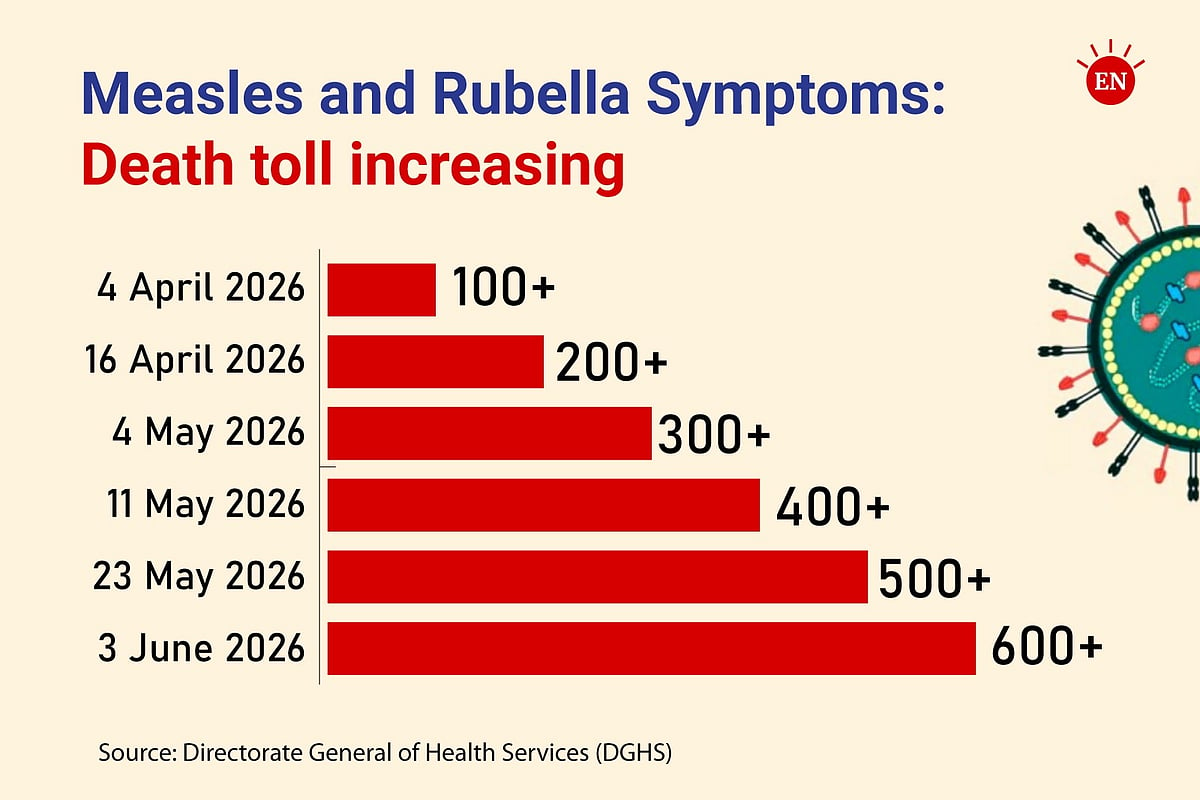
Meanwhile, the number of measles-related deaths in the country has exceeded 600. In a bulletin issued yesterday, Wednesday, the health directorate's Integrated Control Centre reported that seven people died with measles symptoms during the most recent 24-hour period (from 8:00 am on Tuesday to 8:00 am Wednesday).
As of yesterday, 511 people had died with measles symptoms, while 90 deaths had been confirmed as measles-related.
A section of public health specialists believes that the children who died with measles symptoms effectively died from measles.
Following the nationwide vaccination campaign, infection rates have declined. As infections decrease, deaths will also fall. It is important to remember that children commonly develop pneumonia at this time of year, and some of them die from it. Therefore, not every death is attributable to measles.Professor Zahid Raihan, additional director general (Administration) of the Directorate General of Health Services
They argue that limitations in diagnostic capacity have prevented authorities from classifying these cases as confirmed measles deaths.
Bangladesh has not witnessed such a high number of measles deaths in its recent history. Of the 501 recorded deaths, 80 per cent involved children under the age of five.
These deaths began in early March this year and continue to occur. For several weeks, some public health experts have alleged that weaknesses in measles management have prevented authorities from bringing the death toll under control.
Professor Zahid Raihan, Additional Director General (Administration) of the Directorate General of Health Services, told Prothom Alo, "Following the nationwide vaccination campaign, infection rates have declined. As infections decrease, deaths will also fall. It is important to remember that children commonly develop pneumonia at this time of year, and some of them die from it. Therefore, not every death is attributable to measles."
Measles strain identified
The National Polio, Measles and Rubella Laboratory of the Institute of Public Health has been conducting measles detection and strain analysis since 2014.
Khondoker Mahbuba Jamil, a virologist at the Institute of Public Health, told Prothom Alo, "We analysed the genetic sequences of the measles virus from 35 samples collected in December 2025 and January–February 2026, and identified the B3 strain."
What has happened, and what continues to happen, is deeply regrettable. We experienced a measles epidemic, yet we failed to manage it properly. This situation should have received the highest level of priority, but it did not. It is difficult to accept.Professor Be-Nazir Ahmed, former director of the Disease Control Division, DGHS
Khondoker Mahbuba Jamil said that the laboratory is accredited by the World Health Organization (WHO). It regularly submits data from measles genetic sequencing to the WHO.
In addition, the IEDCR laboratory IEDCR analysed the genetic sequences of the measles virus from 38 samples in May. That analysis also identified the B3 strain of measles.
Discussions with scientists and researchers revealed that, to date, scientists have identified a total of 24 measles strains worldwide.
The B3 strain has remained the dominant variant in Bangladesh for many years, although another strain had also circulated in the country.
Virologist Khandakar Mahbuba Jamil said that scientists first identified the B3 strain of measles in 2014. Subsequently, during a measles outbreak in Sitakunda, Chattogram, in 2017–2018, they identified the D8 strain.
The government's National Polio, Measles and Rubella Laboratory under the Institute of Public Health and the IEDCR both carried out genetic analyses of the measles virus. The two laboratories reached identical conclusions. Their findings show that people in Bangladesh are contracting the B3 strain of measles, a variant that has remained active in the country for many years.
Since then, all detected cases have involved the B3 strain. She said, "This is the strain that has been circulating. Therefore, claims that measles spread from the Rohingya camps are not accurate."
Deaths are not declining
Despite shortages of the measles vaccine and considerable debate surrounding vaccination, the health authorities have failed to reduce deaths among children infected with measles. The death toll has now exceeded 600.
Critics have alleged that shortcomings in measles management existed from the outset. In early March, Rajshahi Medical College Hospital treated children infected with measles alongside other sick children.
Hospital authorities and physicians kept measles patients with other children despite knowing that the disease was highly contagious. Prothom Alo published a report on the matter.
Children who contract measles often develop diarrhoea, ear infections and eye complications.
Many also develop pneumonia. In most cases, children who die from measles-related complications succumb to pneumonia.
The Ministry of Health has supplied additional ventilators to several hospitals, instructed government hospitals to establish separate wards for measles patients, and designated the former covid-19 hospital at DNCC Market under Dhaka North City Corporation exclusively for measles treatment. However, these measures have not succeeded in reducing the death toll.
Professor Be-Nazir Ahmed, former director of the Disease Control Division of the DGHS, told Prothom Alo, "What has happened, and what continues to happen, is deeply regrettable. We experienced a measles epidemic, yet we failed to manage it properly. This situation should have received the highest level of priority, but it did not. It is difficult to accept."