RMG sector
Employers propose garment workers’ minimum wage, board withholds figure
The employers' side has submitted a proposal for a minimum wage for ready-made garment (RMG) workers, but the Minimum Wage Board has not disclosed the proposed amount. The board decided at its meeting not to make the employers' proposal public.
The proposal was submitted at a meeting of the Minimum Wage Board at the Labour Building on Monday. The meeting was chaired by board chairman Syed Azad Subhani. At the previous meeting, the workers' representative had proposed a minimum monthly wage of Tk 32,000.
The board members briefed journalists at 4:45 pm. Speaking at the briefing, Syed Azad Subhani said the employers' side had submitted its minimum wage proposal.
Both the workers' and employers' sides would now review the respective proposals before possibly submitting revised ones, he added.
He also said the meeting would continue today and could extend into Tuesday if necessary.
Meanwhile, Babul Akhter, the ready-made garment workers' representative on the wage board, said the proposal submitted by the employers was not acceptable.
The board meeting began at 11:45 am, with Syed Azad Subhani in the chair. Those present included neutral member Mosleh Uddin Ahmed, employers' representative ABM Shamsuddin, workers' representative Babul Akhter, permanent workers' representative Anwar Hossain and permanent employers' representative Asif Ayub.
Also present were BGMEA (Bangladesh Garment Manufacturers and Exporters Association) President Mahmud Hasan Khan and Additional Senior Secretary Nur Mohammad Amin as experts for the employers' representative, and Rashedul Alam, general secretary of the Bangladesh Mukto Garment Sramik Union Federation, as an expert for the workers' representative.
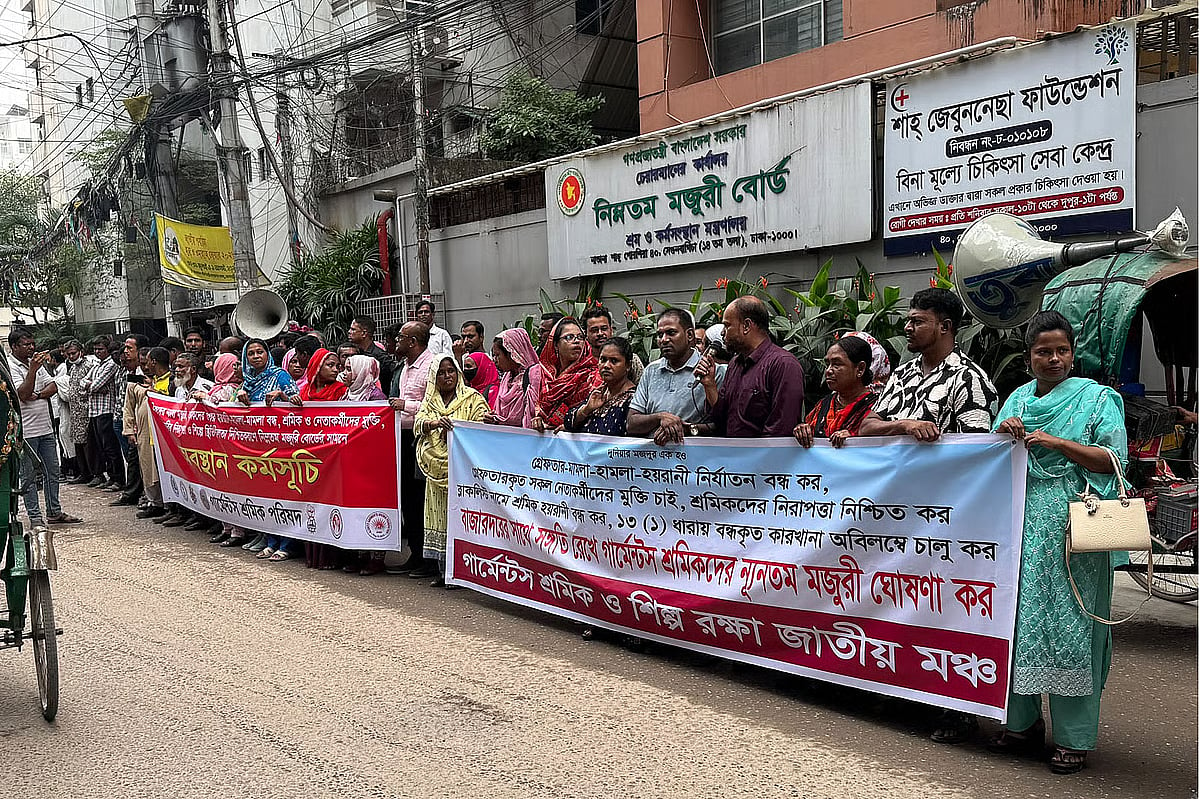
Ready-made garment workers have been protesting since last month, demanding higher wages. In response to the workers' movement, the government formed the Minimum Wage Board on 1 November. At the board's second meeting last Monday, workers' representative Babul Akhter proposed a minimum monthly wage of Tk 32,000.
Presenting the wage proposal, Babul Akhter argued that a worker needed between Tk 45,000 and Tk 60,000 a month to maintain a decent standard of living, taking into account the costs of nutrition, calorie requirements, housing, healthcare and education for a family of four.
However, considering the industry's capacity and the overall situation, the workers' side had proposed setting the minimum wage for Grade 4 at Tk 32,000, he said.
In each of the past five wage boards, employers have proposed wages amounting to half or less than half of what the workers' side demanded. Following negotiations, the final wage was eventually set at a figure higher than the employers' initial proposal.
At the latest wage board in 2023, the workers' representative proposed a minimum wage of Tk 20,393. In response, the employers proposed almost half that amount, or Tk 10,400.
Angered by the employers' low offer, garment workers launched protests the following day. Four workers — Russell Howlader, Imran, Jalal Uddin and Anjuara Khatun — died during three weeks of demonstrations.
Amid the protests, the employers subsequently raised their proposed minimum wage to Tk 12,500. That amount was eventually finalised.