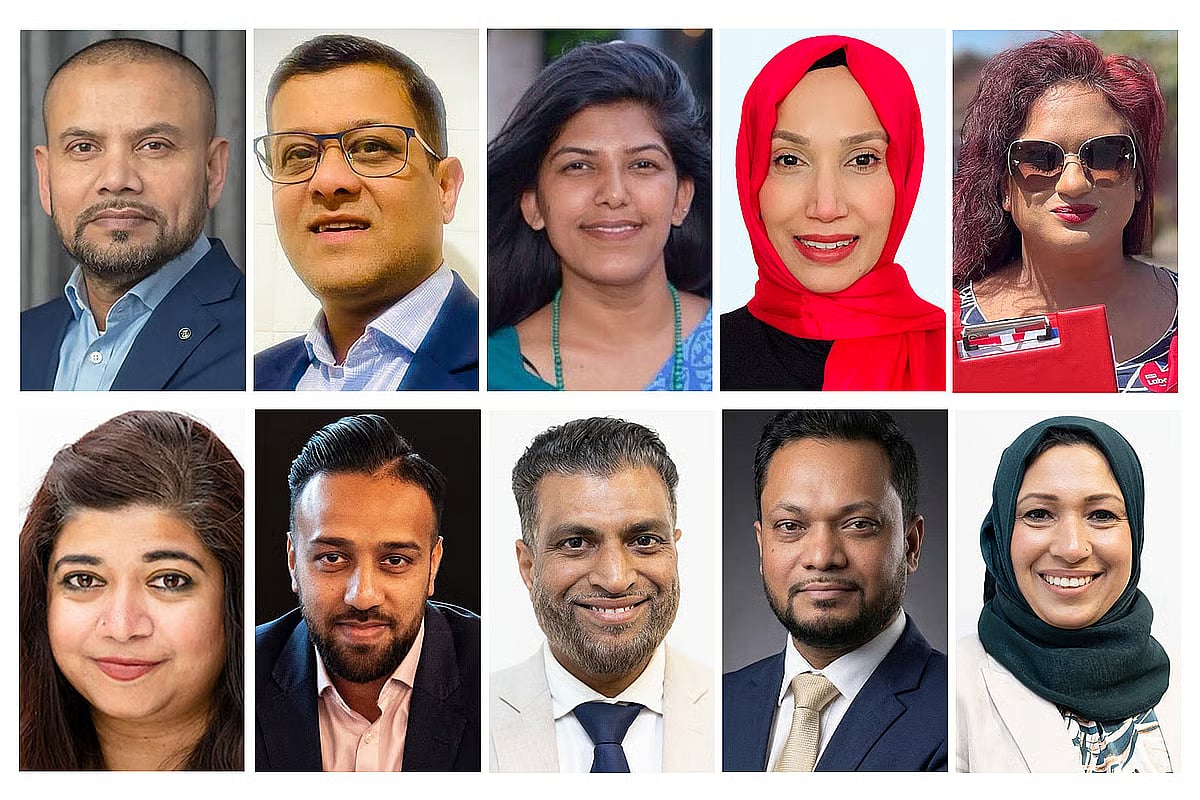
80 British-Bangladeshi councillors elected across 4 East London Boroughs
In the recent UK local government elections, 80 British citizens of Bangladeshi descent have been elected as councillors across four predominantly Bangladeshi-populated boroughs in East London.
Those are: Tower Hamlets, Newham, Redbridge, and Barking & Dagenham.
Local political analysts have hailed this as one of the most significant milestones in the political history of the British-Bangladeshi community. More than 300 individuals from the expatriate Bangladeshi community contested seats in this election.
Election results indicate that in all four boroughs, the majority of Bangladeshi-origin candidates achieved notable success through independent and regional political platforms, moving beyond the traditional mainstream parties.
The most resounding victory occurred in Tower Hamlets, where candidates nominated by the Aspire Party secured a landslide win. The party attained a record majority by winning 33 seats in the 45-member council—all 33 of whom are of Bangladeshi descent. Consequently, Tower Hamlets hosts the highest number of elected Bangladeshi-origin councillors.
Additionally, in Tower Hamlets, three candidates from the Labour Party and one from the Liberal Democrats were elected. Simultaneously, Lutfur Rahman was elected as the Executive Mayor for a fourth term, defeating Labour candidate Sirajul Islam by a significant margin with 35,679 votes.
Bangladeshi candidates also saw major success in Newham. Among those elected, 12 represent the Newham Independent Party, six are from the Labour Party, and one secured a seat for the Green Party.
History was made as Farhad Hossain was elected as the new Executive Mayor of Newham, becoming the first person of Bangladeshi origin to be elected to such a position representing a major mainstream UK political party (Labour).
The Bangladeshi community’s strong presence was equally evident in Redbridge, where nine Labour councillors and five independent candidates of Bangladeshi descent were victorious. The influence of Bangladeshi candidates has notably increased, particularly in the Bangladeshi-populated areas of Ilford.
In Barking & Dagenham, the elected Bangladeshi contingent consists of eight Labour Party councillors and two from the Green Party.
Political analysts suggest that the influence of the Bangladeshi community in East London local politics has reached a new peak.
The establishment of Bangladeshi leadership in the mayoral offices of Tower Hamlets and Newham, alongside a widespread presence across council chambers, has created a new political reality.
Furthermore, both members of parliament for the Tower Hamlets area—Rushanara Ali and Apsana Begum—are also of Bangladeshi descent.
Beyond East London, several Bangladeshi-origin councillors were elected in other London boroughs such as Ealing, Croydon, and Brent, as well as in Birmingham.
Since the early days of migration, Bangladeshis have settled primarily in East London.
According to data from the Office for National Statistics (ONS), these four boroughs maintain significant Bangladeshi populations. In Tower Hamlets, the proportion of Bangladeshis is approximately 35 per cent to 40 per cent. Newham is home to between 40,000 and 50,000, while Redbridge has approximately 30,000, and Barking & Dagenham houses around 20,000 residents of Bangladeshi origin.
Political observers believe that the new generation of British-Bangladeshis are no longer just voters but are now cementing their positions at the heart of local policymaking.
This election is being viewed as the strongest evidence yet of that structural shift.