Measles outbreak
Bangladesh failed to vaccinate children, independent review finds
A joint independent review team has identified gaps in childhood immunisation, depleted stocks of measles-rubella vaccines in 2025 and delays in a special vaccination campaign as reasons for the measles outbreak in Bangladesh.
The team of international and local experts also said the incumbent government’s response to the outbreak was inadequate. It found that Bangladesh had failed to vaccinate children.
The experts warned that outbreaks of other diseases, including whooping cough and diphtheria, could occur unless urgent action was taken. They recommended addressing shortcomings in local vaccination planning, filling vacant positions in the workforce and ensuring an uninterrupted supply of vaccines.
The findings were presented at a hotel in the capital on Wednesday. A Joint Independent Review Team comprising representatives of the World Health Organization (WHO), UNICEF, Gavi, the Vaccine Alliance, officials from the Ministry of Health and the Expanded Programme on Immunization (EPI), and public health experts investigated and assessed various aspects of the measles outbreak, the vaccination situation and EPI activities.
The team said it would be difficult for Bangladesh to maintain its achievements and reputation in vaccination. The measles outbreak was a clear warning, it added.
The review involved international and local experts organised into nine subteams, including one national team and eight divisional teams. Each divisional team collected information from two upazilas in two districts.
The teams gathered data by visiting vaccination centres, interviewing mothers who had left vaccination centres without vaccinating their children, speaking to 10 new mothers in each area, visiting schools and madrasahs, and interviewing mothers and daughters in five households.
The 70-member team began its work on 3 October.
Wednesday’s event was primarily a workshop. Katrina Kretsinger, head of the Joint Independent Review Team, presented the main findings of the investigation and assessment. The public health expert has worked for more than 20 years with the US Centers for Disease Control and Prevention (CDC) and the WHO. Representatives of the eight divisional teams also delivered separate presentations.
At the event, Health Minister Sardar Md Sakhawat Hossain said it was necessary to verify the quality of the vaccines administered to children.
He said the entire cold chain needed to be examined, from where vaccines were manufactured and which warehouses received them to the flights and airports through which they were transported, how they were moved from ports to district level, and how they reached vaccination centres.
Addressing the international representatives present, he said, “We assume that the vaccines are of good quality. That is an assumption. But I urge you to verify their quality as well.”
Causes of the measles outbreak
In the main presentation, Katrina Kretsinger outlined the history of Bangladesh’s EPI programme and described the vaccines administered to prevent various diseases. Explaining the causes of the measles outbreak, she said most of those infected had not been vaccinated.
The independent review found that children had been left unvaccinated both during the Awami League government’s tenure and under the previous interim government.
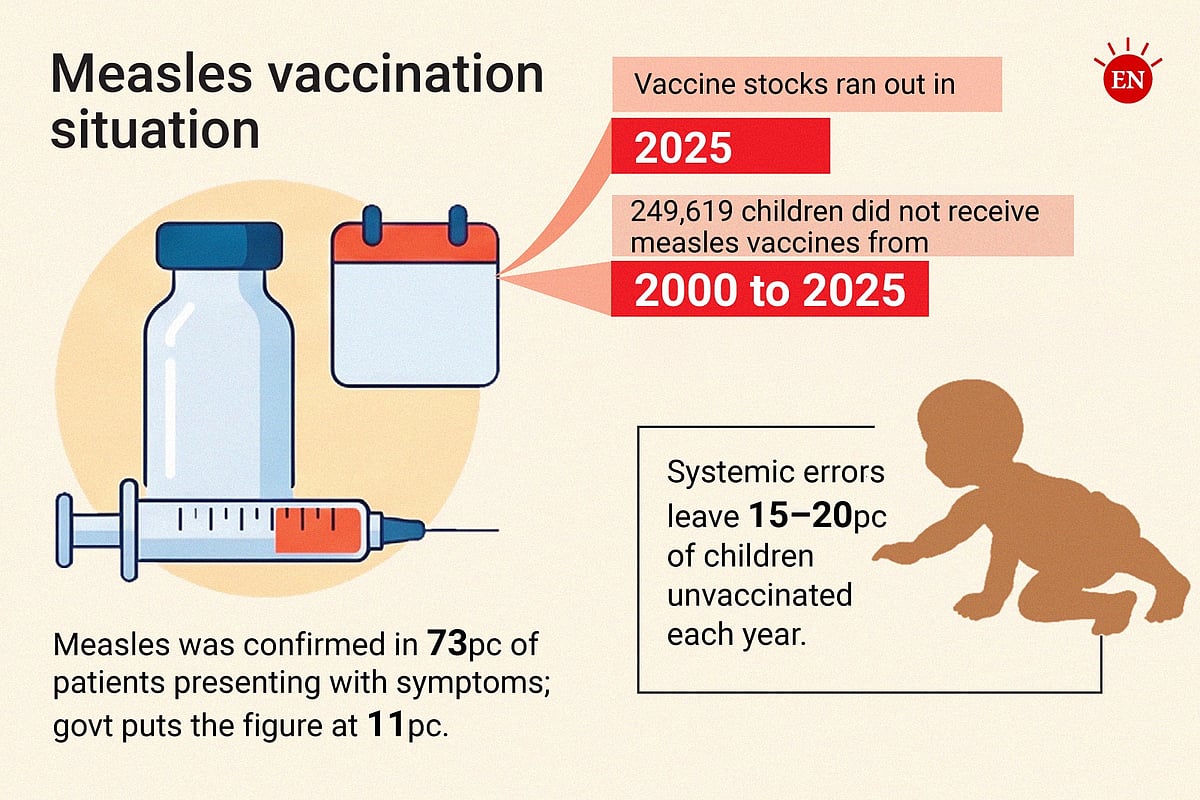
Kretsinger said an immunity gap had developed among children before the outbreak. Under routine immunisation programmes, around 20 per cent of children are left unvaccinated each year, with some variation.
Between 2000 and 2025, a total of 849,619 children missed measles vaccination. Stocks of measles-rubella vaccines ran out in 2025.
Her presentation showed that the most recent measles-rubella vaccination campaign had been conducted in 2020. The next campaign was due in 2024 but was postponed. A decision was taken to hold it in 2025, but it did not take place that year. A typhoid vaccination campaign was conducted in 2025, while the measles-rubella campaign was eventually held in April 2026. The delay in the measles-rubella campaign was one of the reasons behind the outbreak, she said.
Kretsinger identified several other contributing factors, including Bangladesh’s high population density and social gatherings. Vaccination is administered to children aged nine months and older, but children younger than nine months are also contracting measles.
The independent review team also assessed the current government’s response to the outbreak. It concluded that the response had been inadequate and delayed. The government had not extended vaccination to everyone at risk, including children older than five years.
The presentation also appeared to indirectly question the government’s figures for patients presenting with measles symptoms and those confirmed to have the disease.
As of 12 October, samples from 93,852 people who sought treatment with measles symptoms had been tested. Measles was detected in 68,867 of them, meaning 73 per cent of those tested were positive.
The government’s figures show a much lower proportion. According to a Directorate General of Health Services (DGHS) press release on Wednesday, 208,570 suspected measles patients had been admitted to hospitals across the country so far, of whom 22,840 were confirmed to have the disease. Confirmed cases accounted for 11 per cent of suspected cases.
Where the weaknesses lie
The independent review team said the measles outbreak was a warning that the population’s immunity was weakening. It described the outbreak as a test for the country and warned that, without urgent action, outbreaks of whooping cough and diphtheria would be only a matter of time. Polio could also re-emerge, it said.
The team’s presentation identified local vaccination planning as a major weakness in Bangladesh. It said the shortcomings meant that 15 to 20 per cent of children were systematically being left out of immunisation.
Vaccination workers have to administer vaccines while also maintaining records and providing counselling.
Nutrition has not received sufficient attention in vaccination programmes, the presentation said. There is also limited preparedness to deal with problems or adverse events during vaccination.
The review team said the EPI faced a significant shortage of personnel. Around 53 per cent of technician posts responsible for maintaining the cold chain were vacant, as were 34 per cent of field-level health assistant and health inspector posts. In addition, 45 per cent of positions at the EPI’s central office were vacant.
In urban areas, 90 per cent of vaccination workers were employed by non-governmental organisations, and oversight of their work was very weak, the team said.
Vaccination activities were also disrupted for seven months in 2025 because of work stoppages by vaccination workers.
What needs to be done
Local vaccination plans must be redesigned, extending down to the ward level. Vacant positions at different levels need to be filled quickly. The age limit for vaccination should be expanded, and an uninterrupted vaccine supply must be ensured. The team also recommended promptly finalising a plan for vaccine procurement after Gavi’s support ends.
Other recommendations included better coordination among organisations supporting vaccination and greater attention to urban areas. The team also proposed introducing a system to check whether children have received all required vaccines before they enrol in school.
Addressing civil surgeons from different districts who attended the event, Prime Minister’s Special Assistant SM Zia Uddin Haider said they were well aware of the problems. If civil surgeons ensured that vaccination activities were properly conducted in their respective districts, many of the problems could be resolved, he said.
Representatives of several international organisations expressed concern over the current measles situation in Bangladesh.
Gavi representative Dierk Geyl said many people in urban areas remained outside the vaccination system, often without being noticed. Vaccination efforts in cities needed to be strengthened, he added.
UNICEF’s acting representative in Dhaka, Gillian Mellsop, said the measles outbreak in 2026 was unfortunate despite Bangladesh’s strong history of vaccination. She recommended introducing a digital system to track who was receiving vaccines.
WHO Representative to Bangladesh Rajesh Narwal said Bangladesh’s vaccination system had been recognised as strong for decades. Its foundation remained solid, but modernising the system was essential.