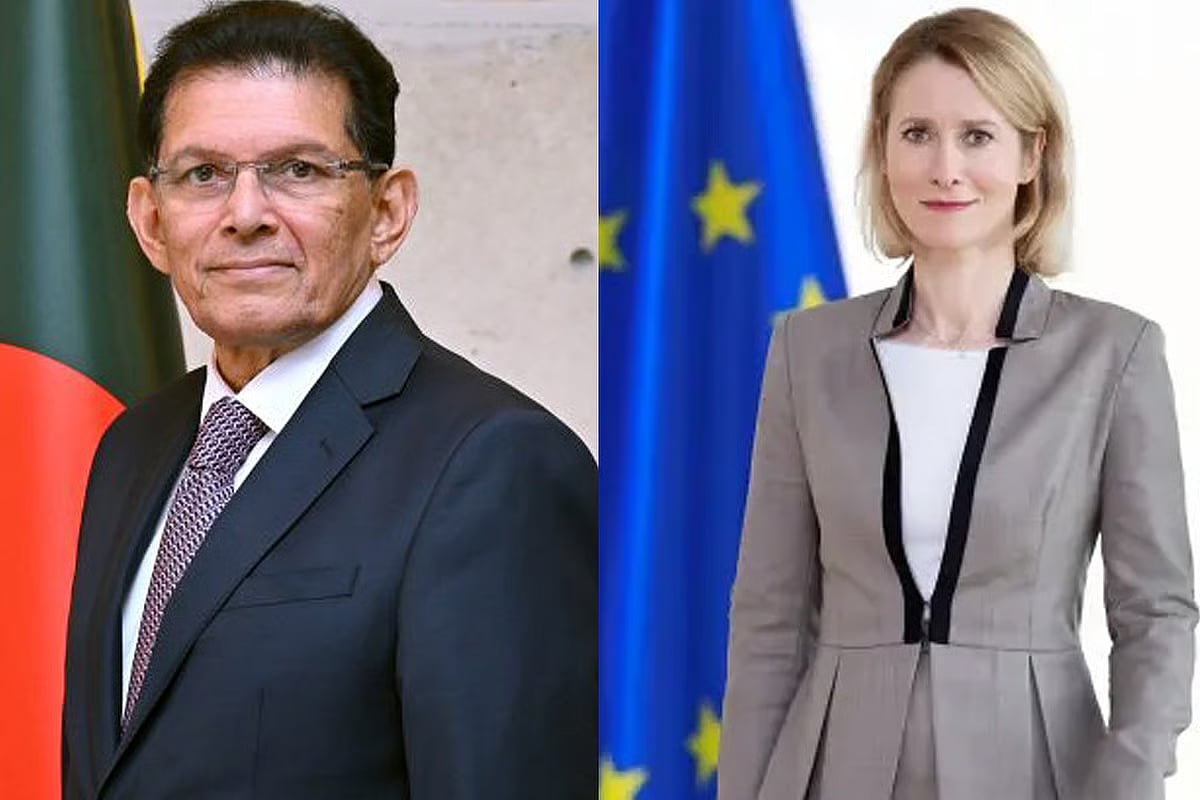
Bangladesh–EU relations set to transition from development cooperation to political partnership
Relations between Bangladesh and the European union are set to transition from development cooperation to a political partnership.
This transition will take a step forward through the initial signing of the Partnership and Cooperation Agreement (PCA). Both sides are scheduled to carry out the initial signing tomorrow, Monday, at the EU headquarters in Brussels.
On the same day, Foreign Minister Khalilur Rahman will meet with the EU’s High Representative for Foreign Affairs and Security Policy and Vice President of the European Commission, Kaja Kallas. The initial signing of the agreement will take place after the meeting.
Diplomatic sources in Dhaka and Brussels told Prothom Alo yesterday, Saturday, that after more than a year of negotiations held in five rounds, both sides finalised a draft PCA consisting of 83 articles. Bangladesh will be the first country in South Asia to sign this agreement.
Foreign Ministry Secretary (Bilateral Affairs) Md Nazrul Islam said that a delegation led by the foreign minister is traveling to Brussels on 19 April. During the visit, he will meet Kaja Kallas, after which Dhaka and Brussels will proceed with the initial signing of the PCA.
According to diplomatic sources, Nazrul Islam will sign on behalf of Bangladesh, while Paola Pampaloni, Deputy Managing Director of the EU’s External Action Service, will sign on behalf of the EU.
A diplomatic source in Brussels said that after the initial signing in English, the PCA will be translated into 24 European languages. It will then require final approval from the EU’s 27 member states before being formally signed.
On Bangladesh’s side, the agreement will be finalised for signing after approval by the cabinet. Diplomatic sources in Dhaka expect that the agreement will be formally signed and implementation will begin within the next two to three months.
Diplomatic sources also indicated that during the foreign minister’s visit to Brussels, various aspects of Bangladesh–EU cooperation may be discussed. These may include energy cooperation, the Middle East crisis, and support for Bangladesh’s candidacy for the presidency of the United Nations General Assembly.
What is the PCA?
Bangladesh signed a cooperation agreement with the EU in 2001, which was primarily focused on development cooperation. It covered areas such as the economy, development, governance, and human rights.
Now Bangladesh is moving toward signing a PCA with the EU. According to information published on the EU’s website, a PCA is a legally binding agreement that establishes a framework for cooperation between the EU and partner countries.
The proposed PCA between Bangladesh and the EU covers around 35 sectors, including trade, investment, economic cooperation, democracy, governance, human rights, labor rights, connectivity, defense, internet security, climate change, energy, fisheries, skilled migration, and agriculture.
In essence, the scope of this cooperation includes supporting democratic and economic development, ensuring a conducive environment for business and foreign investment with a strong free-market economy, and strengthening trade relations and cooperation across various sectors.
Once the PCA is signed, the existing cooperation agreement between Bangladesh and the EU will no longer remain in effect.
Intent toward political transition
To expand the scope of Bangladesh–EU relations, both sides decided on 25 October, 2023, to begin discussions on the PCA.
Accordingly, the first round of talks was scheduled to begin in September 2024. However, the EU suspended discussions at that time due to the situation arising from the July mass uprising in Bangladesh.
Later the EU decided to proceed with the PCA under the interim government, and informal discussions were held in Dhaka in November 2024.
Now the PCA is set to move forward under the new government of the Bangladesh Nationalist Party. Diplomatic sources in Dhaka and Brussels say that once the agreement is concluded, it will mark a significant step toward elevating Bangladesh–EU relations from development cooperation to a political partnership.