The trade agreement with the United States imposes obligations on Bangladesh in a one-sided manner. In comparison, the United States does not have to do much.
In legal or contractual language, the use of the word “shall” indicates mandatory obligations, while “will” denotes discretionary actions. In the 32-page agreement, the word “shall” appears 179 times, whereas “will” appears only three times. Of these, “Bangladesh shall” appears 131 times, while “US shall” appears just six times.
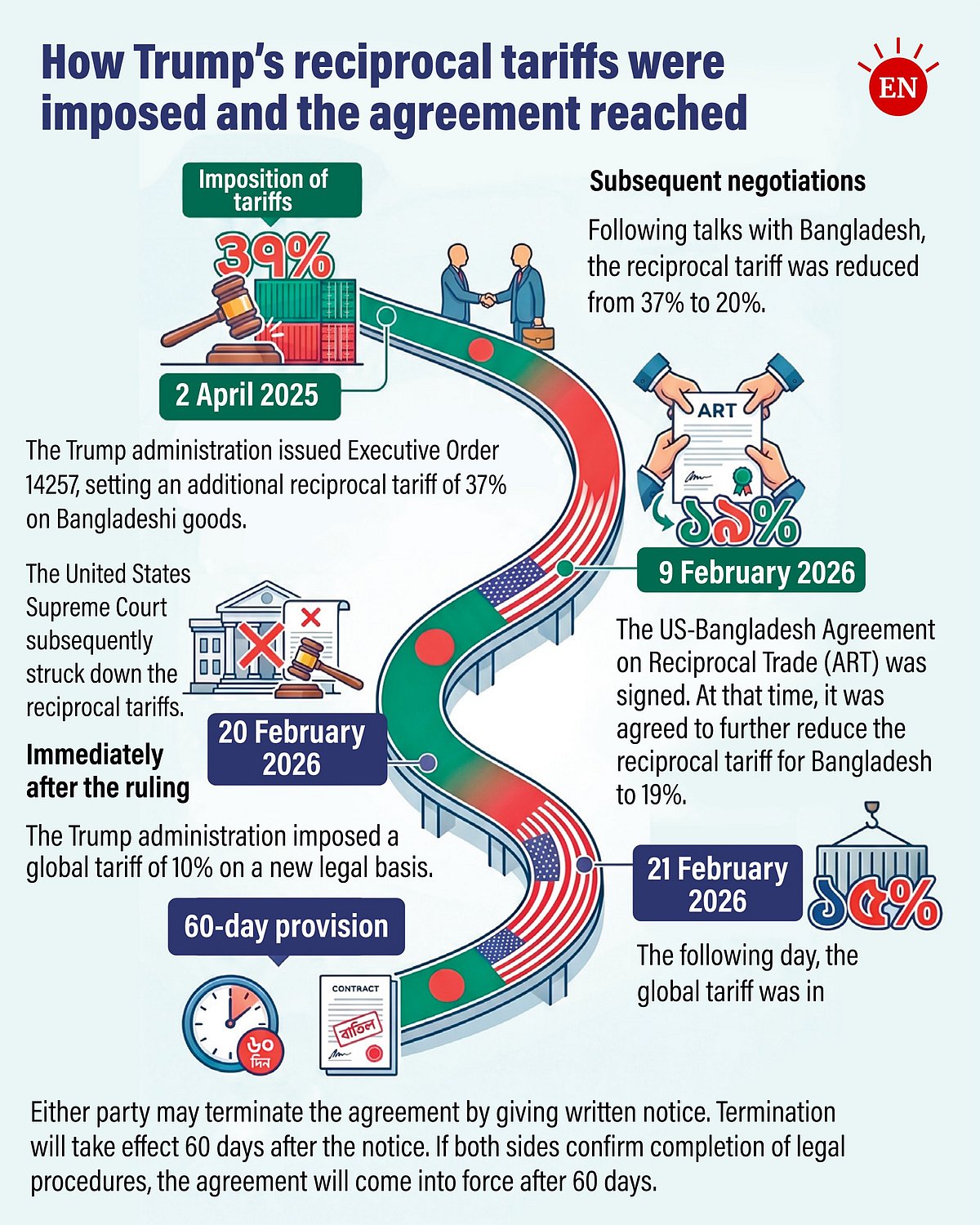
The Agreement on Reciprocal Trade (ART) between Bangladesh and the United States was signed on 9 February, just three days before the national parliamentary election. Later, on 20 February, the Supreme Court of the United States annulled the imposition of reciprocal tariffs.
The agreement has drawn all sorts of criticism within the country. In parliament, Member of Parliament Rumeen Farhana has called for its cancellation. Various political parties and organisations have also demanded that it be scrapped. Economists have suggested engaging in further discussions with the United States to reach an suitable solution.
The agreement has not yet come into force, but Bangladesh has already begun signing deals to import various goods from the United States under its provisions, which has also raised questions.
Key provisions of the agreement
The main agreement contains six articles, while details on its implementation are outlined in annexes, which are considered integral parts of the agreement.
The first article addresses tariffs and quotas. It states that Bangladesh shall impose fixed tariffs on US products, shall not apply quotas on them, and that the United States shall also impose tariffs on Bangladeshi goods at specified rates.
The section on non-tariff barriers includes 11 clauses. Its core principle is that Bangladesh cannot impose regulations, such as documentation requirements, permits, inspections, quality checks, or licensing, that would hinder trade beyond tariffs.
For example, Bangladesh shall not require import licenses for US goods; products that comply with US or international standards shall be allowed entry; and if certification is provided by recognised government or international laboratories, Bangladesh cannot impose additional conditions.
The agreement also includes provisions granting priority access for US agricultural products in the Bangladeshi market. However, if imports need to be restricted for health or safety reasons, such measures must be science-based and risk-based, and not intended to restrict trade.
Bangladesh cannot adopt standards that would put US goods at a competitive disadvantage compared to other countries. Transparency and fairness must also be ensured in granting Geographical Indication (GI) protection or recognition.
The next section refers specifically to cheese and meat products, stating that Bangladesh cannot restrict US products from entering the market solely based on the use of certain names.
Bangladesh is required to ensure strong protection of intellectual property rights. It must take civil, criminal, and border measures to prevent violations, including in the online sphere. Effective enforcement against copyright and trademark infringement must be prioritised.
Regarding the services sector, Bangladesh cannot adopt regulations that would place US service providers at a disadvantage compared to domestic or other foreign entities. Trade-related regulations must be transparent, and no rules can be imposed abruptly without prior consultation.
The following section deals with labour. It states that goods produced through forced labour cannot be imported, including those involving child labour, bonded labour, or coercion. Environmental protection measures must also be adopted and maintained.
The subsequent clause addresses border measures and taxation. If the United States adopts regulations at its borders to protect its workers and businesses, Bangladesh must align with those measures.
If the United States provides tax exemptions or rebates to its exporters, Bangladesh shall not oppose them, even at the World Trade Organization.
Bangladesh cannot impose value-added tax (VAT) in a way that discriminates against US companies. By 2030, Bangladesh must digitise its customs clearance processes for US goods at the border.
Digital trade and technology
This section of the agreement contains four clauses. It first states that Bangladesh shall not impose taxes on digital services in a way that discriminates against companies from the United States. Bangladesh shall also facilitate digital trade with the United States and shall not adopt any discriminatory policies against US digital products. It must ensure the secure cross-border flow of data for business purposes and cooperate with the United States on cybersecurity.
If Bangladesh signs a new digital trade agreement with another country and the United States believes its key interests may be harmed, it can initiate consultations with Bangladesh. If those concerns are not resolved, the United States will have the right to terminate this bilateral agreement. In that case, it may reinstate previous reciprocal tariff rates under Executive Order 14257 issued on 2 April, 2025.
Bangladesh shall not impose customs duties on electronically transmitted content or data. It will also support the proposal at the World Trade Organisation to maintain a permanent moratorium on customs duties for e-commerce transactions.
The next clause addresses conditions for market access. It states that Bangladesh cannot require US firms, as a condition of doing business, to transfer technology, production methods, source code, or confidential business information.
Nor can it compel them to purchase or use specific technologies. However, source code or algorithms may be requested for government procurement, bilateral commercial agreements, investigations, law enforcement, or judicial purposes, provided that confidentiality is maintained.
Economic and national security
Under Article 4 of the agreement, if the United States adopts any trade measures for economic or national security reasons, it will inform Bangladesh. After consultations, Bangladesh shall take corresponding supportive measures in line with its own laws. If a company owned by a third country exports goods from Bangladesh at very low prices in a way that harms the US market, Bangladesh shall take action. The United States will provide relevant information in such cases.
The next clause states that Bangladesh shall cooperate with the United States in controlling trade in technologies and products critical to national security. To this end, Bangladesh shall comply with international standards, align its export control system with US regulations, and ensure that no company can evade these rules.
The agreement further states that Bangladesh will, within the limits of its own laws, cooperate with the United States to prevent transactions that could violate US sanctions or export control laws.
Bangladesh shall also cooperate by sharing information on foreign investments to enhance transparency regarding economic and national security. The United States will consider this cooperation in its decisions related to export controls and investment screening.
In the subsequent clause on other measures, it is stated that the United States shall work to facilitate defense trade with Bangladesh. Bangladesh will promote shipbuilding and shipping industries of market economy countries.
The two countries will also sign cooperation agreements to prevent duty evasion. If Bangladesh enters into a new trade or preferential economic agreement with a non-market economy country that weakens this agreement, the United States may initiate consultations. If concerns remain unresolved, the United States can terminate the agreement and reinstate previous reciprocal tariffs.
Finally, the clause states that Bangladesh shall not purchase nuclear reactors, fuel rods, or enriched uranium from countries that could jeopardise key US interests. However, such purchases may be allowed if no alternative suppliers are available or if agreements for existing reactors were made prior to the enforcement of this agreement.
Commercial considerations and opportunities
This section contains four clauses. The first, on investment, states that Bangladesh shall facilitate US direct investment in key sectors such as critical minerals, energy, electricity, telecommunications, transport, and infrastructure. Investors from the United States shall receive treatment no less favourable than domestic private investors.
If necessary, the Export-Import Bank of the United States (Exim Bank) and the US International Development Finance Corporation (DFC) may provide financing in these sectors. Bangladesh will also support investments that create employment in the United States.
The next clause concerns commercial considerations. It states that Bangladesh’s state-owned or state-controlled enterprises must operate on market-based principles in the purchase and sale of goods and services. They may not discriminate against US goods or services. Such enterprises may not provide subsidies to domestic producers except for the supply of non-commercial goods in the public interest, and they must refrain from giving special assistance or subsidies to state-owned manufacturing enterprises.
If requested in writing by the United States, Bangladesh must provide information on subsidies, including details of any special assistance or financial support given to production entities. However, institutions providing non-commercial public services will be exempt. If such subsidies or support create distortions in trade or investment, Bangladesh must take steps to reduce them.
The following clause addresses textiles and apparel. In this area, the United States has committed to arrangements that would allow certain Bangladeshi textile and garment products to enter the US market at zero or reduced tariffs. However, these benefits will be subject to quotas. The volume will depend on how much cotton, synthetic fibers, or textile inputs Bangladesh imports from the United States.
Implementation, enforcement, and final provisions
This section begins by stating that annexes, appendices, and footnotes are integral parts of the agreement. The agreement may be amended with written consent from both parties, but such changes must not diminish previously granted benefits. The benefits of this agreement are primarily intended for the people and institutions of Bangladesh and the United States. If a third country receives greater advantages, the two parties may negotiate separate provisions regarding beneficiaries.
Despite the agreement, additional tariffs may be imposed in cases of unfair trade practices, sudden import surges, or for economic or national security reasons. If the United States determines that Bangladesh has not complied with the agreement, it will first seek consultations. If no resolution is reached, it may reinstate previous reciprocal tariff rates under the Executive Order issued on 2 April, 2025.
Either party may terminate the agreement by providing written notice. Termination will take effect 60 days after the notice or on a mutually agreed date. The agreement will enter into force 60 days after both parties notify each other in writing that their respective legal procedures have been completed, unless another date is agreed upon.
Contents of the annex
The annex begins with Bangladesh’s tariff schedule, which specifies the rates applicable to certain US goods. These include customs duties, supplementary duties, and regulatory duties. Under the agreement, Bangladesh will reduce or apply tariffs on US products according to specified categories.
Five categories have been defined. For example, under the EIF category, tariffs will be reduced to zero from the date the agreement comes into force. Under the B-5 category, tariffs will initially be reduced by half, with the remainder phased out to zero by the fifth year.
Under the B-10 category, tariffs will similarly be halved initially and reduced to zero by the tenth year. In some cases, tariffs are already zero and will remain unchanged. Under the X category, no concessions will be granted, and existing Most Favoured Nation (MFN) tariff rates will continue to apply.
The section on the US tariff schedule states that eligibility for tariff concessions on Bangladeshi products will be determined according to the US schedule. Certain listed products will not be subject to additional reciprocal tariffs. However, Bangladeshi products not included in the list may face reciprocal tariffs of up to 19 per cent, in addition to the standard MFN tariffs imposed by the United States.
Specific Commitments
This section outlines the commitments both countries undertake to implement the agreement and how these will be carried out. The first set of provisions concerns non-tariff barriers and related issues.
Medical devices and pharmaceuticals: Bangladesh shall give due weight to approvals by the United States Food and Drug Administration (FDA). FDA-approved medical devices and pharmaceuticals will be considered sufficient evidence for market authorisation.
For low-risk devices that do not require separate FDA approval, Bangladesh shall not require additional approval. FDA-issued electronic certificates shall be accepted, and original paper copies, notarisation, or handwritten signatures shall not be required.
Bangladesh shall align its regulations with the guidelines of the International Medical Device Regulators Forum and will accept internationally recognised audits and certifications. Once a pharmaceutical product is approved, repeated approvals shall not be required unless there are significant safety or quality concerns. If a US manufacturing facility has recently passed FDA inspection, Bangladesh shall generally accept that report.
Motor vehicles and parts: Bangladesh shall accept vehicles and parts that comply with US safety and emissions standards. No additional approvals or procedures shall be required for importing such products. Any discriminatory conditions against US vehicles and parts shall be removed.
Remanufactured goods: Bangladesh shall lift import bans and licensing requirements on remanufactured goods and parts from the United States.
Agricultural products: Bangladesh shall recognise US standards on food safety, quality, and technical regulations as acceptable. Official US certifications shall also be accepted.
Only necessary information shall be required in certificates. If Bangladesh introduces new food or standards-related regulations, it shall notify the World Trade Organization (WTO) in advance and consider feedback from other countries.
Factory registration and establishment listing: Bangladesh shall accept oversight and certification by US Department of Agriculture (USDA) agencies for dairy, meat, poultry, and egg products. For dairy products, imports shall be permitted if accompanied by a Dairy Sanitary Certificate issued by the Agricultural Marketing Service (AMS). For meat, poultry, and egg products, oversight by the Food Safety and Inspection Service (FSIS) shall be considered sufficient.
Bangladesh shall not require separate registration of factories or products. It shall also accept official US government lists of approved establishments.
The covered products include dairy products derived from cattle, sheep, and goats; meat; poultry; offal such as tripe and liver; processed meat and poultry; Siluriformes (catfish); and egg products.
Agricultural biotechnology: Bangladesh shall maintain science- and risk-based regulations for agricultural biotechnology products, aiming to ensure efficient approval processes and facilitate trade. Within 24 months of the agreement entering into force, Bangladesh shall adopt policies allowing certain biotechnology products legally marketed in the United States to be imported and sold domestically.
No additional pre-market testing, deregulation requirements, extra labelling, or new approvals shall be required. If trace amounts of such biotechnology material are detected in imported agricultural products, Bangladesh shall address the matter promptly, taking into account risk assessments conducted by the United States or other countries.
Non-living modified organisms: Processed food or agricultural products derived from biotechnology that no longer contain living modified organisms shall not require separate government approval. “Processed” refers to products that have been heated, ground, or otherwise treated so that they cannot germinate.
Highly pathogenic avian influenza: In the event of an outbreak, Bangladesh may not impose a blanket ban on poultry, eggs, or related products from an entire US state. Restrictions must be limited to a 10-kilometre radius around the affected area.
Bangladesh shall follow the standards of the World Organisation for Animal Health (WOAH) and recognise the USDA Animal and Plant Health Inspection Service (APHIS) as the authority determining disease-free status. If APHIS declares an area outside the 10-kilometre zone safe, exports from that area must be allowed. Bangladesh may not impose stricter measures beyond those limits.
Halal certification: If Bangladesh requires halal certification, it must accept certifications issued by US bodies that meet Bangladeshi requirements, without imposing additional conditions.
Maximum Residue Levels (MRLs): Bangladesh shall set limits on chemical residues in food based on scientific evidence and risk assessment. Where domestic standards do not exist, US standards shall apply; if those are also absent, Codex Alimentarius standards shall be used.
If a product fails to meet MRL requirements, enhanced monitoring shall apply only to the responsible entity. That entity must be given an opportunity to respond and correct the issue. Suspension shall occur only in cases of repeated violations.
Plants and plant products: If the United States requests approval to export a plant or plant product, Bangladesh shall complete the process within 24 months. Both countries shall agree on an import protocol. Where pest risks are involved, Bangladesh shall finalise protocols within the same timeframe using internationally recognised methods.
Import licensing: Bangladesh must regularly notify the WTO of its import licensing procedures. It shall not require import permits or letters of credit in advance for US food and agricultural products.
Intellectual property: Bangladesh must ensure transparency and fairness in geographical indication (GI) protection. Procedures must allow for opposition, examination, and cancellation. It must determine whether a GI conflicts with existing trademarks or is a generic term.
The scope of protection must be clearly defined. Generic names cannot receive separate protection. Determination of generic status must consider dictionaries, media usage, websites, market practices, international standards, and usage in other countries.
International agreements: Bangladesh must accede to and implement specified international intellectual property treaties within set timelines if it is not already a member. These include the Budapest Treaty, Hague Agreement (Geneva Act), Patent Cooperation Treaty, Patent Law Treaty, Singapore Treaty, UPOV Convention, WIPO Copyright Treaty, and WIPO Performances and Phonograms Treaty within five years, and the Madrid Protocol within three years. No specific deadlines are set for the Berne Convention, Marrakesh Treaty, and Paris Convention.
Services sector: Within three years, Bangladesh must join and implement the WTO Joint Initiative on Services Domestic Regulation. It must also remove mandatory reinsurance requirements, meaning US insurers shall no longer be required to cede at least 50 per cent of their business to the state-owned General Insurance Corporation.
Investment: Bangladesh shall relax foreign ownership limits in oil and gas, insurance, and telecommunications sectors. It shall provide necessary no-objection certificates (NOCs) to US investors.
Procedures for transferring investment funds shall be made simpler, faster, and more transparent. Investors shall be allowed to repatriate funds at market exchange rates. Outstanding payments to US companies must be settled promptly, in line with IMF commitments.
Good regulatory practices and transparency: Bangladesh must publish laws, regulations, and government decisions online in a timely manner. It must consult stakeholders before introducing new rules. Policymaking must be based on evidence, technical analysis, and risk assessment. Unnecessary trade barriers must be reduced, and existing regulations must be regularly reviewed.
Anti-corruption measures: Bangladesh must strengthen laws and enforcement to combat corruption, including penalties, codes of conduct for officials, transparent procurement, and independent anti-corruption institutions. Regular reporting must ensure accountability.
Labour laws and related measures: Bangladesh must amend labour laws to ensure freedom of association and collective bargaining rights. This includes reducing the 20 per cent membership requirement for union registration, requiring labour court approval for union dissolution, and limiting the collection of personal data.
Union registration shall require only a general meeting, adoption of a constitution, and submission of minutes. Penalties for anti-union discrimination must be increased. Blacklisting workers shall be treated as an unfair labour practice. Workers and unions shall have the right to file cases directly in labour courts.
Unjustified restrictions on the right to strike must be reduced, including removing fixed no-strike periods and reducing harsh penalties such as imprisonment.
Workers’ rights in EPZs: Bangladesh must ensure freedom of association and collective bargaining in Export Processing Zones. Within two years, EPZs must be brought under the national labour law, or EPZ-specific laws must be reformed to allow independent unions.
EPZ labour laws must align with national and international standards. Restrictions on strikes must be reduced, and penalties softened.
Other measures: Pending criminal cases against garment workers and labour leaders related to lawful union activity and protests must be resolved or withdrawn, including cases from the 2023 minimum wage movement.
A regular minimum wage review mechanism must be introduced within three years and conducted annually thereafter. Union applications must be processed within 55 days, with online tracking and simplified procedures.
Labour law enforcement must be strengthened through increased budgets, recruitment, and promotion of inspectors. Inspectors must have authority to conduct unannounced inspections, including in EPZs. Penalties for violations of labour, fire, and building safety laws must be increased, and investigations expedited.
Environment: Bangladesh must ensure high standards of environmental protection in its laws and policies.
Illegal logging and related trade: Bangladesh must combat illegal forest product trade and cooperate with the United States. It must ensure governance, transparency, and anti-corruption measures in the forestry sector, including publishing management plans and logging permits online.
Resource-efficient economy: Bangladesh must promote efficient resource use, reduce waste, encourage recycling, and support circular economy practices.
Fisheries subsidies: Bangladesh must promptly adopt and implement the WTO Agreement on Fisheries Subsidies. It must eliminate subsidies contributing to illegal, unreported, and unregulated fishing, as well as overfished stocks.
Subsidies must not encourage overcapacity or overfishing, and reforms should be introduced where necessary.
Sustainable fisheries management: Bangladesh shall ensure sustainable fishing practices, enforce laws against illegal fishing, strengthen port controls, and prevent transshipment of illegal fish.
Combating illegal wildlife trade: Bangladesh must prevent illegal trade in wildlife and plants, strengthen port inspections, prevent use of its territory for trafficking, and treat intentional international trafficking as a serious crime.
CITES: Bangladesh must strengthen implementation of the Convention on International Trade in Endangered Species (CITES) and finalise and submit national legislation to the CITES Secretariat.
Customs and trade facilitation: Bangladesh shall recognise electronic bills of lading, protect US business data, and expedite clearance for low-risk shipments. Amendments to import general manifests shall be reviewed by customs. Bangladesh must comply with WTO transparency rules and accept electronic certification for US meat, poultry, fish, and egg products.
Digital trade and technology: Bangladesh shall recognise international frameworks for cross-border data flows while protecting personal data. It shall consider input from the US government and businesses when drafting data protection laws.
Freedom of expression protections shall be incorporated into cyber laws, while penalties for cybercrime shall be strengthened. The 2021 digital and OTT regulations needs to be revised or repealed, and requirements to identify users or provide encryption keys must be removed.
Part of the 6 GHz spectrum shall be opened for unlicensed Wi-Fi-type technologies, with faster approval for related equipment.
Economic and national security: Bangladesh shall ensure secure digital systems in ports, cargo monitoring, and shipping to prevent cyber risks and unauthorised foreign access.
Sensitive US-origin goods may not be exported, re-exported, or transferred without authorisation. Bangladesh shall monitor transactions, verify customs data, detect suspicious activities, and share information with the United States.
Bangladesh shall establish its own export control system, including investigation, audit, and penalties. It shall restrict the role of countries considered national security risks in sensitive technology supply chains.
*Read tomorrow: Bangladesh’s gains are minimal, the losses far greater.