Labour migration to Europe
Best environment prevailing to go to Italy through the legal process: Expert
Giuseppe Di Giovanni, Migration Expert, Embassy of Italy, explicitly expressed his opinion and said that presently the best environment is prevailing to go to Italy on an employment visa through the legal process.
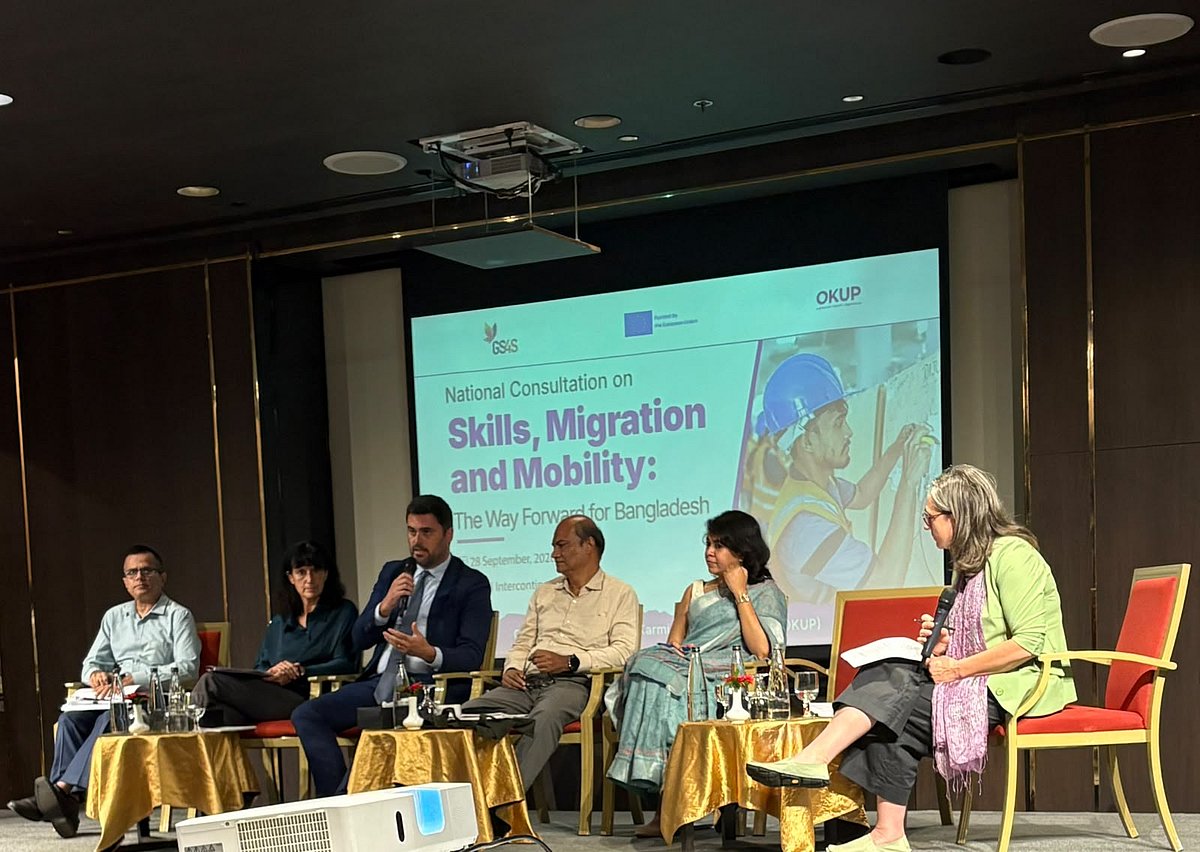
He made the disclosure at a national consultation on 'Skills, Migration and Mobility: The Way Forward for Bangladesh,' organised by the Ovibashi Karmi Unnayan Programme (OKUP) was held on 28 September 2026 at Hotel InterContinental, Dhaka, says a press release.
The consultation was part of OKUP’s engagement in the Global Strategy for Skills Migration and Development (GS4S), a Horizon Europe project led by Radboud University and funded by the European Union.
Very high-profile migration experts presented their thoughtful deliberations on the occasion.
Giuseppe Di Giovanni, therefore, pointed out why are the potential youth from Bangladesh highly exploited by traffickers to go to Italy in such risky and vulnerable illegal ways, spending Tk 2-3 million.
He disclosed with delight that Italy is going to recruit 1,50,000 skilled workers by next year, and Bangladesh is on the list of countries of origin.
He reiterated that the visa fee for Italy is only 65 Euro, but the migration cost is exorbitantly high in Bangladesh.
Giuseppe Di Giovanni expressed his concerns about the undocumented migrants in Italy and mentioned that asylum seekers are abusing our legal process of migration.
He urged all the concerned ministries, departments, and aspirant potential migrants to avail the opportunity of the Talent Partnership Programme, which has been launched through a contract with Bangladesh in 2023. Through this programme, more skilled professionals can get employment in European Countries.
Among others, Prof. Tesseltje de Lange, Professor of Migration Law and Director of the Centre for Migration Law at Radboud University, Netherlands, and Elisa Fornalé, Principal Investigator at the University of Bern, joined the consultation as distinguished panelists and delivered lectures.
The consultations suggested adopting policies to promote legal migration in Europe through strengthening Bangladesh’s approach to skills, migration, and mobility.
Laira Cartanya Llach, First Secretary, EU Delegation to Bangladesh, also called for action on the prospect of the Talent Partnership Programme.
Another panelist in the consultations, Md Nurul Islam, former director of the Bureau of Manpower, Employment and Training (BMET) emphasised strengthening the skills training ecosystem of Bangladesh to overcome the challenges to synchronise that with the demand of Europe.