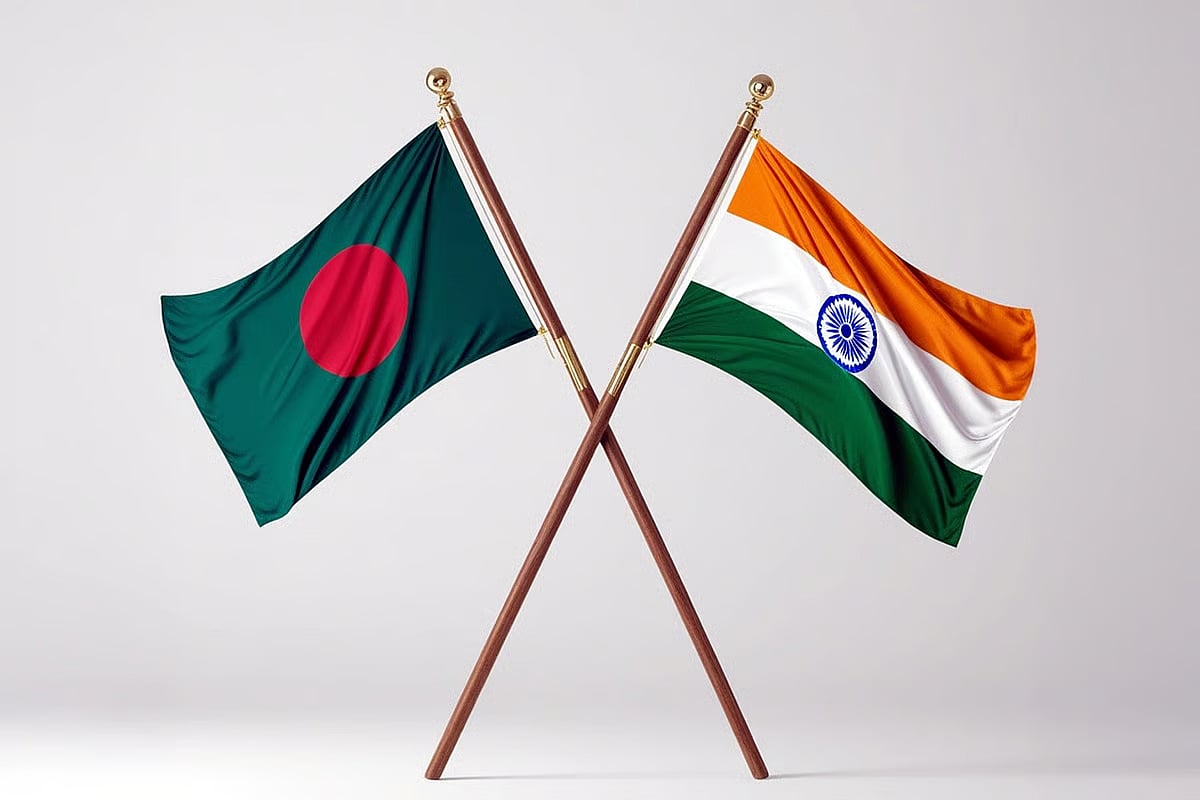
Bangladesh-India joint working group meeting begins today: what will be discussed on trade
The two-day meeting of the Bangladesh-India Joint Working Group began in New Delhi on Thursday morning. According to sources at the Ministry of Commerce, Bangladesh’s main priorities are removing obstacles at land ports, seeking a review of India’s duties on jute products, and restoring normal import and export operations.
A 10-member Bangladeshi delegation led by Ayesha Akter, additional secretary (FTA) at the Ministry of Commerce, travelled to New Delhi yesterday, Wednesday, to attend the meeting.
According to ministry sources, the meeting will discuss ways to reduce the trade deficit between the two countries, remove obstacles to the import and export of goods, and strengthen bilateral trade and economic ties.
India’s new duties on Bangladeshi jute products and Bangladesh’s restrictions on imports of Indian yarn will also receive particular attention.
Meeting held after 3 years
The previous meeting of the Bangladesh-India Joint Working Group was held in Dhaka on 26 and 27 September 2023. Before that, the 14th meeting took place in New Delhi on 2 and 3 March 2022.
Following the political change in Bangladesh in August 2024, tensions developed in relations between the two countries. This affected trade discussions as well. As a result, the regular meeting was not held as scheduled.
According to ministry sources, the meeting will discuss ways to reduce the trade deficit between the two countries, remove obstacles to the import and export of goods, and strengthen bilateral trade and economic ties.
Previous meetings discussed infrastructure development at land ports and integrated check posts, withdrawal of port-related restrictions, reopening border haats, transporting goods by rail and expanding regional connectivity.
Coordination and mutual recognition of product standards, a joint study on a Bangladesh-India Comprehensive Economic Partnership Agreement, and keeping the Petrapole-Benapole check posts open 24 hours a day were also discussed.
Land trade declines amid restrictions
One of the major manifestations of tensions in the commercial relationship between the two countries has been the use of land ports. In April 2025, Bangladesh stopped allowing imports of Indian yarn through the Benapole, Bhomra, Sonamasjid, Banglabandha and Burimari land ports. Imports by sea were still allowed.
A few weeks later, India imposed restrictions on imports from Bangladesh by land of various products, including ready-made garments, processed food, plastics and PVC. In June that year, restrictions were also imposed on jute and certain textile products.
The restrictions affected export figures at Benapole land port. In fiscal year 2025–26, Bangladesh exported 189,358 tonnes of goods to India through the port, compared with 381,440 tonnes in the previous fiscal year.
Despite the decline in volume, export earnings remained almost unchanged. Export earnings through Benapole stood at $1.75 billion in fiscal year 2025–26, compared with $1.76 billion in the previous fiscal year.
New Indian duties on jute products
Ahead of the meeting, India’s imposition of new duties on Bangladeshi jute products has emerged as an issue. On 24 September, India’s Ministry of Finance set revised anti-dumping duties on jute yarn and twine, hessian fabric, jute sacks and sacking cloth imported from Bangladesh and Nepal.
For Bangladeshi jute yarn and twine, the highest duty has been set at $445 per tonne. India has said the new duty was not imposed following a fresh investigation. Rather, the rates were revised based on a mid-term review of the existing duties.
In addition, on 29 September, India’s Directorate General of Trade Remedies (DGTR) recommended imposing anti-dumping duties of up to $218 per tonne on PET film imported from five countries, including Bangladesh.
For Bangladesh’s Akij Biax Films, the proposed duty is $58 per tonne. However, the recommendation will not take effect until India’s Ministry of Finance issues a final notification.
Business community’s demands also on agenda
Before finalising the agenda for the New Delhi meeting, the Ministry of Commerce held a meeting with the country’s leading business organisations in May. Business leaders recommended withdrawing restrictions at land ports, removing non-tariff barriers and restoring the transshipment facility that had previously been cancelled.
Indian Deputy High Commissioner to Bangladesh Pavan Kumar Tulshidas Badhe met with leaders of the Federation of Bangladesh Chambers of Commerce and Industry (FBCCI) last month.
At the meeting, proposals were made to reduce tariff and non-tariff barriers and establish a joint business task force comprising business representatives from both countries.
Earlier, at a meeting in August between Commerce Minister Khandakar Abdul Muktadir and Indian High Commissioner to Dhaka Dinesh Trivedi, the reopening of border haats, increasing the capacity of land ports and withdrawing restrictions on imports of Indian yarn were discussed.