Baul songs have been held beside Ibrahim Shah’s shrine in Bishwanath of Sylhet for nearly a hundred years. This year too, the musical gathering began. Suddenly, more than a hundred people came onto the stage and carried out an attack. Musical instruments, sound equipment, and audience chairs were vandalised. In this attack on the night of 22 March, the century-old traditional musical event was disrupted within minutes. The attackers also threatened to take strict action if such gatherings are held in the future.
This picture in Bishwanath is no longer an isolated incident; it has now become almost a daily reality surrounding folk cultural events in rural Bengal. In recent years, such incidents targeting rural folk festivals and cultural events have been increasing steadily. As a result, many festivals are gradually disappearing. Cultural events are declining.
Folk theatre, puppet shows, Baul songs, narrative folk songs—these were once important means of rural entertainment. Although there are no specific statistics, field data suggests that over the past two decades, regular arrangements of such rural events and performance-based folk cultural festivals have significantly declined. Folk music and folk theatre are now largely confined to special occasions or government patronage.
Artists and organiwers say that incidents such as attacks, obstruction, and social pressure have played a major role behind the shrinking scope of rural cultural festivals and events. In recent years, there have been complaints that whenever events are organised, various local individuals, organisations, groups, and even the administration create obstruction.
One statistic reflects the extent of obstruction in the cultural sphere. According to data from a branch of the police, information on 135 such incidents has been recorded in the past 15 months. Among these, 94 incidents occurred between July and December last year. From January to March this year, 16 incidents took place.
On this issue, Baul artist Arif Dewan was interviewed. He is the singer of the song “Ma Lo Ma.” His family in Keraniganj, Dhaka, has been practicing folk culture for more than two centuries.
Arif Dewan said that for a long time after independence, there were no such obstructions to practise folk culture. However, later, through various incidents such as attacks on shrines and cultural events, a confrontational tendency has developed. An extremist opportunistic group is carrying out these acts. However, in all cases, external obstructions are not the only reason. The promotion-cantered approach of some artists and disregard for religious sensitivity are also creating problems.
Cultural events on the decline
People concerned said that cultural events began to decline comparatively toward the latter part of the Awami League government’s 15-and-a-half-year rule. After the interim government took responsibility, attacks on rural folk cultural events increased significantly. Even after the formation of the Bangladesh Nationalist Party government, such incidents are occurring. Due to attacks, obstruction, and the lack of practice of folk culture, such events are decreasing. However, some believe that the expansion of digital entertainment is also one of the reasons behind the decline of cultural events.
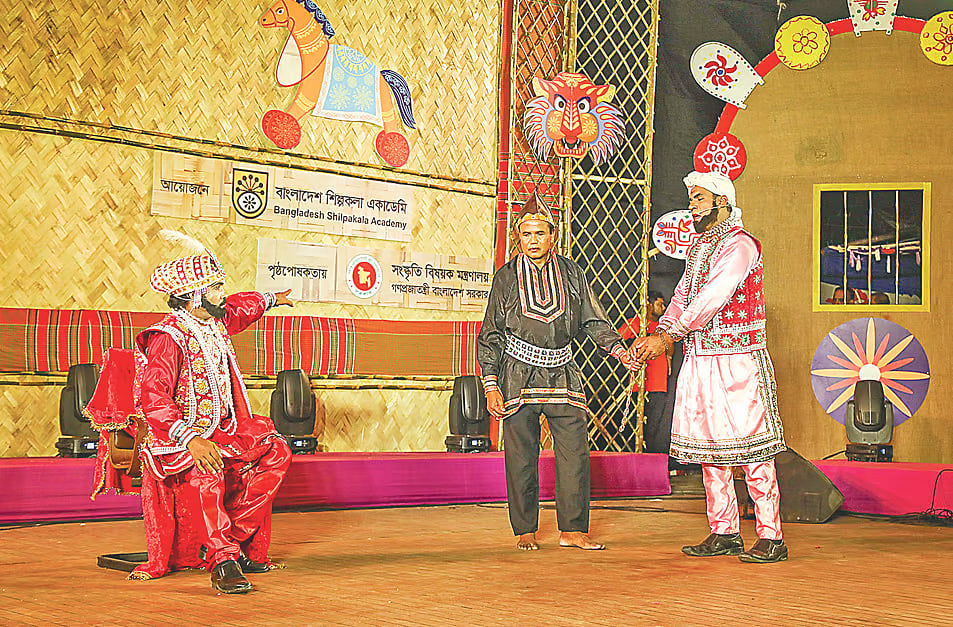
Taking the example of jatrapala (folk theatre), a picture of the shrinking rural arrangements can be seen. According to the Bangladesh Jatrashilpa Unnayan Parishad (Bangladesh Folk Theatre Development Council), the number of folk theatre groups registered with the Bangladesh Shilpakala Academy is now around 205. However, among them, only 40 to 50 groups are actively engaged in regular activities. At one time, during the season, 20 to 50 performances were held across the country, where multiple groups performed in rotation every day in month-long fairs. Now that scene has almost disappeared.
Lakshmi Banik, who has been involved with folk theatre since the age of four, also expressed disappointment. She has been working in folk theatre for about 34 years. Her father was a theatre manager and her mother was a dancer. She told Prothom Alo last Saturday, “Until recently, I had work for 50 to 60 days a year. And in my childhood, I used to get work for 100 to 150 days. Now, if I get work for one or two days a month, I consider myself lucky. Besides, in some places, there have also been incidents of attacks on event structures and arson.” She said the situation has been the worst in the past one and a half years.
The Folk Theatre Development Council, the organisation of artists and technicians involved in folk theatre, said that the number of artists directly involved in this field is 7,000 to 8,000. Among them, 5,000 are professional artists, and another 2,000 to 3,000 people are involved irregularly as amateurs or hobbyists. Including families dependent on this art, the livelihood of 40,000 to 50,000 people depends on this sector. But due to the decline in events, many are living in uncertainty. As a result, new artists are not entering the profession, and older ones are leaving.
Belayet Hossain, president of Bangladesh Folk Theatre Development Council, told Prothom Alo that for half a decade, applications have been made to local administrations to stage performances, but in many cases, permission is not granted. Even when permission is given, various obstructions arise. As a result, large field-based events have almost stopped.
The same situation exists in folk music. According to Banglapedia, the national encyclopedia of Bangladesh published by the Asiatic Society, there were nearly fifty types of folk music in Bangladesh depending on the region. People concerned said that hundreds of songs in genres such as jari, sari, bhatiyali, bhawaiya, murshidi, marfati, baul, gambhira, kirtan, ghatu, jhumur, bolan, alkap, leto, gajan, baramasi, dhamali, patuya, sapure, and khemta are gradually declining.
These songs reflect both folk lifestyles and spiritual thought. The lyrics express the inner feelings and experiences of the nation. While some songs contain religious emotion, most are performed for entertainment. Again, some song types are directly linked to the livelihood of artistes. In certain song traditions, women’s feelings, aspirations, and social experiences are clearly expressed.
However, with the passage of time, these region-based songs are no longer as they once were. Take Baul songs, for example. The United Nations Educational, Scientific and Cultural Organization (UNESCO) recognised Baul songs of Bangladesh as part of the intangible cultural heritage of humanity and included them in its list in 2008. Yet Baul songs are now in a deteriorating state.
Manikganj district is one of the major centres of folk music, including Baul songs. According to the Bangladesh National Portal, rural life in Manikganj was once filled with various forms of folk songs and performances. Even two to three decades ago, lively gatherings of folk music were held in courtyards, fields, and under banyan trees in rural Manikganj.
But that picture of folk culture in Manikganj has now disappeared. On this issue, veteran folk artist Saidur Rahman Bayati, born in 1932, shared his views. He started singing at the age of 10. He said that even before the country’s independence, there were 200 to 250 quality artistes in Manikganj district. Gradually, that number has declined to only a handful.
Saidur Rahman Bayati said, “At one time, Baul and folk music were matters of spiritual practice and philosophy, but now they have largely become a profession and business. As a result, the spirituality and depth within the songs have diminished, and people are losing interest.”
Decline in hill festivals as well
Not only in the plains, the decline in cultural events is also visible in the hills. A correspondent from Bandarban reported that the Rajpunyah festival of the hill regions, which is about one and a half hundred years old, has been discontinued since 2018. It used to include tax collection from jhum farmers and annual gatherings.
Similarly, the Marma community’s musical dramas, based on mythological stories, were regularly organised in almost every locality even 30 to 40 years ago. Now such events are no longer seen. The traditional theatre festival of the Tripura community is also no longer held as spontaneously as before. The narrative song gatherings of the Chakma community are also almost disappearing. Meanwhile, the ‘Sheyakidong’ or hunting festival of the Bom community and the war dance festival of the Khumi community are now rarely seen.
Why the obstruction and attacks, who is responsible
People concerned said that in most cases, obstruction to rural cultural activities is being carried out under a religious banner. In many cases, allegations such as promoting obscenity and hurting religious sentiments are brought to stop these events. Sometimes, instead of resolving the issue and allowing the event to continue, the local administration shuts it down.
For example, in April last year, a two-day staging of the play “Shesher Kobita,” produced by a theatre group, was scheduled at a hall in the capital on the occasion of the end-of-year festival and the Bengali New Year. After completing all preparations, the theatre workers were waiting to go on stage. But after receiving a threat letter, the performance was cancelled.
According to a branch of the police, in the past 15 months, at least 11 cultural events were obstructed under a religious banner alone. Additionally, 36 events faced obstruction on allegations of religious defamation. There have also been incidents of vandalism over staging plays, obstruction to Baul song events, and vandalism of national memorial structures.
Artistes and performers said that in some cases, incidents of obscenity have occurred around folk theatre performances. In a few cases, there were misunderstandings regarding religious issues. However, there is a tendency to place the blame on the entire field.
Wishing anonymity, a female folk theatre artist shared her experience, saying that since 2012 to 2013, performers have been forced to take part in provocative dance performance. Bringing in outside performers for such dances introduced obscenity into the field. As a result, the dignity of genuine artistes has been severely damaged. Out of fear of defamation, she was forced to quit dancing.
Criminal activities surrounding festivals are also putting such events at risk. On 31 March, such an incident occurred in Matlab Uttar area of Chandpur. During a seven-day fair, attackers injured Motiur Rahman, also known as Lal Mia, aged 60, the caretaker of a shrine. He said he was attacked with sharp weapons for preventing drug use and gambling.
Alongside such incidents, opposition from local influential groups to maintain control and dominance, lack of awareness about the historical value of folk culture, and in some cases political reasons are also causing obstruction.
For example, on 7 October last year, during an event organised on the occasion of the 163rd birth anniversary of the music maestro Ustad Alauddin Khan, a group of people went to obstruct it after hearing that there would be “dance and music.” Later, the Shilpakala Academy informed them that it was not a dance and music program, but an event in honour of Ustad Alauddin Khan. After hearing that, they left.
The types of obstruction faced by artistes in stage drama and cultural events were highlighted by theatre activist Poli Parvin. A member of a theatre group, she said that recently, in many places, scripts have to be submitted in advance to obtain administrative permission for staging plays. In one case, even after submitting the script and receiving permission, threats of mob attack were made, forcing the cancellation of the play.
“An atmosphere of fear has been created”
Artistes and organisers say that folk culture is not just entertainment; it carries the memory, beliefs, and identity of rural society. But under the pressure of attacks, obstruction, social pressure, and administrative inaction, that continuity is breaking down. Fields are becoming empty, stages are going dark, and artists are leaving the profession.
Samina Lutfa, professor of sociology at the University of Dhaka and a theatre activist, said that the increasing attacks and obstruction on folk culture are mainly driven by conflicts in cultural values. The traditional culture of Bangladesh has been multidimensional and inclusive, but in recent times, it has come into conflict with different religious and social perspectives. Issues of control over space, dominance, and political interests are also involved, creating an atmosphere of fear.
She added that many attacks during the interim government period were not effectively suppressed, which encouraged further violence. Although there are expectations from the current government to strengthen the rule of law to stop such attacks, in reality there is still a lack of alignment between words and actions. If the state does not act actively, this atmosphere of fear in the cultural sphere will not go away.