Gulshan–Banani–Baridhara
Beauty by the lake, garbage in the water
Signs of development are now clearly visible along the lakeside in Gulshan-1, one of the capital’s upscale neighbourhoods. In some places, the banks have been reinforced; in others, there are walking paths and seating areas. In the afternoon, people go for walks there, while some stand by the lake to take photographs. But a closer look at the water reveals a different picture.
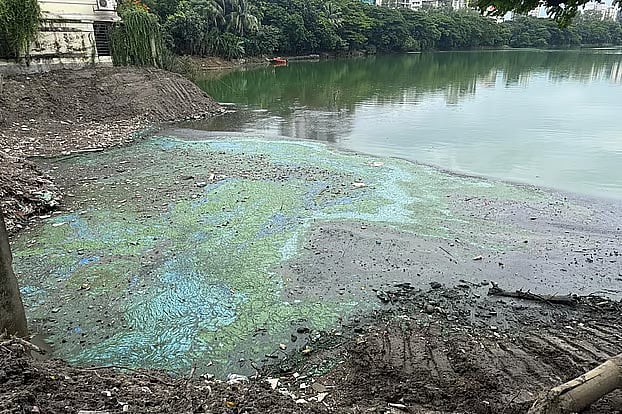
The water is dark and murky, there is floating plastic waste and piles of garbage accumulated in some areas. At times, the air is filled with an unpleasant stench. The contrast between the landscaped lakeside and the condition of the water is striking.
The same can be seen in the Banani part of the lake. Although the lakeside has been improved, local residents remain troubled by the color of the water and the foul smell.
Mahfuzul Haque, a resident of Banani, told Prothom Alo that previously there were fewer places along the lake where people could walk, but some sections have now become usable. He says, “Concrete paving has been laid by the lake, but if the lake water itself remains polluted, then the development remains incomplete.”
A project was undertaken in 2010 to improve the lake in the Gulshan–Banani–Baridhara areas. The project was implemented by the Rajdhani Unnayan Kartripakkha (RAJUK). Under the project, work was carried out on lake excavation, bank protection, construction of lake drive roads, walkways and causeways, tree planting, and installation of streetlights.
The project brought some changes. Areas along the lakeside where walking had previously been difficult are now accessible to pedestrians. In some sections, the lake banks have become more attractive than before. However, it has not been possible to eliminate water pollution from the lakes. Although the foul smell from the lake water decreased somewhat after several days of continuous rain recently, the water remains polluted even during the peak monsoon season.
An intensive monitoring report on the project, prepared in June by the Implementation Monitoring and Evaluation Division (IMED) of the Ministry of Planning, highlighted that sewerage lines connected to the lake had not been disconnected and that an alternative drainage system had not been introduced.
The report acknowledged the positive changes brought by the project in terms of the environment and citizens’ mobility. However, it also pointed out significant risks, stating that water pollution in the lake, direct sewerage connections, and poor waste management had severely undermined the project’s environmental objectives.
Money spent on the banks of the lake
When the project was approved by the Executive Committee of the National Economic Council (ECNEC) in 2010, its estimated cost was set at Tk 4.1 billion (Tk 410 crore). The target was to complete the work by 2013. However, the project was delayed due to various legal complications, including issues related to land acquisition. In 2025, the project was revised, with a new completion target set for December of this year. Under the revision, the project cost increased by 35 per cent, rising to Tk 5.55 billion (Tk 555 crore).
According to the IMED report, 82 percent of the project work had been completed by May this year, while financial progress stood at 56 per cent.
A source at RAJUK said that a large portion of the project cost was spent on land acquisition and compensation. In the revised project, an allocation of Tk 4,474,800,000 (Tk 447 crore 48 lakh) was set aside for land acquisition and compensation for structures. By May 2026, a total of Tk 2,236,700,000 had been spent.
Sewage is continuously entering through water connections that account for at least 85 per cent of the inflow into the Gulshan–Banani–Baridhara lake system. As a result, foul odour frequently emanates from the lake water
In addition, around Tk 770 million (Tk 77 crore) was spent on infrastructure development. Of this, Tk 390 million (Tk 39 crore) was spent on lake excavation, Tk 80 million (Tk 8 crore) on bank protection, around Tk 75 million (Tk 7.5 crore) on land filling, approximately Tk 155.8 million (Tk 15 crore 58 lakh) on construction of the lake drive road, Tk 16.8 million (Tk 1 crore 68 lakh) on walkways, Tk 6.3 million (Tk 63 lakh) on causeways, Tk 40 million (Tk 4 crore) on installing streetlights, and around Tk 1.5 million (Tk 15 lakh taka) on tree planting and maintenance.
This funding was used to carry out lake excavation, bank protection, land filling, and walkway construction from the Banani graveyard to the Banani Road 11 Bridge, and from the Niketan Bridge to the Gulshan–Mohakhali Link Road. A lake drive road was constructed and streetlights were installed from Hatirjheel to Mariam Tower-1. Causeways were built at various locations, and trees were planted along the lakeside.
Project Director and RAJUK Superintending Engineer Saber Ahmed told Prothom Alo that the government has held several meetings at the Prime Minister’s Office not only regarding the Gulshan–Banani–Baridhara lake but also to protect all water bodies across Dhaka. He said the government is considering various initiatives to preserve these lakes.
The main objectives of the project were to free the lake areas from encroachment, increase the water-holding capacity of the lake, enhance their beauty through improvements to the natural environment, create opportunities for walking around the lakes, and develop waterways. However, the polluted water of the lake is undermining the very objectives of the project.
A RAJUK source said that sewage is continuously entering through water connections that account for at least 85 per cent of the inflow into the Gulshan–Banani–Baridhara lake system. As a result, foul odour frequently emanates from the lake water. Because of this, the large investment made for lake development is being wasted.
When will sewage discharge into the water stop?
The issue of sewage entering the water of the Gulshan–Banani–Baridhara lakes is not new. Three years ago, when Atiqul Islam was serving as mayor of Dhaka North City Corporation (DNCC), an initiative was taken to stop sewage disposal into the lake and ensure effective septic tank systems (STPs) in houses across the Gulshan, Banani, Baridhara, and Niketan areas.
At the time, a DNCC survey found that most houses in these upscale neighborhoods did not have effective sewage management systems. As a result, black wastewater from residential buildings was flowing directly into canals and lakes through surface drains.
A roadmap was also proposed involving DNCC, Dhaka Water Supply and Sewerage Authority (WASA), RAJUK, UNICEF, icddr,b, and local residential associations. A senior RAJUK official said that although cooperation was sought from the previous government to implement the roadmap, it was not received.
The documents of the lake development project state that polluted sewage water is still flowing directly into the lake through several locations, including Banani, Chairman Bari, and Korail.
Dhaka WASA is responsible for sewage management in the capital. WASA Chief Engineer, Alamgir Hossain Ahmed, attributed the problem to the incomplete sewage pipeline network. He said that although the sewage treatment plant located at Dasherkandi in Khilgaon, Dhaka, has a capacity of treating 500 million liters (500 MLD) of sewage per day, it is currently underutilised because the network is not fully developed. Since the pipeline network is incomplete, sewage from all areas cannot reach the plant directly. As a result, during rainfall, it flows through drainage channels into the lakes.
City corporations and Dhaka WASA often blame each other over sewage management in Dhaka. The city corporation’s position is that it is responsible for drainage canals. However, because WASA does not have an adequate sewage network, sewage is entering the lakes through drainage channels. On the other hand, WASA argues that ensuring proper sewage management—including the installation of appropriate septic tanks during new building construction—is the responsibility of city corporations and RAJUK. Due to a lack of oversight, many buildings have connected directly to drains without following regulations.
Alamgir Hossain said that various agencies and city corporations tend to shift responsibility for the problem onto one another, but in reality, a lack of planning and ineffective management are disrupting the entire process.
The intensive monitoring report by IMED stated that the true success of this public investment can only be achieved when sewage lines are completely disconnected and strict administrative monitoring ensures water quality and public safety, allowing the lakes to be transformed into ideal urban recreational spaces.
Coordinated action is key
On 6 July, a meeting was held at the Prime Minister’s Office regarding the verification of sewage connection systems in buildings in the Gulshan–Banani–Baridhara–Niketan areas and measures to make the lake pollution-free. At the meeting, Prime Minister Tarique Rahman emphasised the need for the relevant ministries, city corporations, and responsible agencies to work together in a coordinated manner to remove waste from the lake, control water pollution, and protect the environment.
The meeting discussed taking necessary measures to prevent sewage from buildings from flowing directly into the lake. The installation of sewage treatment plants (STPs) to protect the environment of the Gulshan–Banani–Baridhara lake system was also discussed as an important issue. After the meeting, the Prime Minister’s Deputy Press Secretary Hasan Shiplu said that discussions were also held on possible action plans to prevent waste from Korail slum from directly entering the lake.
Experts believe that developing the lake without ensuring proper household sewage management will not produce lasting results. The banks may be improved, but the lake water will remain polluted.
Urban planner Adil Muhammad Khan told Prothom Alo that it would be a mistake to view the Gulshan–Banani–Baridhara lake system merely as a place for beautification. It is one of Dhaka’s important natural water bodies. Constructing walkways and roads may be a part of development, but the first priority should be to disconnect sewage and drainage connections from the lake, maintain the natural flow of water, and protect the surrounding land. Otherwise, there will be a project, but the lake itself will not survive.