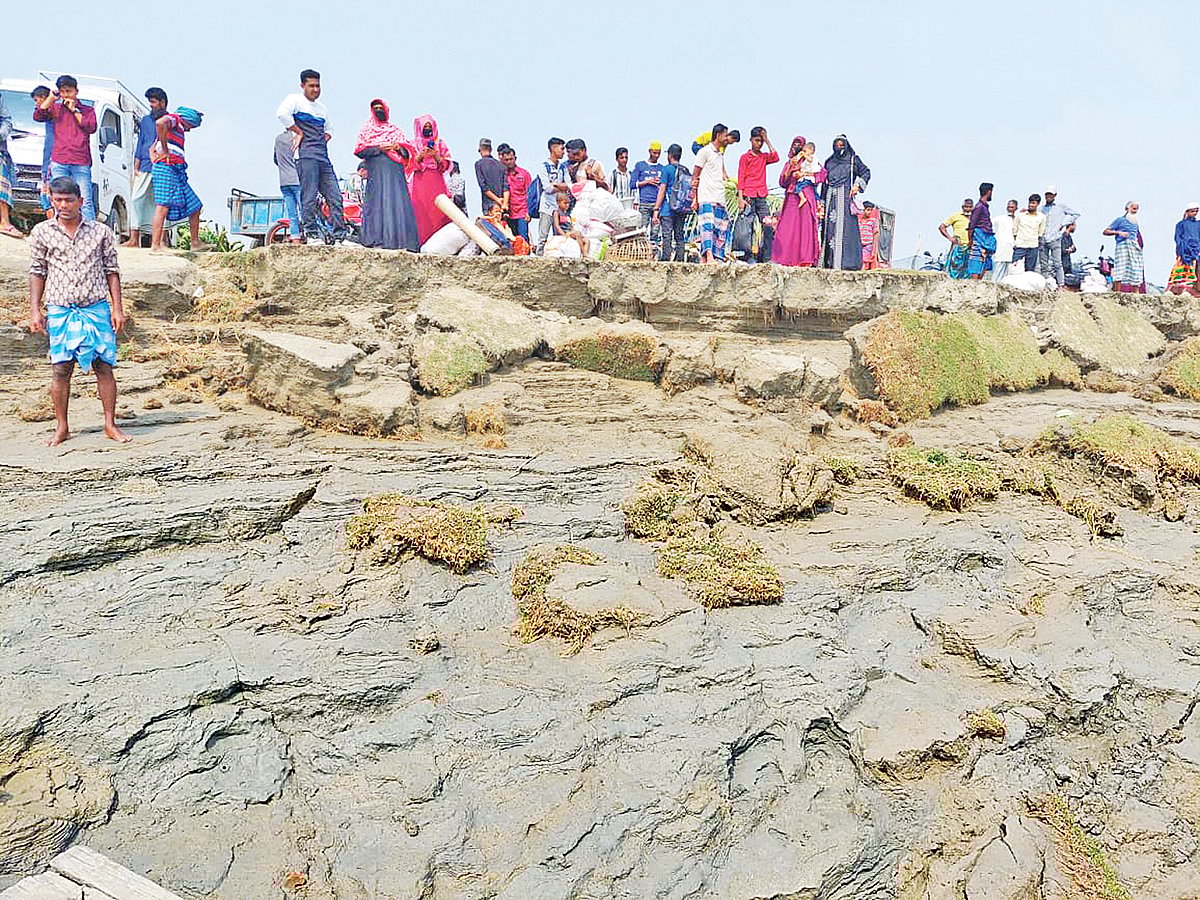
Urir Char: A displaced land caught up in political corruption
Urir Char, the southernmost union of the ancient island of Sandwip, rises quietly from the heart of the Bay of Bengal. Nestled in the estuary of the Meghna, the island is a place of serene beauty, a landscape of lush green fields, fresh fish, and plates of steaming coarse rice. The hospitality of its people leaves every visitor deeply moved.
Yet beneath this calm and charm lies a web of deprivation and exploitation, invisible to most outsiders. The people of Urir Char find themselves trapped between a hostile climate, political corruption, the collusion of local power brokers with river bandits, and the tightening grip of land trading and arbitrary boundary demarcations.
Ironically, Urir Char has long been one of the largest refuges for those displaced by climate change. But land trading has turned this sanctuary into contested territory — land once meant for displaced people due to climate change is now falling into the hands of wealthy outsiders. Locals allege that many involved in these deals have close ties with politically influential figures.
Meanwhile, unilateral boundary demarcations have deepened social divisions and created fears of identity loss among the island’s original inhabitants. Across its fields stand boundary pillars marking the administrative limits of Chattogram and Noakhali districts, physical symbols of confusion and conflict. In the words of one resident, “Two farmers till the same land, and the crops perish in between.”
The first 25 landless families from Sandwip settled here around 1978. Over the next few years, hundreds more arrived after losing their homes to river erosion. Even the devastating cyclone of 1985 could not break their resolve, they rebuilt their lives from the ground up. By 2010, displaced families from Bhola, Lakshmipur, and Noakhali, whose ancestral lands had been swallowed by the sea, found new hope here. Today, nearly 12,000 families live on the island, most of them climate migrants with no legal ownership of the land beneath their feet.
Almost fifty years have passed, yet Urir Char’s landless residents remain without land titles. Instead, they now face the threat of dispossession once again. The government’s Char Development and Settlement Project (CDSP) was designed to grant land ownership to displaced settlers. For a time, it gave people hope. But now, many ask whether that promise has turned into another form of oppression.
Nature, a relentless companion
From Sitakunda’s Kumira Ghat, a cargo boat loaded with goods sets off toward Urir Char. Among the passengers sits 32-year-old Salauddin, his leg still in a plaster cast. He was injured in a pickup van accident in Dhaka and is returning home to Urir Char after two and a half months. Asked why it took so long to come back, he points to the island’s difficult communication routes.
Boats dependent on tides are the main means of transport; speedboats exist, but they are far too costly.
Stepping onto Urir Char, this correspondent meets 65-year-old Shahidul Islam from Ramgati in Lakshmipur. He lost his home to a cyclone and came here hoping for a new beginning. With loans from Grameen Bank and Sagarika, he runs a small grocery shop, but he has no house of his own. His wife lives under someone else’s roof. Drowning in debt and despair, Shahidul now fears an uncertain future as land trading threatens to drive him away again.
Shahidul is not the only one. Across the island, the same fate binds countless families displaced by climate change, from Bhola, Lakshmipur, and Noakhali, who now live in precarious conditions.
A video produced by the Bengal Institute using Google Maps shows the devastating erosion of this region between 1988 and 2024. The footage reveals how the southern part of Urir Char has been rapidly shrinking, while nearby Jahajer Char (also known as Swarnadwip) has expanded over time. Though sedimentation along the coast occasionally gives rise to new land, rising salinity, sea-level rise, and strong tidal currents quickly erase those gains. Climate displaced are thus forced of moving from one island to another as each one disappears beneath the waves.
This cycle of displacement has become an inseparable part of life in Urir Char. Today, nearly 80 per cent of the island’s residents have moved northward over time, driven away by the erosion in the south. Many of the families now living in the island’s northern edge were themselves displaced from other islands less than 15 years ago. In these barren, treeless stretches, they began building homes barely a decade ago.
Over the past 50 years, rising temperatures and repeated cyclones have become part of the islanders’ daily reality. The island has also gained a grim reputation as a hideout for river bandits, where political corruption allows powerful groups to exploit landless refugees for their own interests.
A chronicle of political corruption
Once Urir Char was a haven for coastal robbers, beyond the reach of government or law enforcement. Even after a 2014 joint operation by the police and RAB that led to the fall of top bandits leader Jased alias Jashu, the islanders found little relief. News from Urir Char rarely reaches the national media — when a clash between two bandit gangs left three people dead on 24 March this year, it barely made the headlines.
For generations, the innocent people of this island have been crushed under the influence of elites from both districts. From education and healthcare to housing security, their basic rights were never guaranteedNur Nabi, resident of the island with MA degree in journalism from the University of Chittagong
In the fifty years since the island’s settlement, nearly thirty major bandit leaders have emerged, using Urir Char as their hideout and exploiting displaced refugees as their victims. To secure protection, these robbers have forged alliances with influential political figures from Companiganj in Noakhali and Sandwip in Chattogram. Even in electoral politics, these rootless, vulnerable people have been used as pawns. As a result, nearly half a century after its settlement, this island union now suffers from an identity crisis.
Local residents say the government has failed to ensure even the most basic civic amenities here. No union parishad election has been held in the past 22 years, and there is still no union parishad office building. Administrative work takes place in makeshift shops. The union’s only health center has been converted into a police outpost, and its lone secondary school operates with just three teachers.
No matter how they live, however, one fact is clear — every inhabitant of Urir Char is a climate migrant, locally known as “Doirga Bhanga” (land broken by erosion). Political corruption has turned this island into a quiet colony of the powerful.
Nur Nabi, a resident of the island with a master’s degree in journalism from the University of Chittagong, told Prothom Alo: “For generations, the innocent people of this island have been crushed under the influence of elites from both districts. From education and healthcare to housing security, their basic rights were never guaranteed.”
Victims of land trade
Residents of Urir Char say they have had to buy the same plots of land multiple times just to secure a place to live. Around 2005, new land began to emerge rapidly in the island’s northwestern part. By 2008, two robbers from Ramgati in Lakshmipur — Nasir Kerani and Nijam Dakat — began selling those lands to displaced people desperate for shelter.
In 2010, Urir Char’s most notorious pirate leader, Jased alias Jashu, cleared forests and launched a grand “land festival,” selling land to the landless. Jashu sold each 'dag '(roughly two acres) of land for Tk 2,000–3,000. As a result, the island’s northwestern zone became home to people from nearby islands of Bhola, Hatiya, and Ramgati — all of whom had lost their ancestral homes to river erosion and are locally known as 'bhumihin' (landless).
Urir Char is divided between two districts. The landless mostly live in the Noakhali section, while the original settlers from Sandwip, known locally as Urir Chariyas, live across both Chattogram and Noakhali parts.
Traders in Baro Auliya Bazar, which developed in the 'bhumihin' area, said that although they initially bought their plots from Jashu for Tk 3,000, they later had to pay large additional sums in phases. Locals also said Jashu sold hundreds of acres of boya property (land with existing legal ownership records) along with newly emerged land in the Bar Auliya area.
Residents of Chairman Bazar in the southwest, Baro Auliya Bazar in the middle, and Yusuf Member Market in the north told Prothom Alo that while the government is nominally allotting land to them, it is only on paper. Even though they occupy around two acres of homestead and farmland each, the official registration (kabala) covers only 8 to 20 decimals. Yusuf Member of Yusuf Member Market confirmed this.
When asked why only 8 to 20 decimals are being registered out of two acres, Tanvir Farhad Shamim, Upazila Nirbahi Officer (UNO) of Companiganj, Noakhali, told Prothom Alo, “This is government land, and registration is being done in accordance with official policy.”
However, residents allege that their land is being allocated in the names of influential figures from Companiganj, Noakhali.
When asked whether the remaining lands occupied by the landless are being allotted to outsiders, the UNO avoided a clear answer, saying only, “If the government wants, it can allocate these lands to anyone following due process.”
Local residents said any such attempt would spark conflict. They claimed that from time to time, individuals from Companiganj arrive claiming government allotments and attempt to seize the plots already in their possession.
How the boundary was drawn unilaterally
On the island divided by the boundary pillars of Chattogram and Noakhali districts, many people suddenly found themselves residents of a different district overnight. Locals allege that without following any proper procedures, political influence and collusion with top bandits turned this island union into a target for division between two districts.
In the Chattogram Sandwip section, whichever party—Awami League or BNP—held the parliamentary seat, the respective MPs avoided conflict with heavyweight leaders from Noakhali’s Companiganj side. During the BNP regime, that was Moudud Ahmed; during the Awami League era, it was Obaidul Quader.
Residents believe the boundary demarcation was carried out under the direction of former minister and Awami League general secretary Obaidul Quader, who used the Char Development and Settlement Project (CDSP) to implement it. Meanwhile, his brother Abdul Quader Mirza, along with several politically influential figures, expanded their dominance over robbery and territorial control in the chars (river islands).
However, locals said the process actually began in 1992 under the initiative of Moudud Ahmed, then Member of Parliament from Companiganj. In 2002, while serving as law minister, he accelerated the plan to divide Urir Char between two districts. Though the initiative stalled at that time, Obaidul Quader later pushed to install boundary pillars across the middle of the island, allegedly ignoring a High Court ruling on the matter.
Saiful Haque Chowdhury, the petitioner of that case, told Prothom Alo: “The High Court’s directives were disregarded to prioritise Obaidul Quader’s demand.”
Md. Shahabuddin, 64, a resident of Jonota Bazar, said, “The Sandwip part was taken away into Noakhali. But Sandwip’s former MP, Mahfuzur Rahman, said he would not go against Obaidul Quader. He said a case was filed over the boundary. After the High Court ruling, Noakhali appealed—but without waiting for the hearing, Obaidul Quader’s men forcibly installed the pillars. Those who protested were harassed in various ways.
Abdul Bayes, former professor of economics at Jahangirnagar University, who has long studied the political economy of land in Bangladesh, told Prothom Alo, the plight of the homeless people in Urir Char is no different from that of most chars in Bangladesh. The social and economic structures are such that these problems persist for decades. One of the main reasons is that the people suffering from them are at the very bottom of the power hierarchy, and their voices are rarely heard.
Violation of the law
According to the State Acquisition and Tenancy Act of 1950, khas land (government-owned land) is allocated for settlement. Article 143 of the Constitution defines the state’s authority in this regard. Under the Khas Land Management and Settlement Guidelines of 1987, the largest portion of khas land was allocated to the landless. This guideline was partially revised in 1997, dividing khas land into agricultural and non-agricultural categories. Agricultural khas land is generally meant for settlement of the landless.
In the government’s priority list for the landless, the poorest families of freedom fighters are first, followed by river-eroded families like the residents of Urir Char. The law requires that to obtain khas land, a landless person must submit two attested photographs certified by the relevant ward member or chairman along with a citizenship certificate issued by the local UP chairman.
However, Prothom Alo’s investigation reveals that in Urir Char, people outside the definition of landless, some with substantial property and not local residents, are being granted land allocations.
To receive land across the boundary pillars, officials of the Char Development and Settlement Project (CDSP) have issued orders to change the voter area of Sandwip voters. Yet, the law does not allow voter area changes to obtain khas land. This directive, however, applies only to Sandwip voters; they can be registered in the new area if they choose. Voters from Bhola, Lakshmipur, and Noakhali cannot change their voter area even if they want to.
Moreover, those receiving land allocations are not all getting the same amount of land. Locals allege that the size of the land depends on the amount of bribe paid. Some paid 10,000 BDT, others 20,000 BDT. Md. Islam, 45, from Kamal Market said he paid 75,000 BDT as bribe but did not receive any land. When asked whom he gave the bribe to, he said it was someone accompanying the Assistant Commissioner (Land), whom he did not personally know well.
The law concerning voter area changes requires submission of certain documents. Most river-eroded people, however, do not have these documents. In char households with no electricity, there is no possibility of having other utility bills either. A selection commission official, speaking on condition of anonymity, said there are no special provisions for these people, and a separate arrangement is needed for river-eroded victims.
Regarding voter area changes, the UNO of Companiganj said that a former district commissioner had issued such directives. When asked why they are following it, he said the decision was made in a revenue meeting. When asked whether there is any document recording such a decision, he referred further inquiries to the district commissioner.
The District Commissioner of Noakhali, Khandkar Estiaque Ahmed, could not meet due to being in Dhaka. After multiple phone attempts, he eventually spoke and referred inquiries back to the UNO.
The Land Reform Ordinance of 1984 was repealed and replaced by the Land Reform Act of 2023, which clarified the definition of khas land. It also included river- or sea-emerged chars and land acquired through excess acquisition as khas land. Urir Char is one such land, and the law specifies priority for the landless. Yet, due to various bureaucratic complications, the land rights of thousands of people continue to be violated.
Government attempts to improve the lives of poor people through various social safety programmes, but is unwilling to transfer real assets to them. As long as that remains the case, their socio-economic condition will never changeProfessor Abdul Bayes, researcher on political economy of land
Masterminds behind the land trade
Residents on both the Chattogram and Noakhali sides of Urir Char consider the current system of land allocation deeply flawed and unjust. They allege that Abul Kashem, member of Ward no. 6 under Char Elahi union of Companiganj, controls the activities of the Char Development and Settlement Project (CDSP).
Kashem is accused of colluding with local administration officials to allocate khas land—meant for the landless—to outsiders from Companiganj, who are neither residents of Urir Char nor landless.
Interviews with locals across various markets in Urir Char revealed several names linked to this broker network, including Kashem Member and Tajul Islam. Their political patron is reportedly Abdur Razzak, chairman of Char Elahi union parishad, who is known to be a supporter of Obaidul Quader, the former general secretary of the Awami League and a long-time MP from Companiganj, his birthplace and political stronghold. The mayor of Companiganj’s Basurhat municipality was his brother, Abdul Quader Mirza.
Nurul Islam, a resident of Kamal Market, said he had made his land habitable after years of hardship. For 28 years, he and his neighbours fought to survive against extreme salinity—having to fetch drinking water from a pond five kilometres away. “Half the pitcher would fill with muddy water, and we had to use alum to make it drinkable,” he said. Yet, six or seven years ago, a man from Companiganj arrived and claimed ownership of his land.
Incidentally, Obaidul Quader became Awami League’s general secretary in October 2016. Since then, locals say, people from Companiganj have increasingly begun claiming ownership of lands in Urir Char, while district boundaries were unilaterally redrawn by his close associates. As a result, many residents of Sandwip have found themselves under Noakhali’s jurisdiction, sparking anger and resentment among the local population.
Victims allege that UP member Abul Kashem has illegally occupied nearly 200 acres of “boya land” (land with prior ownership records) in various mouzas, including Char Ramzan, Char Umed, and Char Langta under Char Elahi Union. They claim he forged ownership documents and transferred those lands in the names of fake owners. Prothom Alo has obtained testimonies from several such landowners and victims.
When asked about his presence during the hearing and allegations of using administrative influence to harass people, the UNO denied the claims. During the hearing held on 18 February at Urir Char Nabo Diganta Government Primary School, when this correspondent mentioned UP member Abul Kashem being harassed bylocal residents, the UNO made no further comments. When contacted over the phone regarding the allegations against him, Abul Kashem declined to comment.
Professor Abdul Bayes, a researcher on the political economy of land, said the government attempts to improve the lives of poor people through various social safety programmes, but is unwilling to transfer real assets to them. As long as that remains the case, their socio-economic condition will never change, he said. To resolve the complex land issues in coastal chars like Urir Char, he emphasised the need for good governance and coordinated government and non-government initiatives. He recommended adopting a specialised strategy for all coastal islands under what he called a “Char Economy” policy framework.