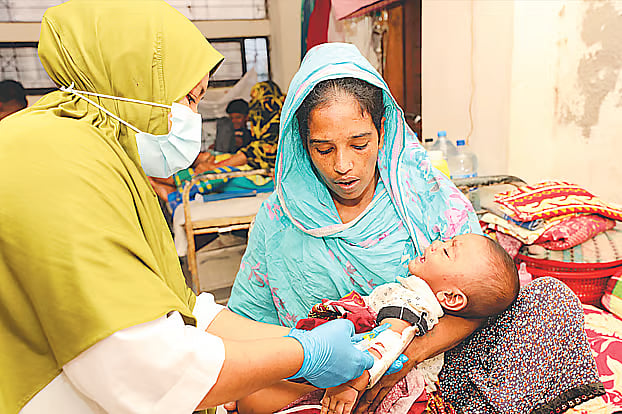
Vaccine shortage for 10 diseases including measles
The country is facing a vaccine shortage. Stocks of vaccines for 10 diseases at the central warehouse have fallen to zero. Meanwhile, 41 children have reportedly died of measles in the country this month. The information was obtained from the Expanded Programme on Immunisation (EPI) and government hospital sources.
Government officials say complications in vaccine procurement have led to the depletion of stock. At the same time, shortages at the field level and a lack of manpower are preventing children and mothers from receiving vaccines properly. As a result, children are dying from measles, and there is a growing risk of other diseases spreading among them.
Bangladesh has long been regarded as a success story in immunisation. Through regular vaccination and various campaigns, the country has successfully eliminated polio and tetanus, and kept hepatitis under control.
Measles was also largely under control. A target had been set to bring measles cases down to zero by 31 December, 2025. However, it now appears that negligence has put a once successful programme at risk.
Gavi, the global vaccine alliance, provides financial support to Bangladesh for vaccine procurement. Nizam Uddin Ahmed, chair of Gavi’s steering committee, told Prothom Alo that along with manpower shortages, there are problems in vaccine supply, logistics, and monitoring of routine immunisation.
Vaccines are not distributed evenly across urban areas. In addition, many children who received the first dose after the COVID period did not receive the second dose due to dropouts. As a result, a large number of children remain unvaccinated, making them vulnerable to measles. Social and environmental risks are further complicating the situation.
Health Minister Sardar Md Sakhawat Husain acknowledged the rise in measles infections, telling journalists at an event in Dhaka on Saturday, “We have already allocated Tk 6.04 billion. We will procure vaccines in time and begin administering them.”
He added that intensive care units with ventilators have been prepared at the Infectious Diseases Hospital for treating children with measles. Preparations have also been taken at the Children’s Hospital in Dhaka, Dhaka Medical College Hospital, and facilities in Manikganj and northern regions.
Shortage of 6 vaccines for 10 diseases
Vaccination in the country is carried out in two ways. One is the routine immunisation programme, which runs throughout the year and is delivered at the field level by health workers according to a fixed schedule based on age.
In addition to routine immunisation, national vaccination campaigns are conducted to cover all children of a certain age group within a short period. These campaigns are preceded by extensive nationwide awareness drives. National Vitamin A campaigns are also conducted. Donor agencies, private institutions, and NGOs are involved in these efforts. Children who miss routine vaccinations are often covered during these campaigns.
EPI officials said that nine vaccines are administered to prevent 12 diseases in Bangladesh. Seven vaccines are given to children of different age groups. BCG is administered to prevent tuberculosis; the pentavalent vaccine protects against diphtheria, pertussis, tetanus, Haemophilus influenzae type b, and hepatitis B; OPV and IPV are given to prevent polio; PCV is used to prevent pneumonia; MR vaccine protects against measles and rubella; and TCV is used to prevent typhoid.
Two vaccines are administered to women. The HPV vaccine is given to girls aged 10 and above to prevent cervical cancer, while the Td vaccine is administered to women aged 15 to 49 to prevent tetanus and diphtheria.
According to EPI data, stocks of six vaccines—BCG, pentavalent, bOPV, PCV, MR, and Td—have fallen to zero at the central warehouse. IPV and TCV supplies are expected to last until June, while HPV stock will last until December.
However, officials from EPI and donor agencies said shortages of certain vaccines are already being reported at the field level.
Why are vaccines unavailable?
Discussions with donor agencies, health officials, and public health experts reveal that vaccines were previously procured through the Health, Population and Nutrition Sector Programme (HPNSP) under an operational plan. The line director could procure vaccines relatively quickly with support from UNICEF and Gavi.
In August 2025, during the interim government period, the Health Ministry abolished the HPNSP operational plan system without full preparation. Since then, delays have occurred in preparing new project documents, approvals, appointing project directors, and releasing funds.
Officials said the Director General of the Directorate General of Health Services plays a crucial role in vaccine procurement. After the fall of the Awami League government in August 2024, the post remained vacant for some time.
During the interim government, Professor Abu Jafar served as DG. Following the formation of the BNP government after elections, Professor Provat Kumar Biswas assumed the role. However, even before he took charge, both vaccine shortages and measles outbreaks had emerged.
EPI Deputy Director Mohammad Shahariar Sajjad said on Sunday that many problems could be resolved if the ministry releases funds quickly.
Manpower shortage
Alongside the vaccine shortage, there is also a shortage of staffs. EPI officials said health assistants have been recruited in 27 districts, but the remaining 37 districts face severe shortages. In those districts, 45 per cent of field-level positions remain vacant. These workers are responsible for administering vaccines at designated centres in union-level wards. There are currently about 150,000 vaccination centres across the country.
Another factor behind the crisis is dissatisfaction among workers. For example, porters have not been paid for nine months. According to Shahariar Sajjad, there are 1,326 porters nationwide who transport vaccines daily from upazila headquarters to vaccination centres using specialised containers.
There are further examples. In 2025 alone, health assistants across the country went on strike three times, during which vaccination activities were suspended nationwide. In some areas, vaccines are unavailable despite having personnel; in others, personnel are available but vaccines are not. In some places, neither is available.
Rising death toll
From Saturday afternoon to Sunday afternoon, two more children died of measles at Mymensingh Medical College Hospital. This brings the number of measles-related child deaths at that hospital to five this month.
Authorities at the Infectious Diseases Hospital in Mohakhali, Dhaka, reported that 19 children have died of measles there this month. Earlier, the hospital had reported three deaths. During the same period, 12 children died at Rajshahi Medical College Hospital, and three deaths were reported in Chapainawabganj.
Another child from Shariatpur died at the North City Corporation Market Hospital in Dhaka. Altogether, 41 child deaths from measles have been reported this month and this year. Such a high number of measles-related deaths has not been seen in recent times.
Public health expert Abu Jamil Faisel said the deaths of so many children from measles are deeply tragic. He said those responsible for the health system must be held accountable. “Why did vaccines run out, and why did children die—these questions must be investigated. This cannot be allowed to continue.”