Some obstacles emerged with India over the past 1.5 years: Commerce minister
Commerce minister Khandaker Abdul Muktadir has said that bilateral trade between Bangladesh and India currently stands at US$11 billion. However, certain obstacles had arisen in relations with India over the past one and a half years.
These issues, he said, have been specifically raised with Indian high commissioner Pranay Kumar Verma, and discussions were held on how to make commercial relations between the two countries smoother and stronger in the days ahead.
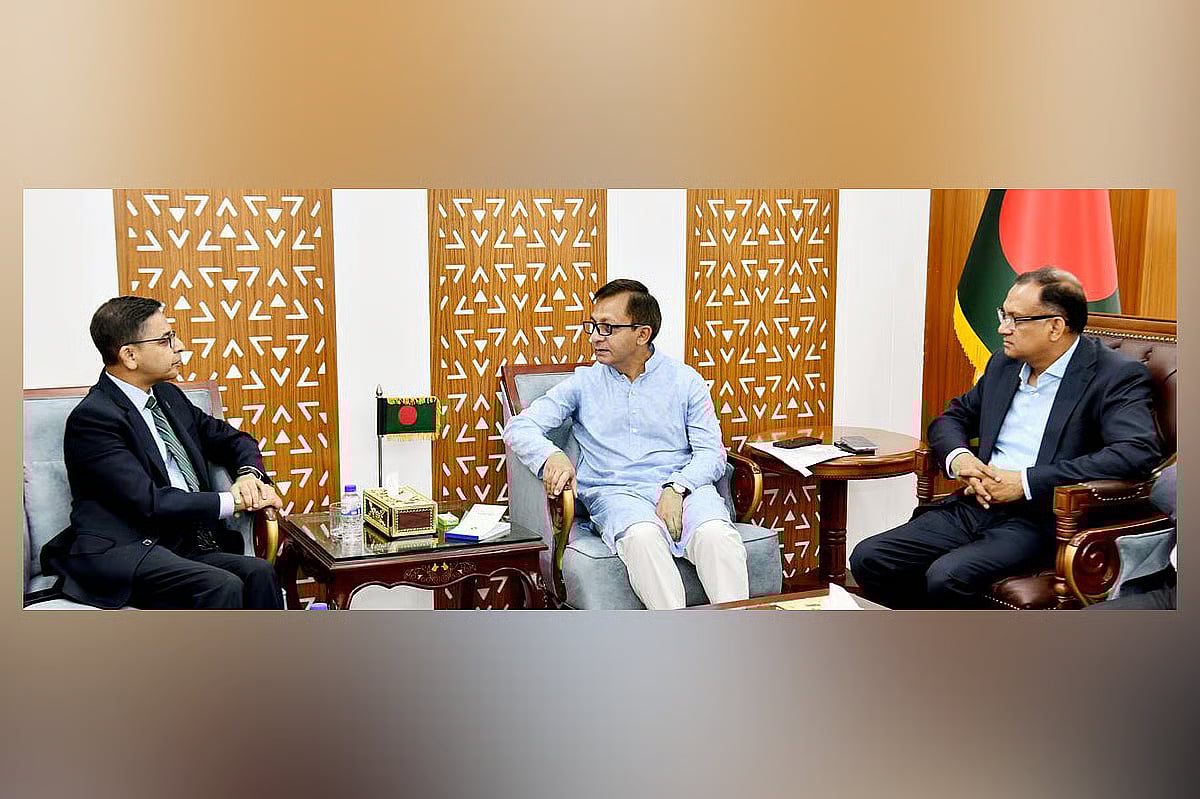
The remarks were made at the secretariat following a meeting between the commerce minister, state minister for commerce Md Shariful Alam, and Pranay Kumar Verma on Monday afternoon.
Responding to questions from journalists after the meeting, the commerce minister elaborated on the discussions. Commerce secretary Mahbubur Rahman and additional secretary Md Abdur Rahim Khan were also present.
Speaking to newspersons after the meeting, Pranay Kumar Verma said that India and Bangladesh share deep trade relations and that India would work jointly with the new government to expand them further.
He expressed India’s interest in working closely with Bangladesh to enhance economic and investment ties and stated that visa operations would soon be normalised.
On 5 August 2024, the Awami League government fell through a student–public uprising, after which Sheikh Hasina took refuge in India. Subsequently, an interim government assumed office. From that time, India adopted stricter policies and limited the issuance of visas, particularly suspending tourist visas.
The commerce minister noted that the Indian high commissioner had primarily called to congratulate the new government. During the meeting, discussions were held on reopening border haats and several land ports that had remained closed, with a view to strengthening bilateral trade relations. There was no discussion regarding the future of Indian-funded projects.
Observing that certain complexities had arisen in the long-standing trade relationship between the two countries, the commerce minister said that the time had come to overcome them.
He added that discussions covered enhanced mutual cooperation in all areas, ranging from the process of postponing Bangladesh’s graduation from least developed country (LDC) status to ensuring the supply of essential commodities.
The minister further said that the letter submitted regarding the deferment of LDC graduation is currently under process, and it is hoped that India will maintain a supportive position in this regard.
Expressing concern over current tensions in the Middle East, the commerce minister said that any closure of the Strait of Hormuz would have an impact on global trade, which could also affect Bangladesh. “The reassuring news,” he added, “is that there is currently sufficient stock and supply of essential commodities in the country.”
What the Indian high commissioner says
The Indian high commissioner stated that discussions were held on ensuring that future cooperation is aligned with each country’s national priorities.
He said the meeting explored ways to make the partnership more future-oriented, technology-driven and innovation-based; how to leverage existing achievements to expand economic relations; and how to deepen trade and investment ties.
Pranay Kumar Verma said, “We have conveyed our interest in engaging closely with the new government and in working together in a positive, constructive and forward-looking manner, based on mutual interests and mutual benefit, to strengthen trade and economic relations as well as people-centric cooperation.”
He added that geographical proximity could be transformed into new economic opportunities and that much could be achieved through joint efforts.
Asked whether the Comprehensive Economic Partnership Agreement (CEPA) had been discussed, Pranay Kumar Verma replied that there had been no specific discussion on the matter, although such issues naturally form part of broader business and economic dialogue.
He also noted that land ports play an important role in expanding trade.