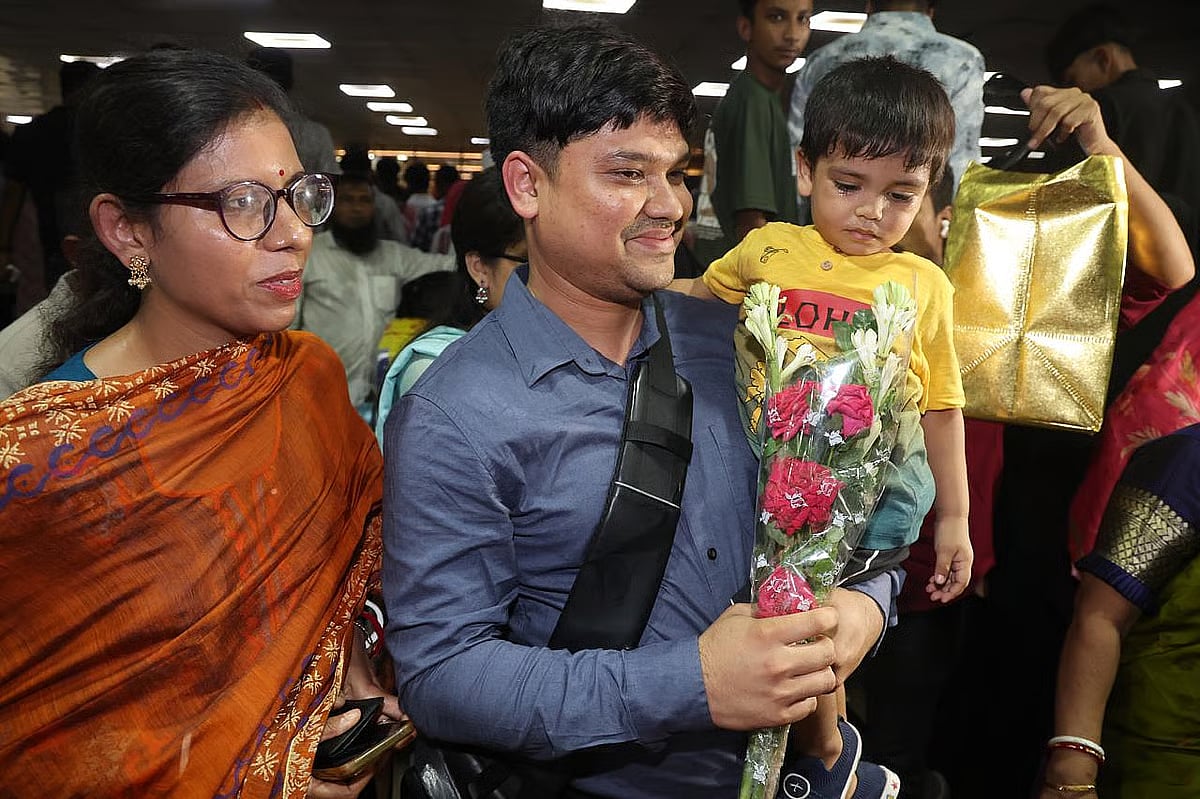
Crew of Banglar Joyjatra return home
‘Many seafarers were traumatised, some died, no one came to provide treatment’
During four months of being stranded in the Persian Gulf, many seafarers aboard different vessels became traumatised, some even lost their lives, yet no one came forward to provide them with medical treatment. At the time, many ships ran short of food and water, while some even sank while attempting to cross the strait.
The Bangladesh-flagged vessel Banglar Joyjatra was stranded in the Strait of Hormuz during the war between Iran and the United States and Israel. After 3 months and 25 days, the ship crossed the Strait of Hormuz on the night of 23 June. Returning home today, the vessel’s captain, Md Shafiqul Islam, recounted the ordeal they endured while trapped there.
Shafiqul Islam spoke to journalists at a press conference today, Tuesday evening at Hazrat Shahjalal International Airport in Dhaka. Earlier in the afternoon today, an aircraft carrying the crew arrived in Bangladesh after departing from Durban, South Africa.
Addressing the press conference, Captain Shafiqul Islam said, “Alhamdulillah, we have been given a second life... We are grateful to everyone in the country who prayed for us, supported us mentally and kept checking on us throughout.”
Shafiqul Islam said they had been able to return safely with the state-owned asset because of the timely decisions taken by the Bangladeshi authorities. He said that during the conflict, while missiles were flying over their ship and vessels nearby were sinking, the government repeatedly advised them to move to the safety of a hotel. However, they chose not to abandon the ship in order to protect the national asset.
Describing their experience at Jebel Ali Port, Captain Shafiqul said that one night a missile struck a berth next to theirs. The attack set a tanker carrying oil on fire, and the blaze could not be extinguished even with six tugboats. He said that if any one of the tanker’s 40 storage tanks had exploded, the fire could also have spread to their vessel.
The ship’s then commanding officer, Pronoy Krishna Sen, told the press conference that because the satellite navigation system had become inoperative, they had to navigate the vessel entirely manually. With mines present in the area, even the slightest deviation carried the risk of an explosion.
When the crew entered the airport terminal, officials of the Bangladesh Shipping Corporation (BSC) welcomed them with flowers. Their family members were waiting outside. After the press conference, emotional scenes unfolded outside the terminal as relatives embraced the returning seafarers.
Banglar Joyjatra entered the Persian Gulf via the Strait of Hormuz on 2 February after carrying cargo from India. It later loaded steel coils at a port in Qatar and arrived at Jebel Ali Port in the United Arab Emirates on 27 February.
The following day, the United States and Israel launched attacks on Iran. As the conflict escalated, the vessel became stranded in the Persian Gulf because of security risks. After 115 days, it finally crossed the Strait of Hormuz with permission from the Iranian authorities.