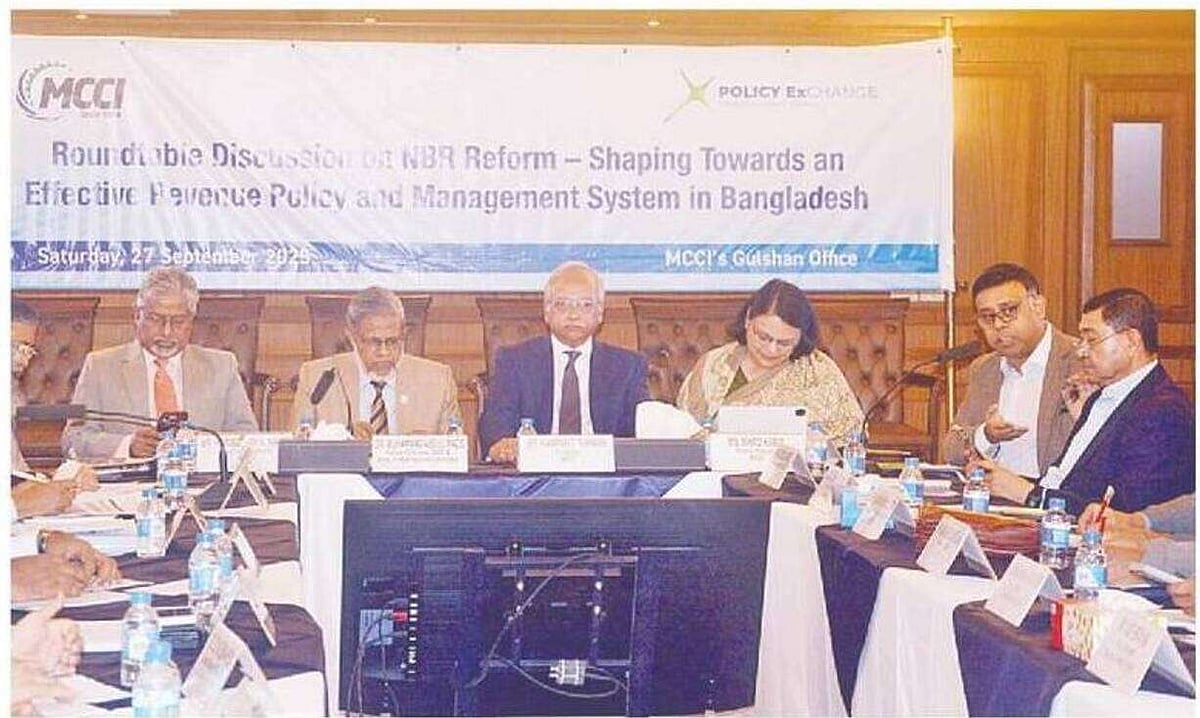
MCCI roundtable
Businesspersons want at least a 5-year revenue policy
Businessmen requested the government for a long-term revenue policy. They said that any changes related to duties and taxes should be kept in force for at least five years. This makes it easier to take up investment plans. In addition, the businessmen have advised consulting stakeholders when issuing or amending any revenue-related law or gazette.
These issues were raised yesterday, Saturday, by top business leaders from various sectors of the country at a roundtable discussion titled "NBR Reforms for Effective Tax Policy and Management'' held in Gulshan, Dhaka. At this meeting, stakeholders gave their opinions on the recommendations made by the advisory committee formed to reform the National Board of Revenue (NBR).
The Metropolitan Chamber of Commerce and Industry (MCCI or Metro Chamber) and the research organisation Policy Exchange jointly organised this roundtable discussion. The MCCI's former president, Nihad Kabir, moderated this event.
MCCI president Kamran T Rahman said in his introductory speech that less than 3 per cent of the people in the country pay income tax. There is large-scale tax evasion at the business level. However, the process of enforcing tax laws is very weak. It is often hampered by institutional weakness and political interference. The revenue collection system is overly complex, arbitrary, and discriminatory. For this reason, taxpayers who follow the rules have to face problems.
Enamul Haque Khan, the senior vice-president of the garment owners association BGMEA, believes that the main task is to free the National Board of Revenue and its affiliated organisations from corruption. He said, just dividing the National Board of Revenue into two departments, the Revenue Policy Department and the Revenue Management Department, will not solve the problems. Business establishments believe that the National Board of Revenue and its affiliated organisations must be freed from corruption.
Enamul Haque Khan also said, revenue policies related to income tax, customs, and VAT need to be at least five years in duration. In addition, the opinions of stakeholders must be taken when issuing and amending laws, SROs, rules, regulations, and gazettes.
MCCI's former president Nihad Kabir said the state of customs automation was made unnecessarily complicated.
Mohammad Hatem, the president of the knitwear manufacturers association BKMEA, said that the tax policy for the export-oriented industrial sector is completely illegal and against human rights. Unnecessary certificates of various types are required for capital machinery imports and many other cases. This not only causes a waste of time but also requires paying extra money.
Snehasish Barua, a partner at the audit firm Snehasish Mahmud & Co., advised that all local-level customs and tax-related work be coordinated and brought under one office. He said, a businessman has to go to the income tax office for an audit, and then he has to go to the VAT office again. Besides, there is the Central Intelligence Cell (CIC). This way, a single company has to seek help in several places. And this also leads to a waste of the government's money and resources.
Masrur Reaz, the chairman of Policy Exchange, opined that the government does not have enough funds for necessary investments. He said that for this shortage of funds, investment in the infrastructure, human resources, health, and law enforcement sectors is being hampered. He also said that businessmen face problems in getting services in the private sector. Besides, there is a lack of institutional capacity.
NBR has not been divided as recommended
NBR was not abolished, and the Revenue Policy Division and the Revenue Management Division were not separated as recommended by the advisory committee formed for the reform of the revenue sector, said Md. Farid Uddin, member of the advisory committee for NBR reform. He said, ''If these two divisions are not managed correctly now, the situation may get even worse in the future.''
At the event, former NBR chairman Mohammad Abdul Majid said that the recommendations of the business community and stakeholders must be taken into consideration. He expressed doubt as to whether it would be implemented if there was only a report and an ordinance, but no political commitment.