Economy bleeding, govt not listening to business community: BCI president
Bangladesh Chamber of Industries (BCI) President Anwar-ul-Alam Chowdhury Parvez has said that the country’s economy is hemorrhaging but the government is not paying any heed to the business community.
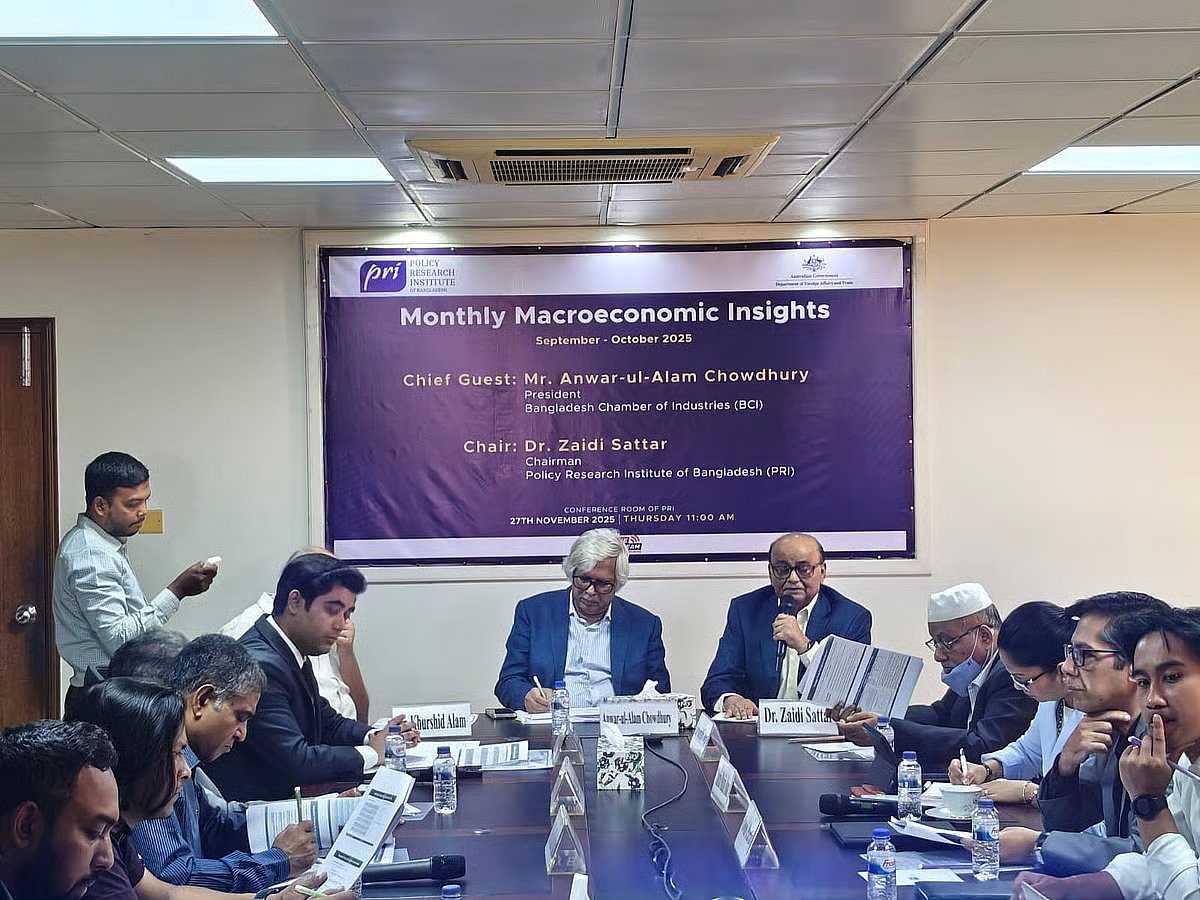
“We are clamoring, but the government is not listening. They are not caring about the business community”, he said today, Thursday while speaking as the chief guest at the 'Monthly Macroeconomic Insights, September-October 2025' event held at the Policy Research Institute (PRI) office in Banani.
The seminar focused on the economic situation of September–October and was chaired by PRI Chairman Zaidi Sattar.
PRI’s Chief Economist is Ashiqur Rahman.
Anwar-ul-Alam Chowdhury Parvez said the government has raised fuel prices but still cannot ensure supply. Since 2022, production has been disrupted due to the energy crisis. Nearly 50 per cent of small enterprises have shut down. Everyone has come to Dhaka to drive battery-run autorickshaws. The population of this city has now reached 35 million.
Speaking about defaulted loans, Anwar-ul-Alam said that when the volume of non-performing loans was 17 per cent, the IMF labeled Bangladesh as moderately risky. Now it has exceeded 35 per cent. He questioned what classification the IMF will give to Bangladesh’s defaulted loans now. He also noted that borrowing costs will continue to rise.
PRI Chairman Zaidi Sattar said that although the pace of the economy has slowed, stability has been achieved. To increase employment, more liberal policies must be adopted. He believes that while export earnings have declined somewhat due to reciprocal tariffs, Bangladesh is still in a better position than India and Pakistan in this regard.
In the keynote presentation, economist Ashiqur Rahman said that unless tough steps are taken, the high volume of defaulted loans will create medium-term risks for the country’s economy. This may undermine the prospects of both the current and future generations.
The biggest challenge, he said, is how these defaulted loans will be managed. He added that the country’s economy is going through one of the most difficult periods in modern history.