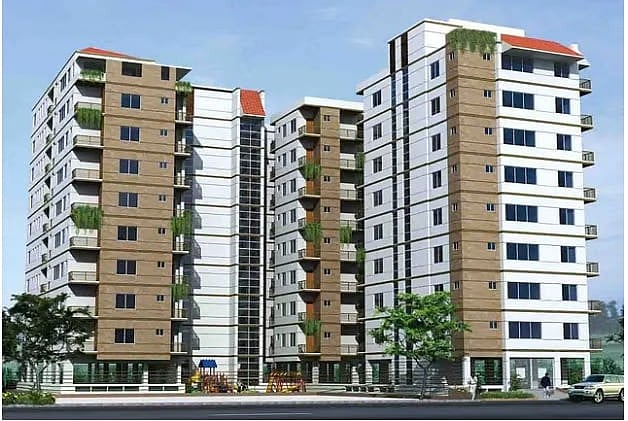
A private-sector employee, AKM Azhar, has booked a flat in Bosila, in the capital. He does not earn a particularly high salary and is the sole breadwinner in his family, which consists of his wife and two children.
Azhar took out a Tk 2 million (20 lakh) loan from a private bank for five years to purchase the flat. He has yet to move into his own home, but he has to pay Tk 45,250 in loan instalments every month.
As the loan has a short repayment period, the monthly instalment is also relatively high.
As a result, a large portion of his monthly income goes towards repaying the loan. On top of that, he has to pay rent for his current home and meet other household expenses.
Like Azhar, many people consider owning a flat one of their major goals in life. There are practical reasons for this.
However, the matter looks somewhat different from an investment perspective. Buying a flat to live in and buying one as an investment are two different matters.
From an investment perspective, therefore, you should consider whether buying a flat represents the best use of your money.
Suppose you live in a rented property in the capital and pay Tk 40,000 in monthly rent. You have no debt and have Tk 5 million (50 lakh) in long-term savings. You could now use this money to start buying a flat, with the remaining amount financed through a bank loan.
It would not be appropriate simply to conclude that buying a flat means you will no longer have to pay Tk 40,000 in monthly rent. Instead, you should consider how much you could earn if you invested the money spent on purchasing the flat elsewhere.
At the same time, you should factor in the interest on the loan, instalments, maintenance costs, taxes and other expenses. Economists refer to this concept as opportunity cost.
In other words, you also need to consider the profit you could have earned by investing the money elsewhere but would have to forgo because you spent it in one particular area.
Suppose you need Tk 10 million (1 crore) to buy a flat in Dhaka. Renting a similar flat, including garage rent, costs Tk 40,000 a month. The annual cost would therefore be Tk 0.48 million (4.8 lakh).
Looking at these figures, many people may conclude that buying a flat would be better than continuing to rent such a property for several years.
However, you also need to consider what could happen if you invested the Tk 1 crore elsewhere instead of buying the flat. If you earned an average return or profit of 8 per cent, the Tk 10 million (1 crore) could generate around Tk 0.8 million (8 lakh) a year, or an average of approximately Tk 66,667 a month. Of course, the return could be higher or lower than 8 per cent.
In other words, by buying the flat, you save Tk 0.48 million (4.8 lakh) a year in rent, but at the same time, you forgo the potential income you could have earned by investing the Tk 10 million (1 crore) elsewhere.
Therefore, to understand the actual financial benefit of buying a flat, you need to compare the savings on rent with the potential return from investing the money elsewhere.
Another important consideration is how much the price of the flat may increase in the future. If property prices rise over the long term, the value of the owner’s asset will also increase, but there is no guarantee of this.
The value depends largely on the location of the flat, the age of the building, the quality of construction, transport links, urban development and future demand.
On the other hand, living in a rented property keeps your capital available for use. You can change your investment strategy when necessary. However, you also need to take into account the fact that the value of money declines over time.
In contrast, a large amount of money remains tied up in a flat, making it difficult to convert the asset into cash quickly when an emergency arises.
Buying a flat with a loan makes the calculation even more complicated. Suppose you have Tk 5 million (50 lakh) in hand and plan to take another Tk 5 million loan to buy a flat worth Tk 10 million.
In that case, the Tk 5 million (50 lakh) will be invested in the flat at once. You will also have to pay monthly loan instalments. The interest on the loan will significantly increase the actual cost of the flat.
In this case, you need to compare the potential increase in the flat’s value with the total interest payable on the loan. An increase in the flat’s price alone does not necessarily mean that the investment will generate a profit.
Registration costs, taxes, fees and other expenses at the time of purchase, as well as maintenance costs during the period of ownership, should also form part of the total investment cost.
However, not everything can be measured in monetary terms. For many people, the security of living in their own home, the freedom to create an environment according to their preferences, freedom from complications with landlords and having a permanent long-term address are important considerations.
Some believe that owning a home for retirement is part of their financial security. Overall, it can also contribute to an increase in wealth.
What should you consider?
When deciding whether to buy a flat to live in, it is not appropriate simply to compare whether you should pay rent or loan instalments. From an investment perspective, you need to consider several factors: the potential return from investing in the flat, the potential return from alternative investments, the cost of borrowing, and what would happen if your capital became tied up or whether you would have the capacity to bear the consequences.
Most importantly, you need to consider whether you will still have sufficient emergency savings after buying the flat. Using your entire savings to buy a flat and then taking out a loan could increase the financial risk for your family.
Ultimately, a flat is not simply an investment; it is also an asset. Therefore, alongside the potential financial return, you should consider your income, ability to repay the loan, future plans and capacity to take on risk when making the decision.