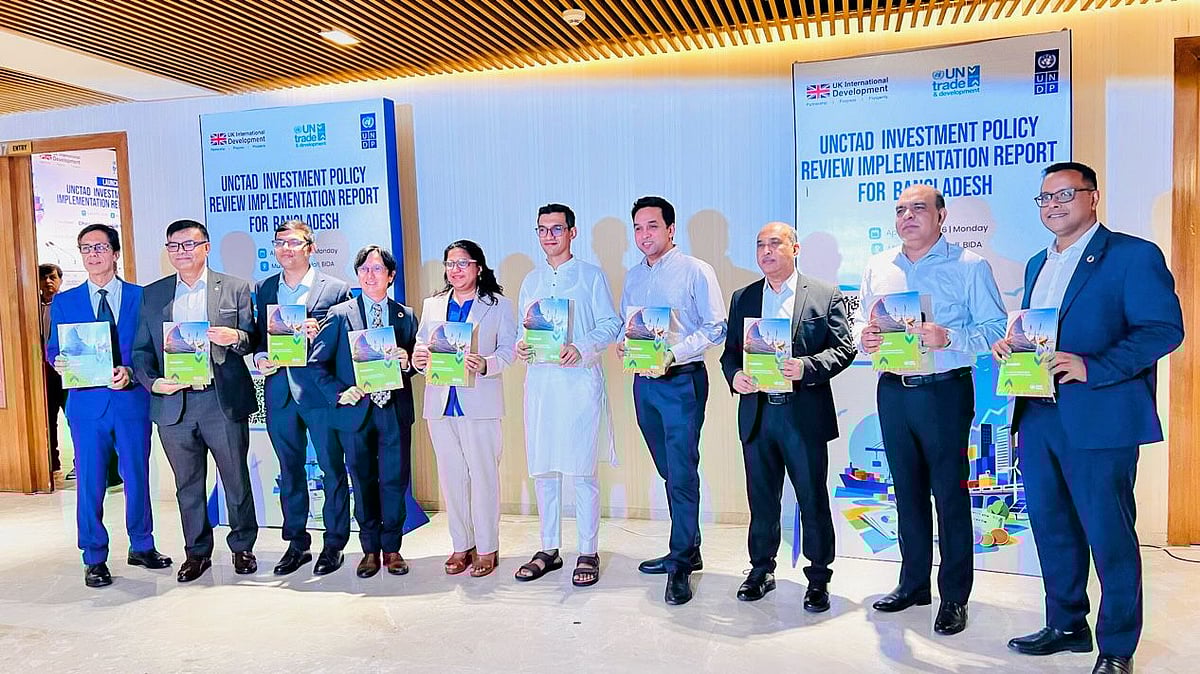
Foreign investment falls by 33pc in Bangladesh: UNCTAD report
Bangladesh lags several times behind regional competitor countries in attracting investment.
Investor confidence in Bangladesh has declined over the past 5 to 6 years.
Some positive momentum has been observed in FDI inflows during the first 6 months of 2025.
Foreign direct investment (FDI) inflows into Bangladesh have been declining for more than six years. In 2019, the year before the COVID-19 pandemic, the country received around US$1.8 billion in FDI. By 2024, this had fallen to approximately US$1.2 billion, marking a decline of nearly one-third, or around 33 per cent, in five years.
These figures were highlighted in a recent report by the United Nations Conference on Trade and Development (UNCTAD).
The report notes that Bangladesh is lagging significantly behind regional competitors in attracting foreign investment. However, it adds a cautiously positive note, stating that FDI inflows showed some improvement in the first half of 2025.
The findings were presented at an event held on Monday at the headquarters of the Bangladesh Investment Development Authority (BIDA) in Agargaon, Dhaka, where UNCTAD published its latest assessment reviewing the implementation of recommendations made in its 2013 Investment Policy Review of Bangladesh.
BIDA Executive Chairman Ashik Chowdhury attended the event as chief guest. The keynote presentation was delivered by Kiyoshi Adachi, an official from UNCTAD’s Investment and Enterprise Division.
Other speakers included Sonali Dayaratne, Deputy Resident Representative of UNDP Bangladesh; M Masrur Reaz, Chairman of Policy Exchange Bangladesh; Ferdous Ara Begum, CEO of Business Initiative Leading Development (BUILD); trade policy expert Md Hafizur Rahman; and BIDA Executive Member Nahian Rahman, among others.
Falling behind regional competitors
According to the UNCTAD report, Bangladesh significantly lags behind regional competitors such as Vietnam, Cambodia, and Indonesia in terms of FDI stock.
In 2024, Bangladesh’s FDI stock stood at US$18.29 billion. In contrast, Vietnam’s FDI stock reached USD 249.14 billion—more than 13 times higher. Indonesia and Cambodia also recorded FDI stocks approximately 17 times and 3 times higher, respectively.
Declining investor confidence
UNCTAD attributes the decline in investment inflows over the past five to six years to weakening investor confidence. Major contributing factors for this decline include depreciation of the local currency, delays in bill payments, import restrictions, rising energy costs, and broader socio-economic conditions.
The report notes that the Bangladeshi Taka has depreciated by around 36 per cent against the US dollar since 2021. Disruptions in energy imports have adversely affected industrial activity, increasing operational costs and uncertainty for investors.
It also highlights significant political and social changes during 2023–24, along with factory closures in the country’s largest export sector—the ready-made garments industry—and incidents of labour unrest.
Unimplemented reforms
UNCTAD states that many of the recommendations made in its 2013 report remain unimplemented. These include a lack of coordination in investment, industrial, and trade policy formulation and execution, as well as the failure to amend the 1980 Foreign Private Investment Act, leaving several investment restrictions in place.
The report also highlights continued procedural requirements for approvals from agencies such as BIDA, which have not been significantly streamlined. Transparency issues in public institutions persist, and Bangladesh still lacks a central land authority and comprehensive land database, making land acquisition for major infrastructure projects time-consuming and complex.
Other concerns include the absence of a strategic framework to address the shortage of skilled labour, and complex, time-consuming, and partially manual processes for work permits and residence permits for foreign nationals.
Despite some reforms, the tax system remains complicated, with multiple corporate tax rates and inadequate evaluation of tax exemptions, UNCTAD report added.
3 key recommendations
At the event, UNDP Bangladesh Deputy Resident Representative Sonali Dayaratne outlined three central priorities. First, she stressed the need for reform implementation to support the next phase of Bangladesh’s development and to restore investor confidence through improved coordination among government institutions.
Second, she emphasised that improving the investment climate requires not only laws, policies, and incentives, but also stronger institutional capacity for planning, coordination, implementation, and monitoring of reforms.
Third, she said investment policy must align with inclusive development objectives.
Comments from speakers
BIDA Executive Chairman Ashik Chowdhury said Bangladesh had made limited progress since 2013 in attracting FDI.
“The investment-to-GDP ratio has remained largely unchanged, or has slightly declined. That means, we are working to increase investment, but the results have not yet been reflected. At this stage, it is time to move into a second phase of reforms by accelerating our efforts,” he said.
BUILD CEO Ferdous Ara Begum noted that starting a business in Bangladesh requires 23 separate registrations, taking up to 477 days to complete. She stressed the need to reduce both procedural complexity and time requirements.
Policy Exchange Chairman M Masrur Reaz emphasised that policy stability is crucial for business.
He also argued that blanket incentives across sectors are not producing effective results and that incentive structures should be better targeted and evidence-based.