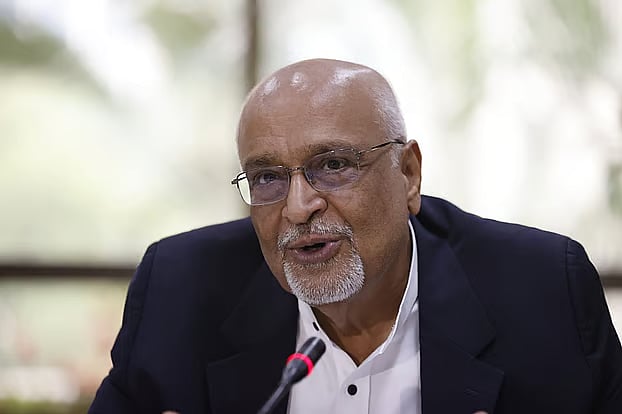
Economy experiencing a downturn: Debapriya Bhattacharya
Debapriya Bhattacharya, a distinguished fellow at the private research organization Center for Policy Dialogue (CPD), has commented that the country's economy is currently under a low-pressure phase.
Debapriya Bhattacharya stated, "There is indeed a low pressure in the country's economy, and that's a fact. Entrepreneurs are facing hardships, and that's also a fact. The ongoing low pressure in the economy, characterised by clouds and rain, is known to everyone. However, it doesn't seem that this situation is being adequately reflected in the government's actions or parliamentary activities."
He made these remarks at a press conference titled "Fair Wages in the Garment Sector 2026: Issues to Consider, " held today, Wednesday, at the CPD office in Dhanmondi, Dhaka.
The keynote was presented by the executive director of the organisation, Nazneen Ahmed. Also present were CPD distinguished fellow Mustafizur Rahman, and the head of the research department, Towfiqul Islam Khan.
Renowned economist Debapriya Bhattacharya stated that in the current situation, economic and labour-related issues have transformed into issues of law and order, and are gradually taking on a political shape.
According to the Public Finance and Budget Management Act of 2009, the government is supposed to provide a statement on the economic situation to Parliament every three months. It's been five months since the budget was passed. Our finance minister is an extremely experienced person. Until now, he has not given that statement, resulting in a lack of transparency.Debapriya Bhattacharya
This was not supposed to happen. One major reason for this is that the government is not being able to effectively communicate the steps it is taking to tackle the low pressure inside the economy with transparency and accountability.
During the event, as an example, Debapriya Bhattacharya said, "According to the Public Finance and Budget Management Act of 2009, the government is supposed to provide a statement on the economic situation to Parliament every three months. It's been five months since the budget was passed. Our finance minister is an extremely experienced person. Until now, he has not given that statement, resulting in a lack of transparency."
Those who speak of a lack of good governance and corruption are the same people who sponsor politicians. They are the ones who financially aided them to win elections. So why can’t they now demand a corruption-free and well-governed economy from them?
Debapriya Bhattacharya commented, "If the finance minister had given statements to Parliament regarding budget implementation and the overall economic scenario, including investment and trade, the economic low pressure might have been alleviated somewhat. I don’t think it would have disappeared completely, but it could have been dealt with more effectively. At the same time, the implementation of the reforms promised by the government, notably anti-corruption measures, would have been easier."
Debapriya Bhattacharya remarked that completing the government's announced reforms would have facilitated negotiations with foreign buyers.
He added, "Foreign buyers question why buyers from advanced countries like ours should subsidise your weak infrastructure and corrupt revenue management. Address these issues through development and reform."
He advocated for moving away from the excessive reliance on a single sector, like the ready-made garment industry, in the country's economy.
He emphasised, "We have three years to transition out of the list of least developed countries, where one crucial consideration is industrial diversity. We want to change the situation where our industrial structure is built solely on the garment industry, with 80 per cent of exports coming from just one sector. We have commitments to the global community in this regard."
The distinguished fellow of CPD said, "In the wage discussions, those who question whether small factories will survive, whether medium factories will face tougher situations, or whether large factories will grow larger must consider one thing. If there is a lack of good governance and corruption, should a worker bear the burden of that corruption with their wages? Is denying workers fair wages the solution? On what logic is this acceptable? On what grounds of fairness can this be justified?"
He added, "Those who speak of a lack of good governance and corruption are the same people who sponsor politicians. They are the ones who financially aided them to win elections. So why can’t they now demand a corruption-free and well-governed economy from them?"
Debapriya Bhattacharya further commented, "We can't have a society where we subsidise corruption through the toils of hardworking people. "