For several years, revenue collection has faced substantial deficits. Consequently, as with previous years, the National Board of Revenue (NBR) remains aggressive in its pursuit of customs and tax mobilisation for the upcoming budget. This urgency stems from the need to fund escalating budgetary expenditures.
On one hand, the implementation of the new pay scale for public sector employees takes effect on 1 July. On the other hand, the allocation for the Annual Development Programme (ADP) has been expanded by Tk 100,000 crore (1 trillion).
Against this backdrop, the NBR is being set a formidable revenue collection target of Tk 604,000 crore (6.04 trillion) for the forthcoming financial year—an increase of Tk 1 trillion. To achieve this ambitious target, the NBR plans to raise customs duties and taxes across various sectors. As a result, the tax burden on the general public is expected to intensify in certain areas.
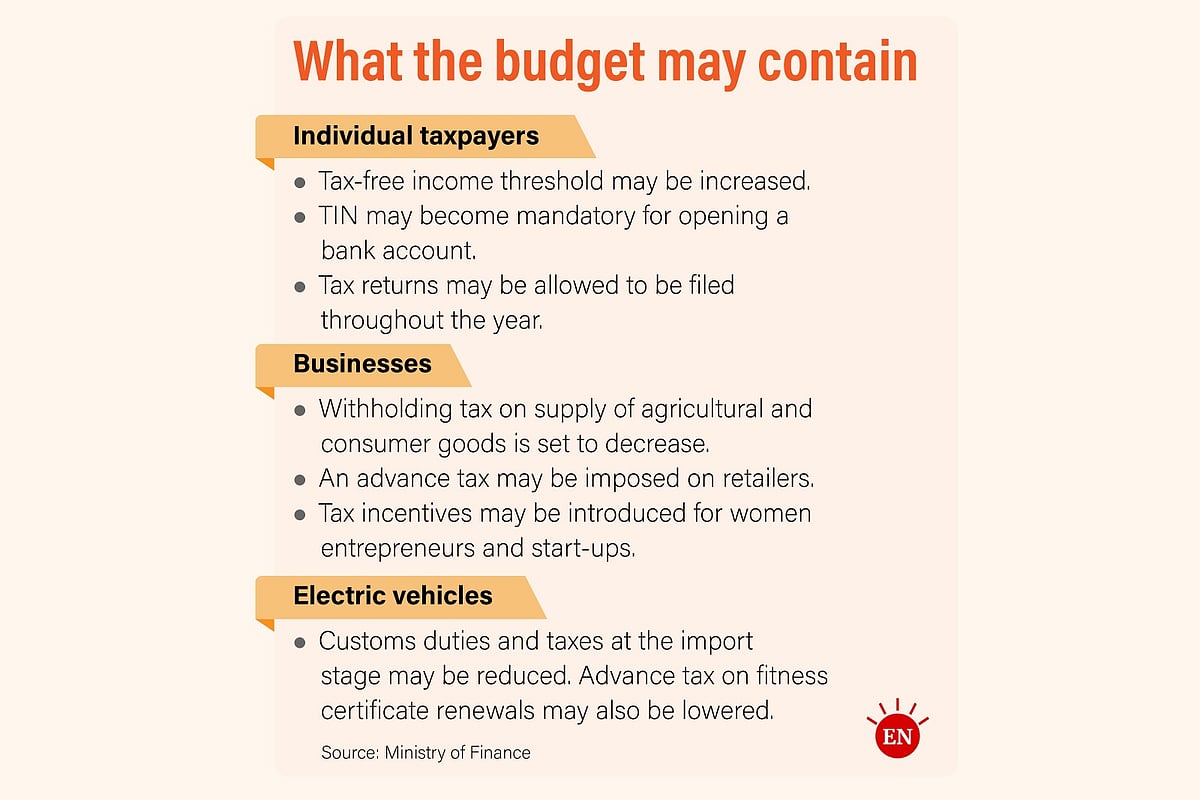
To offer relief to individual taxpayers, the tax-free income threshold is being raised. Conversely, holding a Taxpayer Identification Number (TIN) may be made mandatory for opening bank accounts.
To foster business expansion and attract investment, the upcoming budget may introduce various tax concessions for entrepreneurs. However, an advance tax may be levied on retailers. Duties and taxes on electric vehicles are set to decrease, whilst cigarette prices could rise if proposals to elevate the price tiers are approved.
Furthermore, sources within the Ministry of Finance indicate that the budget speech includes a specific section on ‘de-regulation’ aimed at making rules and regulations more business-friendly. Under these provisions, the tenure for commercial licences and renewals may be extended to five years.
Muhammad Abdul Mazid, former Chairman of the NBR, told Prothom Alo that to keep the economy vibrant, the fiscal proposals in the upcoming budget ought to be pro-business.
“During this period of high inflation, relief must be provided to ordinary taxpayers at the lower strata of society. To stimulate investment and commerce, tax concessions must be granted on one hand, whilst the tax compliance process needs to be simplified on the other,” he stated.
According to Muhammad Abdul Mazid, the NBR drafts the budgetary tax proposals independently. When these proposals are formulated, tax rates are adjusted with the sole focus of meeting vast revenue targets. Source taxes are consequently imposed on various minor sectors.
He emphasised that the NBR must pivot away from the discretionary powers currently exercised by its officials.
Tax-free income threshold to rise
For the upcoming 2026–27 financial year, the Finance Minister may announce an increase in the annual tax-free income threshold for individual taxpayers, raising it from 350,000 taka to 375,000 taka.
The announcement will also specify that the threshold will remain at 400,000 taka for the subsequent two years. A comprehensive roadmap for the tax-free income threshold up to the 2030–31 financial year may be outlined in the budget speech.
Alongside ordinary taxpayers, the tax-free threshold will also rise for female taxpayers, individuals aged 65 and above, third-gender taxpayers, physically challenged individuals, gazetted freedom fighters, and gazetted ‘July warriors’ wounded in the July 2024 mass uprising.
Furthermore, the tax-free income threshold will be extended for each child or dependant of parents or legal guardians of persons with disabilities.
The budget may also announce that tax returns can be filed year-round from the next financial year. Filing at the start of the year will yield tax rebates, whereas late submissions may incur a penalty of 5,000 taka or 10 per cent of the tax payable.
TIN mandatory for bank accounts
From the next financial year, possessing a Taxpayer Identification Number (TIN) may become compulsory for opening a bank account. However, exemptions may apply to certain categories, such as students, state welfare recipients, and pensioners.
Currently, a TIN secures a tax deduction waiver on interest earned from bank deposits. There are over 170 million bank accounts in the country. Additionally, the budget speech may declare TINs mandatory for registering motorcycles with an engine capacity exceeding 150cc.
Withholding tax on export incentives may fall
Currently, withholding tax is levied at varying rates on export incentive funds. According to multiple sources involved in drafting the budget, this withholding tax may be halved from 10 per cent to 5 per cent in the next financial year.
In addition, the withholding tax on interest paid on foreign loans secured by private sector entrepreneurs may be reduced from 20 per cent to 10 per cent. Previously, this tax was exempt; however, from the next financial year, withholding tax will apply when servicing foreign loan interest.
Content creators’ income to be tax-exempt
The upcoming budget may declare income generated by social media content creators as tax-exempt. Creating digital content has now become a mainstream profession for many. Furthermore, the Finance Minister, Amir Khasru Mahmud Chowdhury, may announce tax exemptions for freelancers.
Incomes earned from abroad by content creators and freelancers may be recognised as inward remittances, making them eligible for remittance incentives.
Tax exemptions will also be sustained for startups, innovation ventures, and technology-based enterprises.
Tax relief for electric vehicles
The budget is expected to propose an overall reduction in customs duties and taxes on the import of electric vehicles (EVs). Currently, the total tax incidence on EVs stands at 93 per cent.
Under the new proposal, the finance minister may suggest a 64 per cent tax rate for EVs valued up to US$25,000, and an 80 per cent rate for those priced between $25,000 and $50,000.
The government is also taking steps to reduce the advance tax deducted during EV registration and fitness certificate renewals. Additionally, the regulatory duty on the import of brand-new hybrid vehicles with an engine capacity of up to 1800cc may be withdrawn from the next fiscal year.
What’s there for businesses
Taxpayers are currently required to pay withholding tax at rates of 5 per cent, 2 per cent, or 1 per cent on the supply of agricultural and consumer goods. The new budget may propose reducing these rates to a uniform 0.5 per cent. These commodities include paddy, rice, wheat, potatoes, onions, garlic, ginger, salt, sugar, and edible oil.
An initiative has been taken to collect an advance income tax at a rate of 0.2 per cent at the distribution or retail supply stage. Consequently, retail traders will pay a tax of 2 taka per thousand, which will be reconciled with the taxpayer’s final tax liability at the end of the fiscal year.
To promote renewable energy, the government is introducing major tax incentives for the solar power generation and supply sector. Companies involved in setting up solar power plants and distributing energy may receive an income tax exemption on earnings accrued until 30 June 2035.
Furthermore, the tax-free turnover threshold for women entrepreneurs may be raised from 5 million taka to 7 million taka. Ministry of Finance sources indicate the budget will propose a 10-year tax exemption for domestic companies producing edible oil.
Sources also reveal that duty and tax exemptions on raw material imports for the domestic manufacturing of mobile phones, refrigerators, air conditioners, washing machines, ATMs, and CCTV cameras will be extended until 2030.
Similarly, import exemptions for raw materials in the semiconductor industry and eco-friendly battery manufacturing will remain in place until 2031 and 2030 respectively.
Price fluctuations: What may cost more or less
Due to downward adjustments in import duties, supplementary duties, advance taxes, VAT, and regulatory duties at both import and local levels, the prices of certain commodities may fall in the next financial year, whilst others may rise.
Expected price increases
Tobacco Products: The price tiers for cigarettes, bidis, and other tobacco products could rise by up to 15 per cent, driving up retail cigarette prices.
Cashew Nuts: To protect domestic growers, the import duty on imported cashew nuts may be raised from 5 per cent to 25 per cent.
Steel Rods: The finance minister may propose increasing the VAT on steel rods from 150 taka to 350 taka.
Pangasius Fillets: A 20 per cent supplementary duty may be imposed on imported pangasius fish fillets, which is likely to escalate prices in high-end hotels and restaurants.
Expected price decreases
POS Machines: To encourage cashless transactions, the import duty on Point of Sale (POS) machines is set to be halved from 10 per cent to 5 per cent.
Air Conditioners & Refrigerators: The VAT at the manufacturing stage may be slashed from 15 per cent to 7.5 per cent.
Mobile Phones: A proposal to lower the advance tax from 5 per cent to 1 per cent on 22 types of raw materials imported for handset manufacturing is expected to reduce the cost of locally made phones.
Cosmetics: The budget may reduce the assessable import value of lipstick from $40 to $30 per kilogramme. Similarly, the assessable value for imported lotions, face creams, and face washes may drop from $10 to $7 per kilogramme, benefiting consumers.
Mortuary Equipment: The import duty on mortuaries used for preserving deceased bodies may be drastically cut from 25 per cent to 1 per cent.
Revenue mobilisation suboptimal
The NBR’s duty and tax collection trajectory remains far from satisfactory. Chronic revenue deficits over recent years have forced the government to rely on borrowing to finance the budget. The country’s tax-to-GDP ratio continues to hover precariously between 6 per cent and 7 per cent.
Deficits persist in the current fiscal year as well. According to the latest NBR data, a deficit of 69,782 crore (697.82 billion) taka was recorded during the first 10 months (July–April) of the ongoing financial year. Total collection during this period amounted to 326,928 crore (nearly 3.27 trillion) taka, against a revised target of 396,710 crore (nearly 3.97 trillion) taka.
Industry stakeholders argue that streamlining business operations will stimulate investment, catalyse commercial expansion, and ultimately boost tax revenues.
Experts contend that automating tax compliance pathways would encourage taxpayers to fulfill their obligations willingly—a transition that underscores the urgent need for structural revenue sector reforms.