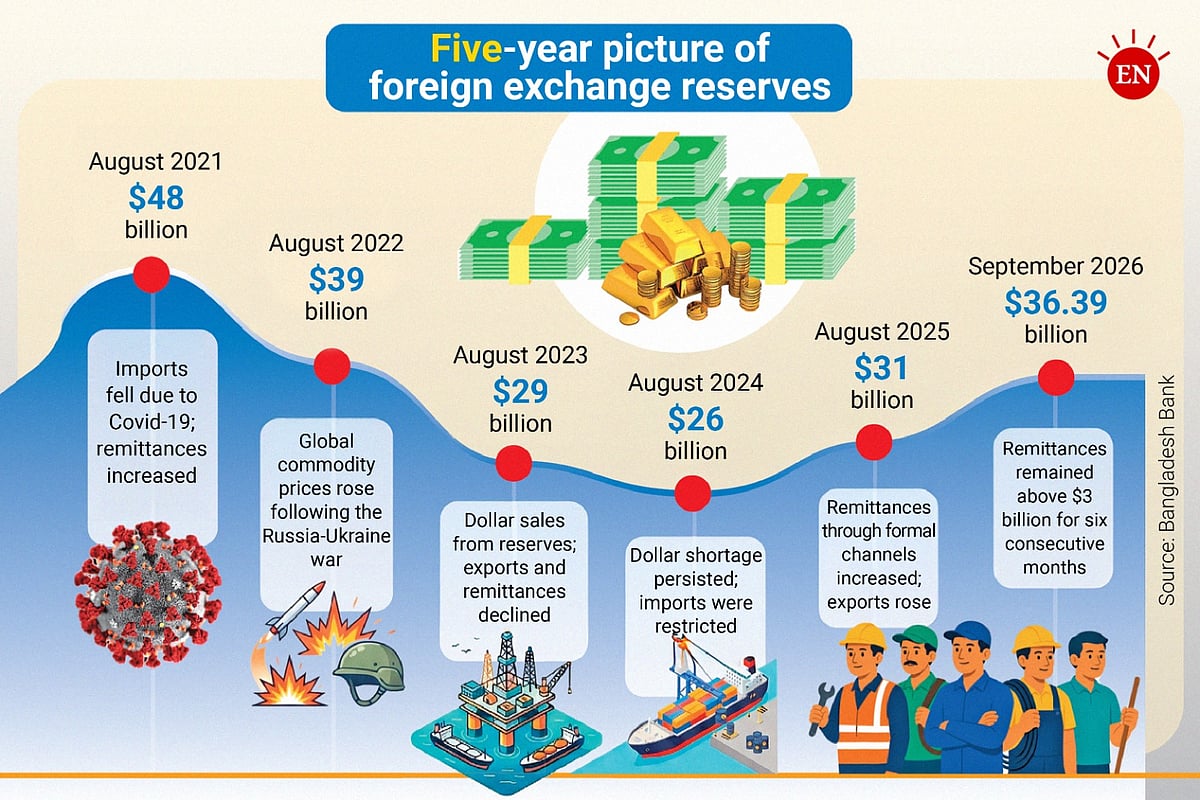
Bangladesh’s foreign exchange reserves have strengthened significantly over the past two years, with the country now holding enough reserves to cover four months of import payments.
Generally, a reserve cover of three months’ imports is considered adequate.
According to Bangladesh Bank data, reserves stood at USD 36.39 billion (USD 3,639 crore) yesterday, Sunday. Reserves have increased by nearly $3 billion over the past six months.
Bangladesh Bank said reserves had exceeded $37.5 billion last week. However, they fell after a payment of $1.39 billion was made to settle bills.
This is the figure for gross reserves. As a condition of the International Monetary Fund (IMF) loan, Bangladesh reports both gross reserves and its actual reserves, known as the BPM6 (Balance of Payments and International Investment Position) measure. Under this measure, reserves stand at more than $31 billion ($3,474 crore).
Without sufficient foreign currency, imports of food, fuel and other goods can be disrupted. The price of the dollar rises, pushing up inflation. A country can also default on foreign debt and become bankrupt. Sri Lanka faced such a situation.
Bangladesh’s position was also deteriorating under the Awami League government, which was ousted in the July mass uprising. Ahsan H Mansur, who was appointed governor of Bangladesh Bank under the interim government, succeeded in stemming the decline in reserves.
Reserves have continued to rise even after the elected government took office, with the BNP government assuming power on 17 February.
In recent months, the Middle East crisis has pushed up the prices of oil, gas and fertiliser. However, because the country now has sufficient dollars in reserve, it has been possible to absorb the higher cost of imports. There is also enough dollar liquidity to repay foreign debt.
There are some concerns, however. Investment in the country remains largely stagnant. Credit flows to the private sector are weak. With entrepreneurs showing little appetite for investment, demand for imports of industrial capital machinery and raw materials has also fallen. As a result, fewer dollars are being spent, but the economy is failing to pick up.
Asked about the matter, Centre for Policy Dialogue (CPD) Distinguished Fellow Mustafizur Rahman told Prothom Alo, “One of the main reasons reserves are in a good position is that we have been able to keep the exchange rate stable for the past one and a half to two years. Remittance earnings have increased. Because reserves are healthy, we have been able to spend an additional $3–4 billion to import fuel. Foreign debt is also being repaid.”
According to Mustafizur Rahman, pressure on reserves will increase when demand for imports rises. The pressure of repaying foreign debt is also increasing. By 2029, Bangladesh will have to repay around $7 billion in foreign debt.
How the crisis began
Foreign exchange reserves are the stock of foreign currencies and other foreign assets held by a country’s central bank. In Bangladesh, dollars make up the largest portion of these reserves. Reserves may also include euros, pounds, yen and other foreign currencies, as well as some gold.
Bangladesh Bank manages the country’s reserves. Foreign currency comes from various sources, including export earnings, remittances, foreign loans and grants. It is then spent on imports, repayment of foreign loans and other international transactions.
In August 2021, reserves reached a record $48 billion. Import demand had fallen because of the Covid-19 pandemic, while expatriate Bangladeshis sent more dollars home to help their families cope with the economic impact of Covid-19. As a result, reserves reached a record level.
At the time, the Awami League government also used reserve funds to finance Biman Bangladesh Airlines and dredging of the Rabnabad Channel at Payra Port. The Export Development Fund (EDF) was already in place.
Bangladesh also extended a $20 million loan to Sri Lanka. The IMF subsequently instructed Bangladesh to calculate its actual reserves excluding such amounts, under the BPM6 measure.
In 2022, the Russia-Ukraine war and rising global commodity prices left the then Awami League government struggling to meet import costs.
A dollar shortage emerged, and the exchange rate rose. Amid mismanagement, the dollar climbed from Tk 86 in 2023 to Tk 128. Bangladesh Bank also sold dollars from its own reserves to meet import costs, causing reserves to decline.
Before its fall from power in August 2024, the Awami League government left behind reserves of $25.92 billion. This had been achieved through strict controls on imports and by delaying debt payments.
After the Awami League government fell and the interim government took office, Bangladesh Bank prioritised addressing the dollar shortage and rebuilding reserves. The exchange rate was allowed to be determined by market forces. Remittances through formal channels subsequently increased, boosting the supply of dollars.
Export earnings also rose. As a result, reserves increased by $9 billion during the interim government’s 18-month tenure. At the same time, the government began repaying its debts, while restrictions on imports were eased to some extent.
After the BNP government took office, the steady flow of remittances and export earnings continued. From December through May, expatriate Bangladeshis sent more than $3 billion in remittances for six consecutive months. Export earnings also recorded growth, causing reserves to rise further.
The new Bangladesh Bank Governor, Mostaqur Rahman, did not maintain the same level of restrictions on imports. As a result, imports have become easier and increased in volume.
Bangladesh Bank spokesperson Arif Hossain Khan told Prothom Alo that the dollar market was stable because the exchange rate had been kept market-based and monitored closely. “No one is complaining about dollars now,” he said. The strong flow of remittances has also helped keep the supply of dollars normal.
Why the reserves provide relief
The biggest relief from the rise in reserves is that the country’s ability to pay its import bills has become somewhat stronger. Bangladesh regularly needs to spend large amounts of dollars to import industrial raw materials, fuel, food and other goods. As a result, stronger reserves reduce pressure over import payments.
Before the Iran war began, the price of crude oil was $70–75 a barrel. It has now risen to $95. Liquefied natural gas (LNG), which previously cost $14–15 per unit, is now being purchased at $27–28.
As a result, the government has to spend significantly more foreign currency to purchase the same amount of fuel.
At a Dhaka Chamber event on 22 August, Finance Minister Amir Khosru Mahmud Chowdhury said the ongoing Middle East crisis had added $4–5 billion to the government’s fuel bill.
Analysts say that without sufficient reserves, it would not have been possible to purchase fuel, import other goods or repay loans. Foreign banks would have imposed various conditions on transactions.
The fact that reserves are available provides relief. The dollar is currently trading at around Tk 123–124 in the banking system and around Tk 126 in the open market.
Where the concern lies
Behind the comfort provided by rising reserves lies another, weaker picture of the economy. Dollars are not accumulating simply because supply is high. Demand for imports, investment and production is also weak. In other words, the problem is no longer a shortage of dollars; rather, the economy has not generated enough momentum to use those dollars. That is why the news of rising reserves is reassuring, while weak demand for dollars is equally concerning.
Because private investment remains sluggish, imports of capital machinery, raw materials and intermediate goods are not growing at the desired rate. As a result, dollar use has declined. There is also uncertainty over whether new investment and import demand will increase amid the ongoing shortages of gas and electricity.
Bangladesh Bank data show that in the 2025–26 fiscal year, letters of credit settled for imports of capital machinery fell by 10.5 per cent compared with the previous year. Imports of intermediate goods declined by 6.5 per cent, while imports of industrial raw materials fell by 3.33 per cent.
Economists and trade analysts say that while a comfortable level of reserves is necessary, the country also needs to maintain adequate imports of essential goods.
CPD Distinguished Fellow Mustafizur Rahman recommends focusing on four areas to maintain reserves: keeping the exchange rate stable, managing the pressure of foreign debt repayments, maintaining the capacity to finance imports as investment picks up, and managing import pressures when global commodity prices rise.