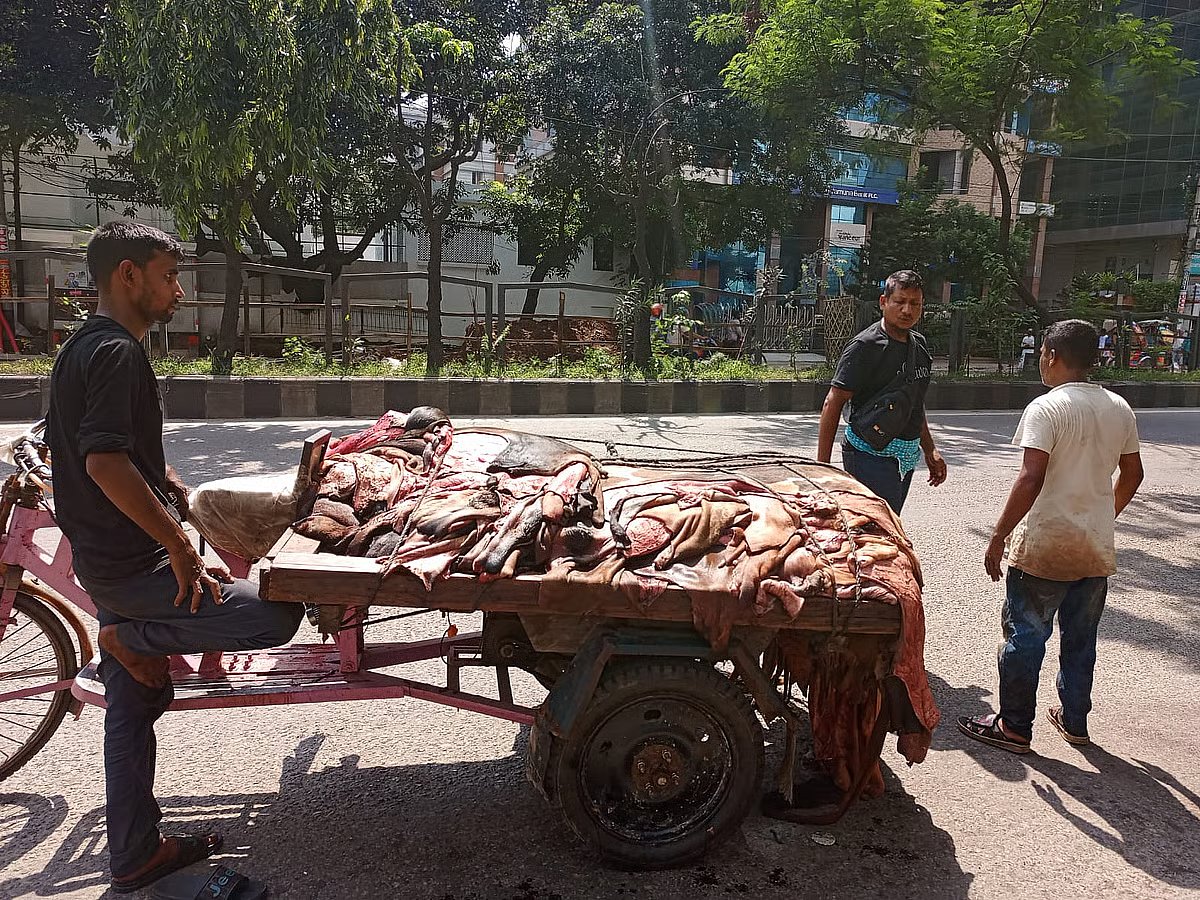
Prices of sacrificial animal hides in Dhaka lower than last year
The government raised the price of salted cowhide from sacrificial animals by Tk 2 per square foot this year compared to last year. However, hides are not being sold at those rates in the capital. Instead, sellers have alleged that prices per hide are Tk 150 to Tk 200 lower than last year. As in previous years, traders are also showing little interest in buying goat skins.
Seasonal hide traders claim that although the government increased prices, they were not assured by tannery owners that hides would be purchased at those rates. According to them, tannery owners are offering lower prices than last year, prompting traders to buy hides at reduced rates. Tannery owners, however, insist that prices have not fallen this year and are in fact Tk 50 to Tk 60 higher per hide than last year.
This was found today, Thursday, after visiting Mohammadpur Town Hall, Dhanmondi and Science Lab areas in the capital and speaking with buyers and sellers.
During Eid-ul-Azha, raw animal hides are collected and sold by people offering sacrifices, seasonal traders, and various mosques, madrasas and Lillah Boarding (charitable institutions). These hides are then bought by rawhide wholesalers and warehouse traders. Tannery owners also purchase raw hides directly.
The Ministry of Commerce sets the price of salted hides every year. On 13 May, Commerce Minister Khandaker Abdul Muqtadir fixed this year’s prices following a meeting with stakeholders in the sector.
The price of salted cowhide in Dhaka has been set at Tk 62 to Tk 67 per square foot this year, compared with Tk 60 to Tk 65 last year. Generally, large cowhides measure between 31 and 40 square feet, medium-sized hides between 21 and 30 square feet, and small hides between 16 and 20 square feet.
Accordingly, the price of a small salted hide could range from Tk 990 to Tk 1,200. Medium-sized salted cowhides are expected to sell for Tk 1,300 to Tk 1,850, while large salted cowhides could fetch between Tk 1,900 and Tk 2,600.
Although the government sets prices for salted hides, traders generally purchase raw hides during the first two to three days of Eid-ul-Azha. Processing each raw hide requires an average expenditure of Tk 350 for salt and labour costs. Based on this calculation, small raw hides in Dhaka should sell for Tk 650 to Tk 850, medium-sized raw hides for Tk 950 to Tk 1,500, and large hides for Tk 1,550 to Tk 2,300.
Situation on the ground
Visits to different areas today showed that small-sized raw hides were being bought and sold for between Tk 250 and Tk 400. Medium-sized hides were selling for Tk 500 to Tk 650, while large raw hides were selling for Tk 700 to Tk 800.
Most of the hides, however, were medium-sized. Last year, similar hides sold for between Tk 700 and Tk 800. Meanwhile, goat skins were being sold this year for only Tk 5 to Tk 10 each. Goat skin prices had remained at similar levels over the past two years as well.
Faruk Hossain has been involved in the seasonal hide trade during Eid-ul-Azha for the past eight years. At around 2:00 pm today, Thursday, he arrived in front of LabAid Hospital with 15 hides, both small and medium-sized, collected from the Kalabagan area.
There, he asked trader Rubel for Tk 1,000 per hide. However, Rubel offered Tk 650. Faruk then lowered his asking price to Tk 800, but as no agreement was reached, he left without selling the hides.
A little further ahead at the Science Lab intersection, workers from a tannery were collecting raw hides. Faruk asked Tk 800 per hide there as well, but the tannery workers offered Tk 600. As no deal was reached there either, he moved on elsewhere.
Speaking to Prothom Alo at the time, Faruk Hossain said, “Last year I sold these hides for Tk 800 to Tk 900 each. Prices are lower this year. I would have let them go for Tk 750, but nobody is offering more than Tk 650. Now I’ll look elsewhere to see if I can get a better price.”
Md Shahjahan, a supplier who purchases hides and delivers them to tanneries, was buying hides in the Kalabagan area of the capital this afternoon. Between 11:00 am and 2:00 pm today, he bought 55 hides from seasonal traders and madrasas. He paid an average of Tk 650 per hide.
Md Shahjahan told Prothom Alo, “Hide prices are slightly lower this year. Tannery owners have told us that the prices of various chemicals and production costs have increased compared to last year. As a result, they will not offer more than Tk 600 to Tk 700 per hide.”
“That is why we are also buying hides at Tk 100 to Tk 150 less than last year. Even then, our profit margin will only be around Tk 50 to Tk 60 per hide,” he added. However, he acknowledged that seasonal traders were receiving lower prices this year.
Bangladesh Tanners Association (BTA) Senior Vice-Chairman Md Sakhawat Ullah, however, claimed that hide prices had not fallen this year. He told Prothom Alo, “Raw hide prices have not decreased this year; rather, they are Tk 20 to Tk 50 higher than last year. I myself have bought hides at prices ranging from Tk 650 to Tk 950.”
Sakhawat Ullah said tanneries buy raw hides directly to help keep the raw hide market stable in the capital. He added that trading had not yet picked up properly by this afternoon, which may be why some sellers received lower prices. Prices could rise further by late afternoon or evening.
Volume of hides arriving also low
According to the Department of Livestock Services, the demand for sacrificial animals this year was around 10.106 million. Against that demand, nearly 12.334 million animals, including cows and goats, had been prepared for sacrifice.
However, tannery owners had already anticipated that the number of sacrifices might decline this year. For that reason, they set a target of collecting between 7.5 million and 8 million hides in total. Last year, the target was between 8 million and 8.5 million hides.
Several seasonal hide traders said the volume of raw hides arriving by midday appeared lower than last year.
At around 1:00 pm today at Town Hall Market in the capital, seasonal trader Umair Hossain said the number of sacrificial animals this year might have declined somewhat.
“Between 11:00 am and 1:00 pm, I managed to buy only 23 hides. Last year, by 1:00 pm, more than 150 hides had already been purchased. The real picture will become clear by the evening,” he said.