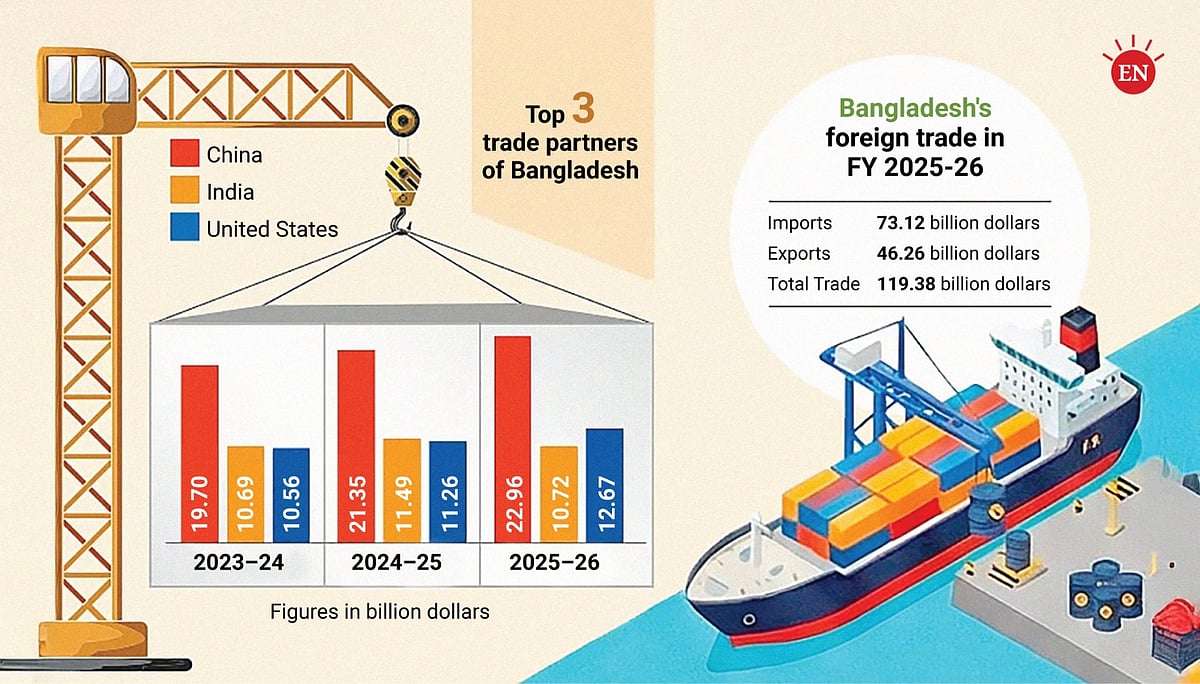
Driven by a sharp surge in imports over the past year, the United States has officially overtaken India to become Bangladesh’s second-largest trading partner—marking a significant shift in the country's bilateral trade dynamics.
On the other hand, both imports and exports with India have decreased.
Meanwhile, China remains in the top position by a large margin. After being in the second position for 16 years, India has now slipped to third place.
A big factor in this change is the increase in imports from the US.
Bangladesh's imports from the United States have grown by 43 per cent in one year. Exports have increased slightly—by about 4 per cent.
On the other hand, imports from India have decreased by approximately 7. 5 per cent, and exports to the country have decreased by about 3 per cent.
During discussions regarding counter tariffs by the United States, Bangladesh took initiatives to increase imports from that country. In the public sector, purchases of wheat and energy have increased, while in the private sector, soybean seeds and cotton purchases have grown. There is also a deal to purchase 14 aircraft from the US company Boeing.
Importers say that along with trade benefits, the quality of products and assurance of supply have encouraged them to buy more from the US. Conversely, businessmen believe that trade disruptions amid strained political relations between Bangladesh and India have harmed business between the two countries.
According to the National Board of Revenue's (NBR) data, in the last fiscal year, the trade (import-export) between Bangladesh and the United States was 12. 67 billion dollars. With India, it was 10. 72 billion dollars, meaning that the trade between Bangladesh and the United States was 1.95 billion dollars more than with India.
According to Mustafizur Rahman, a distinguished fellow at the Center for Policy Dialogue (CPD), the increase in imports from the United States is the reason for the overall increase in trade with the country. Especially in government procurement, this increase is more significant. However, the promised special concessions for garment exports have not yet been implemented.
Regarding trade with India, he explained that imports and exports have decreased due to non-tariff barriers between the two countries, negatively impacting consumers and producers. If zero-tariff benefits for Bangladeshi products in the Indian market were absent, exports could have decreased further.
How the United States advanced
The United States is Bangladesh's largest export market as a single country. Bangladesh exports much more than it imports from the US. In the 2024-25 fiscal year, Bangladesh had a trade surplus of 6.26 billion dollars with the US, meaning that exports were higher than imports.
Due to significant purchases from the US, the trade surplus decreased to 5.55 billion dollars in the 2025-26 fiscal year. During this time, Bangladesh exported 9.11 billion dollars worth of goods to the US and imported goods worth 3.56 billion dollars.
The trend of increased imports began with steps by the United States. As part of a policy to reduce trade deficits, President Donald Trump imposed counter tariffs on Bangladeshi goods in 2025. After negotiations, the rate was set at 20 per cent, effective from 7 August.
After several months of discussions, on 9 February, Bangladesh and the United States signed a mutual trade agreement. The agreement includes plans to purchase agricultural products worth approximately 3. 5 billion dollars from the US, energy products worth nearly 15 billion dollars over 15 years, and initiatives to increase the purchase of aircraft and military equipment.
The agreement reduced the counter tariff to 19 per cent. Additionally, the US pledged to eliminate the counter tariff on specific amounts of textiles and garments. However, 11 days after signing the deal with Bangladesh, on 20 February, the US Supreme Court declared most of the global counter tariffs imposed under the emergency power law by the Trump administration as illegal. Despite the court's ruling changing the legal basis of the counter tariff, there are no new initiatives to cancel or amend the 9 February Bangladesh-US trade agreement.
How much import has increased
Before the full implementation of the agreement, Bangladesh started executing the import commitments made as part of discussions to reduce counter tariffs. Wheat, liquified natural gas (LNG), and private-sector imports of soybean seeds and cotton have increased.
According to NBR's data, while there was no wheat import from the US in the 2024-25 fiscal year, 227. 7 million dollars worth of wheat arrived in the last fiscal year, the majority of which was for the government sector. Soybean seed imports increased from 350 million to about 620 million dollars, and cotton imports rose from 230 million to 380 million dollars. LNG imports in the government sector also rose to nearly 480 million dollars.
Overall, imports from the US grew by 43 per cent from 2. 49 billion dollars to 3. 56 billion dollars. Despite such an increase in imports, the growth rate of exports has slowed down. While Bangladesh's exports to the United States grew by 14 per cent in the 2024-25 fiscal year, the growth was only 4 per cent in the last fiscal year.
In the last fiscal year, Bangladesh's total import-export trade with the United States increased by about 13 per cent. A significant portion of this increase came from imports.
What importers are saying
To understand why imports are increasing, Prothom Alo spoke with two major industrial groups that import goods from the United States. In the private sector, the Meghna Group of Industries was the top importer from the United States last fiscal year. The chairman of this group, Mostafa Kamal, told Prothom Alo that trade facilities have increased in imports from the US. Considering product quality, prices were also competitive. For these reasons, the Meghna Group of Industries has increased imports from the United States.
Amirul Haque, Managing Director of the Saicom Group and President of the Chittagong Chamber, also spoke of increased trade facilities.
He stated to Prothom Alo that the quality of US products is relatively good, and there is greater assurance of supply. On the other hand, conflicts have increased risks and uncertainties in the use of ports for importing goods from Ukraine and several other countries. Therefore, considering all aspects, they are buying more goods from the United States. He believes that if trade facilities were not improved, private sector imports would not have grown this much.
The fall of India
While trade with the United States is increasing, the opposite is true for India. Amidst the interim government's tenure in March 2025, Bangladesh decided to suspend the import of yarn from India through land ports due to strained relations between the two countries. Then, in April 2025, India withdrew the facility of allowing Bangladesh to export goods to various countries through Kolkata Airport.
Additionally, India imposed restrictions on the imports of Bangladeshi goods in three stages. On 17 May and 27 June of the previous year, India imposed various conditions on the export of garments, food products, jute products, cotton waste, plastic products, and wooden furniture. Later, on 11 August, further restrictions were imposed on some jute products. Moreover, India initiated an investigation into imposing remedial duties on imports of Bangladeshi jute products.
These reciprocal measures have resulted in trade being hampered between the two countries. Exports of Bangladeshi garments to India have decreased, as has the import of cotton and yarn from India.
In the 2024-25 fiscal year, garments worth about 650 million dollars were exported to India. In the last fiscal year, garment exports decreased by nearly 12 per cent to 570 million dollars. A ban was imposed on the export of Bangladeshi-made garments through land ports. In the last fiscal year, the total exports to India amounted to 1.19 billion dollars. Overall exports decreased due to the decline in garment exports.
The import of raw materials for the textile and garment industry from India also decreased. In the 2024-25 fiscal year, 520 million dollars worth of cotton was imported from India. In the last fiscal year, it decreased by about 23 per cent to 400 million dollars. During the same period, the import of all types of cotton yarn decreased from 1.75 billion dollars to 1. 47 billion dollars. Thus, the import of these two raw materials alone decreased by 400 million dollars.
Advantages and disadvantages
Products like wheat, soybeans, and cotton were purchased from different countries based on international prices and supply facilities. The commitment to buy a certain amount from the United States came in exchange for reducing tariffs on garment exports, say exporters. However, they report that these concessions have not yet been implemented. In the last fiscal year, Bangladeshi garment exports to the country grew by 2. 72 per cent.
According to Mahmud Hasan Khan, President of the Bangladesh Garment Manufacturers and Exporters Association (BGMEA), Bangladesh's increased imports are reducing the US trade deficit.
He believes that this will reduce the likelihood of additional tariffs being imposed on Bangladesh in the future.
Mahmud Hasan Khan also mentioned that they are working to secure the promised concessions on garment exports made from US cotton. Discussions regarding the structure of this benefit are expected to take place in September. He hopes that implementing these benefits will increase Bangladesh's garment exports to the United States.
Discussing the impact of reduced trade with India, Mahmud Hasan Khan said both sides are suffering losses due to reciprocal measures. The shorter distance for trade with neighbouring countries reduces transportation costs and time. Therefore, both countries would benefit from increased trade with India.
The progress of China
Despite the changes in the second and third positions, China remains Bangladesh’s largest trade partner. In the last fiscal year, trade with China amounted to 22. 96 billion dollars, more than double Bangladesh's trade with the United States.
Bangladesh's trade with China is mostly import-dependent. In the last fiscal year, 22.14 billion dollars worth of goods were imported from China, an increase of about 7 per cent from the previous year. In contrast, 820 million dollars worth of goods were exported to China, an increase of about 11 per cent compared to the previous year.
Bangladesh imports raw materials, machinery, and various production inputs from China. Due to high imports and relatively low exports, there is a large trade deficit with China.
39 per cent of trade with 3 countries
According to NBR’s data, Bangladesh's total imports were 73.12 billion dollars, and exports were 46.26 billion dollars last fiscal year. The combined total trade amounted to 119.38 billion dollars.
Of this, 19 per cent, 11 per cent, and 9 per cent respectively involved China, the United States, and India. This means nearly 39 per cent of Bangladesh's total trade is with these three countries.
Economist Mustafizur Rahman believes that the advantages of increasing imports from these three countries should also be considered. A large portion of imports from China and India consists of raw materials for export-oriented industries. Finished goods made from these raw materials are exported to various countries around the world.