How is hilsa being exported to India at prices lower than the domestic market?
The price of hilsa locally is higher than its export price. As a result, many in Barishal are questioning how exporters — who have received official export permission — are purchasing hilsa at high prices and selling it to India at lower rates.
Some traders suspect that illegal money transfer (hundi) operations are behind these low export prices.
This year, the commerce ministry has set the minimum export price of hilsa at $12.50 per kg, or Tk 1,525 (based on an exchange rate of Tk 122 per USD).
The designated size for export is hilsa weighing 900 grams, known as 'LC size' hilsa.
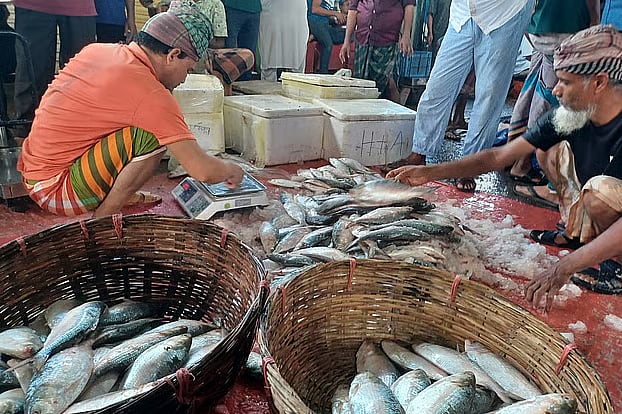
Last Thursday, at the wholesale fish landing centre on Barishal’s Port Road, one maund (42 kg) of LC-size hilsa was sold for Tk 76,000. That means the wholesale price per kilogram was Tk 1,788. However, the same hilsa is being exported to India at Tk 1,525 per kg, which is Tk 260 less per kg.
For this year’s Durga Puja, the commerce ministry has made a policy decision to allow the export of 1,200 tonnes of hilsa to India. The order was issued 8 September. Last year, for Durga Puja, the ministry initially approved the export of 3,000 tonnes, which was later reduced to 2,420 tonnes. Compared to that, this year’s export volume has been halved.
Several traders from Barishal’s Port Road and Barguna’s Patharghata wholesale markets told Prothom Alo that, on paper, hilsa is indeed being exported at the official price set by the ministry.
Indian importers are transferring the payment through official banking channels. However, the fish is actually being sold to Indian buyers at local market rates there. The excess amount — the difference between the official and actual selling prices — is reportedly being returned to Bangladeshi exporters either in cash or through hundi (informal money transfer networks). As a result, although the paperwork shows a loss, in reality, exporters are making extra profits through illegal channels.
A maund (42 kg) of LC-size hilsa was sold for Tk 76,000. That means the wholesale price per kilogram was Tk 1,788. However, the same hilsa is being exported to India at Tk 1,525 per kg, which is Tk 260 less per kg.
For the current quota of 1,200 metric tonnes of approved hilsa exports, if just the additional price (Tk 263 per kg) is taken into account, an estimated Tk 315.6 million (approx. Tk 31.56 crore) could be transacted via hundi. Several traders added that if the actual market rate in India is even higher, the volume of illegal transactions could increase further.
Zahir Sikder, a trader at the Barishal hilsa wholesale market, told Prothom Alo: "In the peak season, our market usually receives 2,000 to 3,000 tonnes of hilsa. This time, it’s not even reaching 100 tonnes per day. If exporters now start collecting hilsa from this limited supply, there will be none left for the domestic market, and prices will become completely unaffordable.
Right now, LC-size hilsa (900g) is being sold in the local wholesale market at Tk 1,788 per kg, but it’s being exported to India at Tk 1,525. That’s unbelievable. I don’t understand how hilsa can be exported at such a low price. There must be something shady going on. We’ve heard about hundi operations, but I can’t say for sure whether it’s true or not."
Golam Mostafa Chowdhury, president of the Barguna District Trawler Owners’ Association, said: "I just can’t make sense of it. How can anyone buy hilsa at high prices in the local market and then export it at lower prices? The whole thing seems mysterious."
Ranjit Dutta, general secretary of the Barishal district committee of Consumers Association of Bangladesh (CAB), told Prothom Alo: "During peak season, both buyers and sellers are frustrated by the sky-high prices of hilsa. We can't even afford to eat it ourselves. If export continues under these conditions, traders will raise prices even further. The government should have prioritised ensuring availability for ordinary people."
Same syndicate controls exports
Among the 37 companies that received export permission this year, four are from Barisal: Mahima Enterprise, Nahian Enterprise, AR Enterprise, and Tanisa Enterprise. All four are owned by Nirab Hossain alias Tutul.
He is the banned Awami League Barisal City branch’s Secretary for Industry and Commerce and is known to be a close associate of former Mayor Sadiq Abdullah.
According to sources close to Nirab Hossain, he moved to Kolkata after the fall of the Awami League government last year. Although he resides in Kolkata, he continues to control both export business in Bangladesh and import business in Kolkata through his close associates.
For the past five years, the hilsa export syndicate has been under his control, and this year, his four companies have again received export permission.
Several traders on Port Road said that a man named Md Babar, claiming to be Nirab Hossain’s uncle, manages his business operations. When asked, Md Babar told Prothom Alo on Thursday evening that each of their companies will export 30 tonnes of hilsa to India. However, they managed to export only a tonnes in two small trucks three days ago due to a shortage of fish.
Bangladesh accounts for only 0.29 per cent of total production. Moreover, the actual quantity exported to India is often less than the approved limit.
Regarding buying fish at higher prices and exporting at lower rates, he said, “There will always be profits and losses in business. There is nothing to be done about it.” When asked whether Kolkata importers pay extra beyond the fixed export price, he said, “I do know nothing about that.”
Hilsa exports in past six years
For the first time, hilsa was conditionally included in the list of exportable products under the 2015 National Export Policy. However, hilsa were first exported in 2019, with the first three shipments being sent to India. Since then, every year, export permission is granted ahead of the Durga Puja festival.
There is strong demand for Bangladeshi hilsa in West Bengal, India. Analysis of the last five years shows that the total hilsa exported from Bangladesh accounts for only 0.29 per cent of total production. Moreover, the actual quantity exported to India is often less than the approved limit. For example, last year the Ministry of Commerce approved 3,950 tons for 79 companies, but only around 802 tons were exported through the Benapole and Akhaura land ports.
According to the National Board of Revenue (NBR), 476 tonnes of hilsa were exported in the 2019-20 fiscal year, earning $395,000. In the 2023-24 fiscal year, 802 tonnes of hilsa exports generated $800,000 for Bangladesh, with an export price of $10 per kg (Tk 1,098).
Data from the Department of Fisheries show that hilsa catches fell by 42,000 tonnes in 2023-24. In 2022-23, the catch was 571,000 tonnes, decreasing to 529,000 tonnes last fiscal year. For the second consecutive year, there are concerns that production may decline further.
This correspondent spoke Naimul Islam, a private service holder, in Barisal’s Bangla Bazar area on 18 September.
He said, “My whole family has been craving hilsa for a long time. I went to the market several times, but the price made my head spin, and I had to return empty-handed.”
“I thought maybe the price would drop toward the end of the season, but now the government has decided to export it to India. There is no hope of eating hilsa at home anymore,” he added.