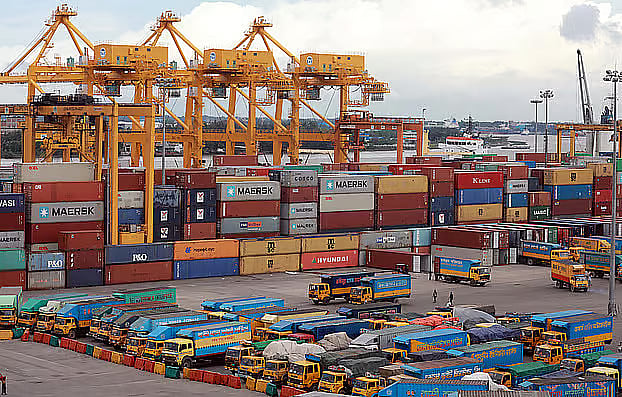
The Chittagong Container Terminal (CCT) of Chittagong Port has now drawn direct competition from two powerful Middle Eastern countries—the United Arab Emirates and Saudi Arabia—for its long-term operation rights. Dubai-based DP World and Saudi Arabia’s Red Sea Gateway Terminals (RSGT) have both submitted proposals to operate the same terminal. The domestic multinational company MGH Group has also joined the competition.
DP World, owned by the Dubai government, first proposed operating the CCT during the Bangladesh–Dubai platform meeting held on 8 April in Dubai. Two weeks later, on 22 April, Saudi Arabia’s public–private joint venture RSGT officially submitted its proposal for the same terminal.
Until now, the two countries had shown interest in separate terminals in Chittagong Port, but this is the first time they have openly competed for the same terminal. In 2024, RSGT was given the responsibility to operate the Patenga Container Terminal for 22 years, while the process of leasing the New Mooring Container Terminal (NCT) to DP World is still ongoing.
The Saudi–UAE rivalry in Middle Eastern geopolitics has now become more open. The two countries are competing in almost every strategic sector. On 1 May, the UAE reportedly exited OPEC, the Saudi-led oil exporters’ alliance. Whether the competition for port terminals in Bangladesh is part of this geopolitical rivalry remains unclear.
Port stakeholders say this competition is not only about business but also about expanding geopolitical influence in the Middle East. In recent years, Saudi Arabia and the UAE have increasingly taken opposing positions in many strategic sectors.
Preference for operating existing terminals
Chittagong Port currently has four active container terminals. Among them, the Patenga Terminal is operated by RSGT. The other three—General Cargo Berth (GCB), CCT, and NCT—are currently operated by local operators.
Port officials said that building new terminals requires billions of dollars in investment and carries long construction risks. In contrast, operating existing terminals ensures immediate cash flow. As a result, both local and foreign operators are now mainly interested in existing terminals.
Saudi–UAE strategy around CCT
According to DP World’s proposal, it wants to merge NCT and CCT into a single large terminal for operation, as the two are located adjacent to each other, making the plan feasible. On the other hand, Saudi RSGT wants to merge CCT and GCB for long-term operation. It has proposed an initial investment of $600 million (around Tk 73.80 billion). The company claims this will enable handling 1.8 million TEUs and 5 million tonnes of cargo annually.
CCT’s geographic position is a key factor in this competition. Located between NCT and GCB, whoever gains control of it would effectively dominate most of the port’s container operations.
According to port sources, last year 44 per cent of containers were handled at NCT, 36 per cent at GCB, 16 per cent at CCT, and around 4 per cent at Patenga Terminal. This means that if NCT and CCT are merged, DP World would control about 60 per cent of container handling. If CCT and GCB are merged, RSGT would control around 55 per cent. Thus, the competition is essentially for control of the port’s main business.
Local MGH Group’s counter proposal
Alongside the foreign firms, local multinational MGH Group is also actively competing. It first submitted a proposal to operate CCT in March last year and later submitted a fresh proposal on 28 April to operate NCT.
While DP World had proposed revenue per container between $155 and $161.8, offering the port $93.50 and $97.50 respectively, MGH Group proposed $98.50 at the same level. The group claims that under this model, the port could earn around $1.68 billion (Tk 206.64 billion) over 15 years.
MGH Group Managing Director Anis Ahmed told Prothom Alo, “We have proposed higher revenue sharing than any other company for operating NCT.” He also said that being a local company would ensure that money stays within the country.
What is the government’s decision?
A committee is currently being formed to evaluate DP World’s proposal for NCT operations. However, no final decision has yet been made regarding the operating model for CCT and GCB.
Chittagong Port Authority Secretary Syed Refayet Hamim told Prothom Alo, “Many investment and operation proposals have been received for Chittagong Port terminals. We will review them through the Ministry of Shipping and make decisions according to government directives.”
Bangladesh’s maritime trade hub, Chittagong Port, is no longer just a cargo handling point; it has also become a stage for strategic competition between two Middle Eastern powers and domestic business groups. The government’s final choice will shape the port’s future economic direction. However, concerns remain that increased interest in existing terminals may slow investment in new projects.
Former port board member Md Zafar Alam said that interest in existing terminals is high because they involve less construction risk. But for long-term modernisation, investment in new projects like the Bay Terminal is necessary. If attention remains focused only on old terminals, investment in new infrastructure may decline.