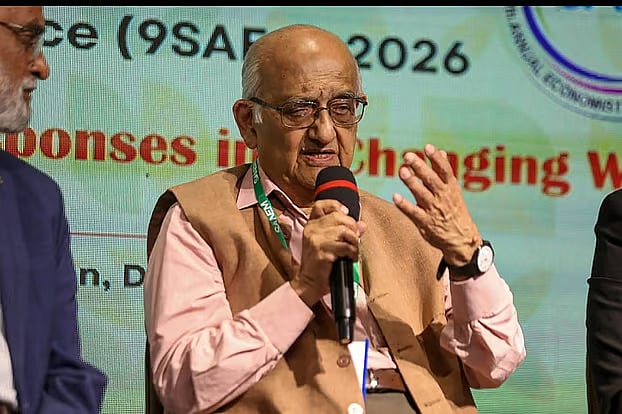
SANEM economist conference
Loan defaulters have become part of political system: Rehman Sobhan
Renowned economist Rehman Sobhan has said that loan defaulters have become part of the political system and are themselves creating obstacles to reform.
The problem is not individualistic but structural, he said adding reform is not just about enacting laws; rather it is a continuous process.
He said that initially laws are made, then the necessary administrative framework is developed for implementation. Next comes effective implementation of the laws and finally, evaluation of the outcomes.
On the last day of the three-day-long 9th annual economist conference of the South Asian Network on Economic Modeling (SANEM), Rehman Sobhan made these remarks while speaking as a special guest at the session titled ‘Illusion about Reforms: The Story of Bangladesh.’
The theme of this year’s conference is ‘Development Challenges and Policy Responses in a Changed World.’
The session, moderated by SANEM's Executive Director Selim Raihan, featured the keynote presentation by Debapriya Bhattacharya, Distinguished Fellow of the private research organisation Centre for Policy Dialogue (CPD).
Former Finance Secretary and Comptroller and Auditor General (CAG) of Bangladesh, Mohammad Muslim Chowdhury, was a designated discussant.
Renowned economist Rehman Sobhan commented that while political parties make big promises during elections, it’s not clear how much actual leadership or commitment they have towards implementing reforms.
He said, historically, major reforms succeed when they receive strong support from the public. For example, the 6-Point Movement reached the people as a framework for political and economic reform and received widespread support.
Currently, public campaigns like the 6-Points are very weak, said Rehman Sobhan, adding that political parties are failing to effectively communicate their manifestos to the public. Even many party members are not well informed about their own manifestos.
Rehman Sobhan raised questions about how many of the discussants have actually worked in the government or been directly involved in the reform implementation process.
Without such experience, understanding the real picture of reforms is challenging. Knowing who supports or opposes reforms, and why implementation often fails, is sometimes hard to comprehend without working in the government.
Many people view reforms as a theoretical or academic discussion matter, remarked Rehman Sobhan.
He said, "When I worked at the Planning Commission, my experience was different. I witnessed that getting laws enacted was not the biggest issue; rather, the real challenge was effective implementation."
Using police reform as an example, Rehman Sobhan stated that the true evaluation of reform is only possible when it starts delivering results. If it is said that the police will be made accountable and they must accept complaints mandatorily, then what should happen is verifying what happens a few years later. Journalists should visit police stations to file complaints and see how easily they are received – that would be the real test of the reform.
Rehman Sobhan commented that reform proposals from the World Bank or International Monetary Fund (IMF) are nothing new; they have been discussed for years and have been attempted to be implemented under various governments.
His question is, "What happens in reality? Governments initially show some progress because they want to receive financial aid installments. Similarly, development partner organisations have interests – they want to disburse their funding."
Rehman Sobhan reminisced about the significant initiatives taken in the 1990s concerning judicial reform.
He said, "At the same time, various development partners worked on budget reforms as well. But if we look at the current state of the judiciary, it becomes evident that the long-term impact of those efforts is quite limited. Similarly, key reforms in the budget system, such as the integration of the revenue and development budgets, have been discussed for decades but have not been implemented."
Rehman Sobhan mentioned that he has proposed introducing a performance-based budget system multiple times.
He argued that this would allow the government to inform the public about the outcomes of expenditures in different sectors. However, currently, only expenditure accounts are being presented without any analysis of the results.
Rehman Sobhan also gave examples from the health and education sectors.
He said every year, it is observed that allocated funds in these sectors are not spent fully. Yet, at the same time, there are complaints about low allocations in these sectors.
His question is, if the allocation is not utilised correctly, where is the problem then? There is very little deep analysis of why effective expenditure is not occurring in these sectors, even though people are receiving low-quality health services and there is dissatisfaction with the quality of education.
He mentioned that although exam results might be good, students' skills are often questionable in real-life scenarios. That's where the core issue lies – how the state machinery is functioning is the key question.
Referring to India's experience, Rehman Sobhan said, "There, major reforms such as the right to food, the right to education, or the right to work came through powerful citizen movements. But in Bangladesh, civil society is largely isolated and divided. We are unable to create united pressure in favour of major reforms."
Rehman Sobhan also believes that the role of the opposition is highly important for reforms.
He said that the opposition should not only engage in political opposition but should also focus on the implementation of reforms and ensure government accountability. On the other hand, if the government genuinely wants reform, it has to develop a strong internal accountability system. Merely announcing policies is not enough; there needs to be the capacity and willingness for implementation.
He described the democratic process as the ultimate test of reform and emphasised the need for free, fair, and inclusive electoral systems.
He remarked that a government becomes truly accountable only when it is prepared to accept the people's verdict based on its performance.
However, such examples are very rare in Bangladesh's political history.
He cited the power transfer by Sheikh Hasina through an election in 2001 as an important example. He concluded by stating that until such an accountable political culture is robustly established, the path to implementing reforms will remain challenging.