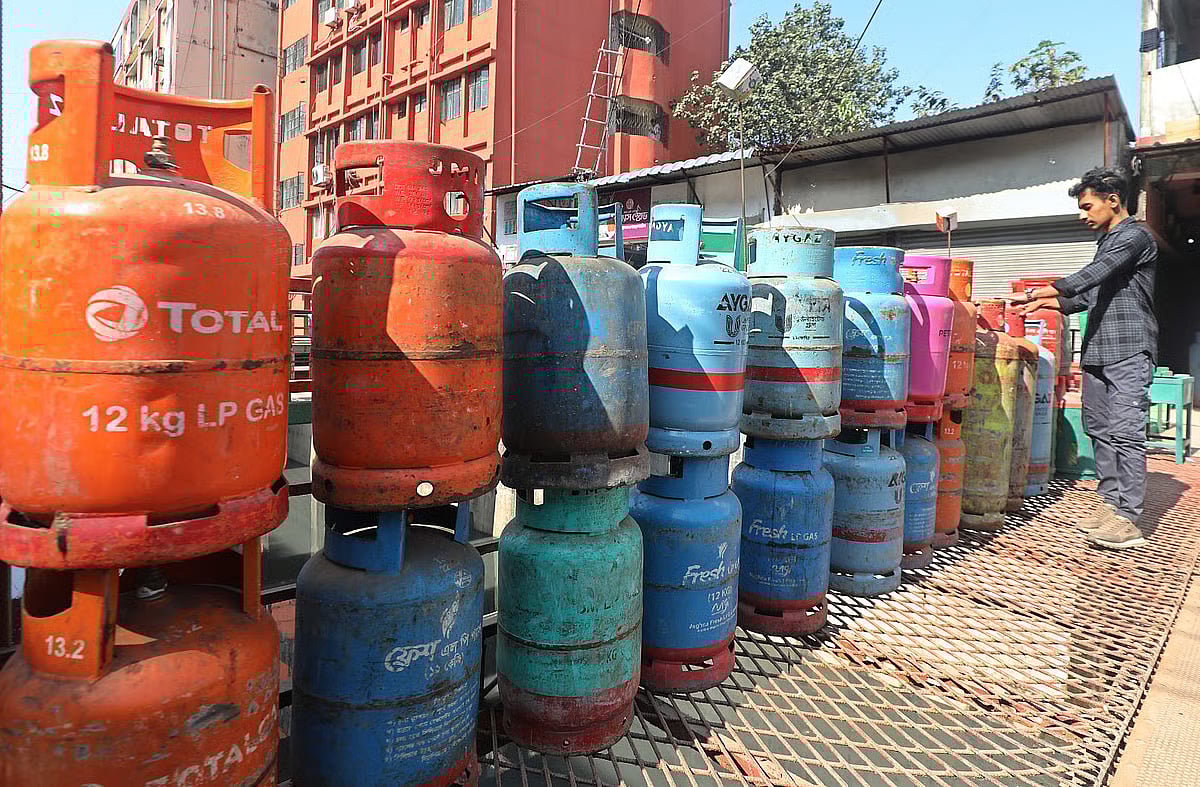
LPG: Meghna Group becomes top importer for first time
Companies operating in Bangladesh’s liquefied petroleum gas (LPG) market are facing increasingly fierce competition. Four years ago, Bashundhara Group was the market leader in this sector; it has now slipped to 12th position.
Three years ago, Omera Petroleum overtook Bashundhara to claim the top spot. Now, surpassing Omera, Meghna Fresh LPG Limited, a concern of Meghna Group of Industries (MGI), has risen to the top of the LPG business for the first time.
Not only has there been a change at the top, but the reshuffle has also significantly altered the list of top ten LPG importers. In the first six and a half months of the current 2025–26 fiscal year, five companies have dropped out of the top ten. Amid an LPG supply crunch in the country, data from the National Board of Revenue (NBR) show how much market share each company holds in the LPG sector.
According to the Bangladesh Energy Regulatory Commission (BERC), 52 companies currently hold licenses to operate in the LPG business in the country. Of them, 32 have their own cylinder plants, while 23 companies have import capacity. Government approval is required at every stage of the LPG business.
LPG is imported into Bangladesh through Chattogram Port, Mongla Port, and the Sitakunda jetty. According to NBR data, 16 companies imported 1.083 million tonnes of LPG in the country between 1 July and 14 January of the current fiscal year—six and a half months. Other companies purchase LPG from importers, fill cylinders, and sell them in the market.
Meghna Fresh LPG tops the list
For a long time, Bashundhara Group dominated the LPG business. As recently as the 2022–23 fiscal year, it retained the top position by importing nearly 200,000 tonnes of LPG. However, the following year (2023–24), Omera Petroleum surged to the top by importing 298,000 tonnes. That year, Bashundhara slipped to fourth place with imports of 148,000 tonnes.
Omera retained its top position in 2024–25 as well. However, a major shift has occurred in the first six and a half months of the current fiscal year. During this period, Meghna Fresh LPG Limited imported 187,000 tonnes of LPG, emerging as the market leader. The company accounted for 17 per cent of total LPG imports during this time. Over three years, its market share has increased by 7 per cent.
Meanwhile, Bashundhara Group’s market share—once dominant—has now dropped to just 1 per cent, placing it 12th in the import ranking. Omera Petroleum, once the market leader, currently stands in fourth position with a 12 per cent market share. However, Omera’s market share may increase in the near future following its acquisition of the Bangladesh operations of French company TotalEnergies. This could potentially alter the leadership calculations by the end of the current fiscal year.
Commenting on Meghna Fresh LPG’s rise to the top, Mostafa Kamal, Chairman of MGI, told Prothom Alo that government approval is crucial for increasing LPG imports. He said Meghna Fresh LPG’s import approval has recently been increased, enabling the company to source LPG quickly from the spot market. “We are preparing so that there is no shortage during the upcoming Ramadan,” he said.
Major shifts in market share
The fastest growth in the LPG sector has been recorded by United Aygaz LPG Limited. Formed as a joint venture between United Group and Turkey’s Aygaz, the company’s market share has increased by 11 per cent over three years. In the first six and a half months of the current fiscal year, it imported 171,000 tonnes of LPG, rising to second position. Last fiscal year, it ranked eighth.
In third place is Jamuna Spacetech Joint Venture Limited, a joint venture between the Netherlands and Bangladesh. The company imported 148,000 tonnes of LPG in the first six and a half months of the current fiscal year, maintaining a 14 per cent market share.
Another Netherlands–Bangladesh joint venture, BM Energy (BD) Limited, imported 111,000 tonnes and stands in fifth position. Its market share has declined by 1 per cent, now standing at 10 per cent.
In addition, the market shares of other top-ten companies—Petromax LPG, Laugfs Gas Bangladesh, Premier LP Gas, Delta LPG, and SKS LPG—have increased.
Costs will not fall without policy support
In Bangladesh, 98 to 99 per cent of LPG is import-dependent, and the private sector carries out the bulk of these imports. In the 2024–25 fiscal year, the private sector imported over 1.75 million tonnes of LPG. During the same period, public-sector LPG supply stood at just 19,479 tonnes, giving the government a market share of 1 per cent. In addition, LPG produced at three private refineries is supplied to the market.
Industry insiders say private companies import LPG using small vessels from the Middle East, Singapore, Malaysia, and the United States. Transporting LPG on small vessels significantly increases costs. If LPG could be imported using large vessels, costs could be reduced substantially.
Amirul Haque, President of the LPG Operators Association of Bangladesh (LOAB), told Prothom Alo that demand for LPG is increasing, which will naturally lead to higher imports by companies in the sector. To ensure uninterrupted supply, LPG terminals must be built where large vessels carrying around 50,000 tonnes can berth. Importing LPG via large vessels could save USD 20–25 per tonne, allowing consumers to benefit from lower prices.
For this, he said, the government needs to provide policy support, including land allocation, to enable private-sector terminal construction. “If this is done, the country will not face shortages like the current one in the future,” he added