Budget 2026-27
Govt needs 2 yrs to stabilise fragile economy: Finance Minister
The government will need at least two years to fully stabilise the country’s fragile economy and put it back on the path to prosperity, Finance and Planning Minister Amir Khasru Mahmud Chowdhury has said.
Describing the current economic situation as a major challenge, he said, “Given the overall situation, we need to be given two years.”
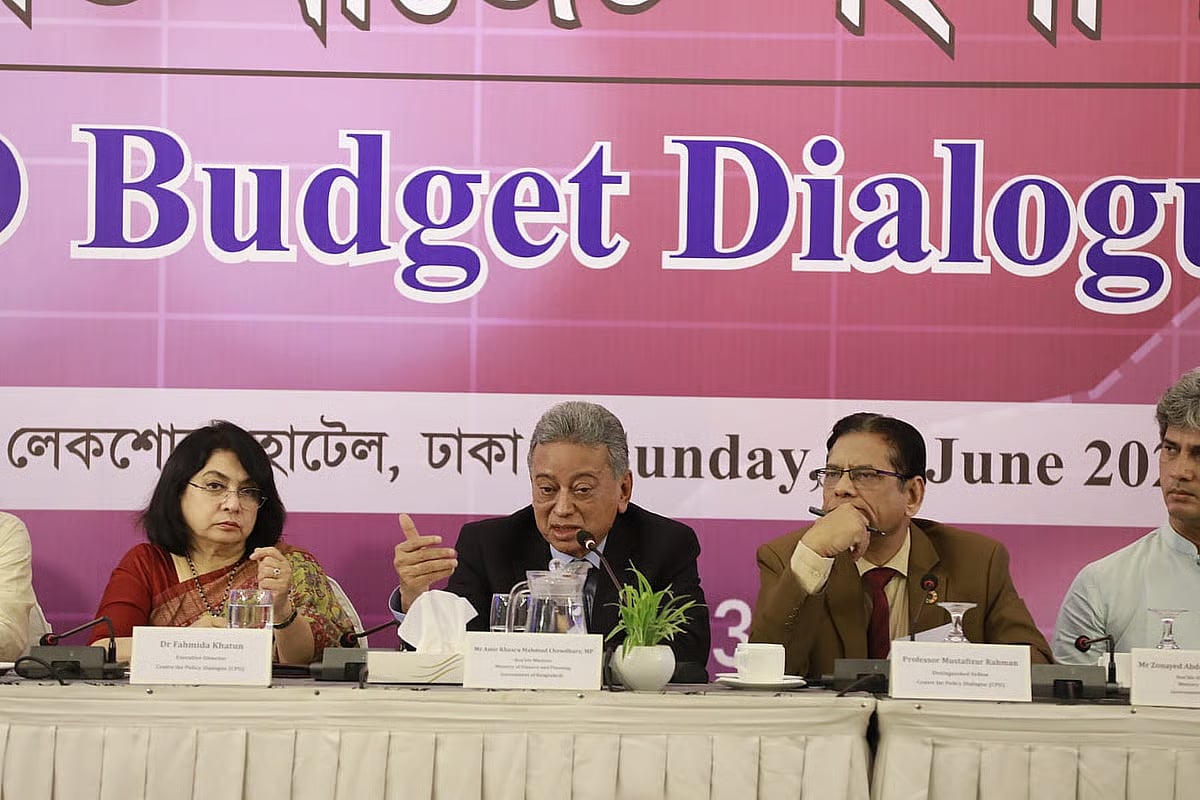
The minister made the remarks while speaking as chief guest at a budget dialogue organised by the private research organisation Centre for Policy Dialogue (CPD) at the Lakeshore Hotel in Gulshan, Dhaka on Sunday.
The event was chaired by CPD Distinguished Fellow Mustafizur Rahman. Minister of State for Planning, Zonayed Abdur Rahim Saki attended as special guest, while Akhter Hossen, a member of parliament elected from the National Citizen Party (NCP), was present as an honoured guest.
Hossain Zillur Rahman, executive chairman of the Power and Participation Research Centre (PPRC); MA Razzaque, chairman of Research and Policy Integration for Development (RAPID); Anwar-ul-Alam Chowdhury, president of the Bangladesh Chamber of Industries (BCI); Enamul Haque Khan; and Montu Ghosh, president of the Garments Workers Trade Union Centre discussed the budget from various sides.
CPD Executive Director Fahmida Khatun presented the keynote paper.
Speaking at the event, Amir Khasru Mahmud Chowdhury said, “We believe that within two years the economy will move from a fragile state towards stability. From the third year, the country’s economy will begin to recover, and in the fourth and fifth years it will advance towards prosperity.”
Referring to the current gas and electricity situation as the country’s principal problem, the finance minister said, “I cannot solve these problems in three months. Even with money, these problems cannot be resolved that quickly. Although the previous government did not take the initiative to explore for gas, the current government has started doing so. However, it will take at least 18 months to import gas from abroad, store it and supply it.”
PPRC Executive Chairman Hossain Zillur Rahman said that for ordinary people, borrowing had ceased to be a means of investment and had instead become a tool for survival.
Reiterating the government’s target of building a trillion-dollar economy by 2041, Amir Khasru Mahmud Chowdhury said, “The country cannot develop without gas, electricity and strong internet connectivity. We are investing in these three areas.”
‘Dashboard’ to monitor projects
At the event, PPRC Executive Chairman Hossain Zillur Rahman advised the government to introduce a three-month progress monitoring mechanism for budget implementation.
In response, the finance minister said a special digital dashboard would be launched in the first week of July to address the historic stagnation and delays in project implementation.
“We are not opting for quarterly reviews; we are creating a dashboard. Through the dashboard, every project will be monitored on a daily basis,” he said.
CPD Executive Director Fahmida Khatun questioned the large lump-sum allocations made in various sectors in the budget. In reply, the finance minister said, “We have not kept any lump-sum allocation for operational expenditure. Whatever is there is entirely for development work.”
Amir Khasru Mahmud Chowdhury also said a taskforce was being formed to ensure that the decisions taken in the budget to simplify rules and regulations are properly implemented by all concerned. At the same time, a website is being developed.
“If any citizen or businessperson feels they are facing obstacles or harassment because these rules are being violated or not properly implemented, they will be able to report it on this website. The taskforce will be responsible for overseeing the entire matter. It is hoped that this will help improve the situation,” he said.
We believe that within two years the economy will move from a fragile state towards stability. From the third year, the country’s economy will begin to recover, and in the fourth and fifth years it will advance towards prosperity.Amir Khasru Mahmud Chowdhury, Finance Minister
The finance minister further said the government had significantly reduced customs duties and taxes on the import of industrial raw materials. All kinds of incentives and facilities had also been opened up to diversify products in the export sector.
As a result, he said, not only the readymade garment sector but businesses in any sector wishing to export products would now be able to access bond facilities, allowing duty-free import of raw materials. Businesspeople would be able either to use the bond facility directly or, if they chose not to, import raw materials completely free of customs duties and taxes by providing a bank guarantee and then manufacture and export goods.
He added that opening letters of credit (LCs) for importing raw materials would no longer be mandatory.
State Minister for Planning, Zonayed Abdur Rahim Saki said work was under way to identify the specific reasons why development projects had failed to stay within their allocated budgets and set timelines, and to determine solutions.
A full roadmap or action plan in this regard would be prepared within the next one to two months, he said.
NCP lawmaker Akhter Hossen described the newly announced budget as “unrealistic” and “deficit- and debt-dependent” in the context of the country’s current fragile economic situation.
He also called for transparency in budget implementation, saying that a clear account of allocations made to different sectors should be presented to parliament and the nation in due course.
3 crises the government facing
PPRC Executive Chairman Hossain Zillur Rahman said that for ordinary people, borrowing had ceased to be a means of investment and had instead become a tool for survival.
Low-income families, he said, were cutting food consumption and other household spending, postponing medical treatment, and taking on multiple jobs or forms of work at the same time. As a result, new realities such as mental health problems were emerging among them.
According to Hossain Zillur Rahman, the government’s economic planning currently faces three major crises: a crisis of employment, a crisis of investment, and a crisis in the quality of education.
RAPID Chairman MA Razzaque said the organisation’s estimates showed that just 1 per cent of the population currently held nearly 50 per cent of the country’s total wealth.
“In other words, we have created an unequal society, and correcting that is imperative. For that, a properly planned wealth tax system is essential,” he said.
MA Razzaque further said the existing surcharge system, which is currently used in considering wealth distribution, was not the right approach for imposing a wealth tax. To tackle the growing inequality, an inheritance tax should be introduced; otherwise, these problems would not be resolved, he said.
Energy crisis a major problem for industry
BCI President Anwar-ul-Alam Chowdhury said the energy crisis had become a major problem, to the extent that existing industries were struggling to survive. High bank interest rates were another headache, he said.
“In this reality, growth is not the main issue; the central issue is keeping existing industries alive. For that, energy is the biggest concern. But we are not seeing a realistic action plan on this,” he said.
Anwar-ul-Alam Chowdhury also said, “We have still not been able to come out of the culture of mob violence. We still do not feel secure about the law and order situation. Yet we can see that the home minister appears highly self-satisfied.”
Garments Workers Trade Union Centre President Montu Ghosh said the budget had brought no meaningful change to workers’ lives.
He said workers had long been demanding ration support because their wages were not sufficient to cope with the current economic situation. However, the budget had said nothing on the matter.