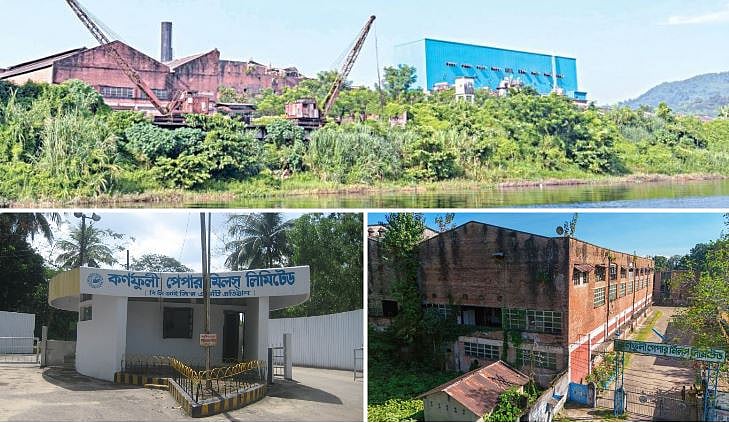
Once supplying nearly 70 per cent of the government's paper demand, state-owned Karnaphuli Paper Mills Limited (KPM) is now on the verge of collapse, with production falling sharply, mounting losses and most of its machinery remaining idle.
The mill, which produced around 20,000 metric tonnes of paper annually 15 years ago, now produces only about 3,000 tonnes, an estimated decline of 87 per cent.
Aging machinery, frequent breakdowns, raw material shortages, high gas prices and a lack of skilled workers have pushed the mill into a deep crisis.
It now operates with only one of its three machines, while its annual losses stand at around Tk 280-300 million.
The government has taken initiatives to revive the historic industrial establishment.
The Bangladesh Chemical Industries Corporation (BCIC) has proposed setting up an integrated pulp and paper mill alongside six other chemical plants at the existing KPM site.
A consultancy firm has already completed a feasibility study for the proposed projects. The plan aims to restore the mill's production capacity by introducing modern technology, producing pulp locally, developing domestic sources of raw materials and manufacturing chemicals at the site.
The proposed integrated facility would have an annual paper production capacity of 100,000 tonnes.
According to relevant sources, the Ministry of Industries has forwarded the proposal to the Planning Commission. After reviewing it, the Commission informed KPM authorities that the government was seeking investment from both domestic and foreign sources.
If the authorities fail to secure investment, the projects will be implemented gradually with government funding.
Last October, BCIC Chairman Md Babul Miah visited KPM and discussed possible ways to revive the ailing state-owned industrial enterprises. The options included foreign investment, Balancing, Modernization and Replacement (BMR), Public-Private Partnership (PPP) and Government-to-Government (G2G) arrangements.
Production data signed by KPM Production Department Head Md Moidul Islam shows a steady decline in the mill's output over the years.
In 2011-12, the mill produced 20,123.44 tonnes against a target of 25,000 tonnes. Production fell to 13,775 tonnes in 2012-13, 13,099 tonnes in 2013-14, 12,671 tonnes in 2014-15 and 10,581 tonnes in 2015-16.
The output dropped further to 6,000 tonnes in 2016-17 and 3,000 tonnes in 2017-18, against annual targets of 8,000 tonnes in both years.
Production later increased to 5,000 tonnes in 2018-19 and 6,000 tonnes in each of the following two fiscal years.
However, it fell to 2,000 tonnes in 2021-22 and 1,542.02 tonnes in 2022-23. In 2023-24, production reached 2,510.52 tonnes against a target of 2,500 tonnes. The target for 2024-25 was set at 3,000 tonnes.
Over the same period, the annual production target declined from 25,000 tonnes to 2,500 tonnes, reflecting the extent of the mill's deterioration.
Stakeholders said the factory's production capacity had declined steadily over the past 15 years. They also said that the previous Awami League government failed to take effective initiatives to modernise the mill during its tenure.
According to BCIC, KPM was established in 1953 by the then Pakistan Industrial Development Corporation on 501 acres of land. Of the total area, 68 acres were allocated for the factory and 433 acres for residential facilities.
The mill initially had an annual production capacity of 30,000 tonnes and once met nearly 70 percent of the government''s paper demand.
It used to produce pulp from bamboo and pulpwood at its own facility and manufacture 33 varieties of paper, including cream-laid, writing, brown, offset, typewriting and azure-laid paper. It also produced 10 types of packaging materials.
Currently, the mill produces only four to five varieties of paper.
KPM sources said its pulp production unit had remained closed for the past eight years. The mill now depends on imported pulp and locally collected waste paper, increasing production costs.
Although the mill sells paper at around Tk 130,000 per tonne, it incurs a loss of Tk 35,000-40,000 on each tonne, according to the sources. Its annual losses are estimated at Tk 28-30 crore.
The mill has an approved workforce of 2,376, but only 188 employees are currently on its payroll. Another 250 temporary workers are employed through contractors.
High gas prices have further increased production costs. KPM officials said fertilizer factories pay Tk 16 per cubic foot of gas, while the mill pays between Tk 30 and Tk 31.50.
Producing 25-30 tonnes of paper a day requires around Tk 13 lakh worth of gas, they said. They believe production costs could be reduced significantly if the mill received a gas subsidy similar to that provided to fertilizer factories.
Water shortages also disrupt production. Internal audits have identified problems with the mill''s water supply system. During low tide, falling water levels in the Karnaphuli River make it difficult to draw sufficient water from the Wagga Pump House, often forcing the factory to suspend production.
Under the proposed revival plan, the government is also considering afforestation projects and factories to produce paper-related chemicals, including soda ash, sodium sulfate, basic chemicals and synthetic polyester fibre.
Other proposed chemical plants would manufacture caustic soda, chlorine, hydrogen peroxide and titanium dioxide.
KPM Managing Director Md. Shahid Ullah told BSS that production had declined due to multiple crises despite the authorities'' efforts to maintain and increase output.
"Despite our best efforts to sustain or increase output, it is often not feasible, as the economic lifespan of this 72-year-old facility ended long ago," he said.
He said a proposal for seven projects, estimated to cost Tk 30,000-35,000 crore, had been submitted to the Ministry of Industries through BCIC.
The proposal had undergone scrutiny and received preliminary approval. Once implemented, the projects would increase the mill''s annual paper production capacity to 100,000 tonnes, he added.
"Karnaphuli Paper Mills is an integral part of the nation's history and heritage. If it becomes fully operational, it will not only improve the socio-economic conditions of the local region but also contribute to the country''s broader economic development," Shahid Ullah said.
Describing the mill as more than an industrial establishment, he said it had played an important role in maintaining social harmony among communities in the Chattogram Hill Tracts.
People from different communities, including hill peoples and Bengalis, had worked at the mill, helping build and preserve a sense of social harmony, he said.
"It is essential to rethink the future of KPM to ensure its survival," he added.