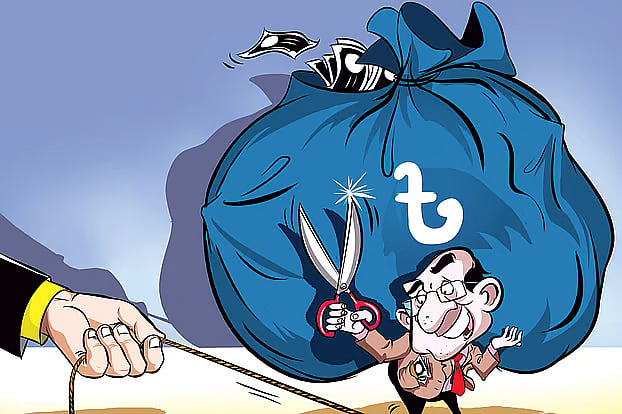
Both non-performing loans and rescheduled loans have increased in Bangladesh. Yet whenever borrowers are given the opportunity to reschedule their loans, it is invariably argued that the move will help recover money stuck in banks, revive struggling businesses and reduce non-performing loans.
In reality, although the amount of non-performing loans in banks’ books has temporarily declined, recoveries have not increased at the same rate. Instead, a large portion of rescheduled loans has once again become bad.
The old question has therefore resurfaced: can the problem really be solved by granting blanket concessions to loan defaulters, or does this simply give some borrowers additional time while leaving the underlying problem to be dealt with in the future?
15 years to repay loans of Tk 10 billion or more
On 31 August, Bangladesh Bank further expanded the facilities for rescheduling and restructuring non-performing loans. Under the new guidelines, if a company or business group has outstanding loans of Tk 10 billion or more, the loans can be repaid over a maximum of 15 years, including a two-year grace period. Previously, the maximum repayment period was 10 years.
Applications for this facility can be submitted until 30 September. Banks must dispose of the applications by 31 December, after determining the required instalments or down payment.
Borrowers who previously received the facility under the 2025 policy support measures or through a Bangladesh Bank selection committee will also be eligible to apply again.
Bangladesh Bank said the repayment capacity of many companies has declined because of the conflict in the Middle East, the energy crisis, rising borrowing costs due to market-based interest rates and a slowdown in business activity. The facility has been introduced as part of the central bank’s 18-month plan to reduce non-performing loans.
The mysterious three months
After the fall of the former Awami League government, a new round of special policy support was introduced on 16 September, 2025, when the interim government was in power. Under the facility, affected companies were allowed to repay their non-performing loans over a maximum of 10 years, including a two-year grace period, with a down payment of just 2 per cent.
The scope of the facility was expanded on 24 November. Loans that had become non-performing by 30 November of that year were also made eligible. Borrowers were given an additional two years to repay unclassified and previously rescheduled term loans, while the exit facility allowed for another one-year extension.
Three months later, on 22 February, 2026, the rules for making the down payment were eased further. Borrowers were allowed to pay half of the prescribed down payment when applying and the remaining half over the following six months.
Within another three months, on 7 May, the application deadline was extended to 30 June. Again, roughly three months later, the deadline was extended once more on 31 August, this time to 30 September.
In other words, in less than a year, the authorities have repeatedly expanded the scope of the concessions, eased the down-payment requirements, extended application deadlines and lengthened loan repayment periods.
The question now is whether this is the final opportunity for the time being, or whether another concession will be introduced after three months. When one concession is followed by another within a short period, borrowers may begin to expect further benefits. Some may then stop paying instalments and wait, thinking that an even better opportunity could come a few months later.
This undermines the culture of repaying loans on time. Even borrowers who have the ability to repay may stop making instalment payments in the hope of receiving better concessions in the future.
If becoming a defaulter and waiting for concessions is more advantageous than repaying loans regularly, the incentive to repay diminishes. The same pattern has been seen in the past.
Big concessions for large borrowers
Under the current policy, large borrowers will get the most opportunities. If larger loans alone are enough to qualify borrowers for greater concessions, questions of fairness inevitably arise.
Small and medium-sized entrepreneurs can lose access to the banking system’s normal facilities even after defaulting on relatively small amounts. Yet large borrowers are being given more time. This could create a situation in which becoming a major defaulter appears more beneficial than repaying loans regularly.
One in every three taka is in default
The new concessions have been introduced at a time when non-performing loans in the country’s banking sector are at a historic high. According to Bangladesh Bank data, NPLs stood at Tk 6.06 trillion (Tk 606,284 crore) at the end of June 2026. This accounted for 32.78 per cent of total outstanding loans—meaning that roughly one out of every three taka disbursed by banks was in default. Bangladesh is now among the countries with the highest NPL ratios in the world.
One reason for the rapid rise in NPLs over the past two years is that the true condition of old loans has come to light. For years, many bad loans were not classified as defaulted because of political influence, court injunctions, rescheduling, special concessions and incorrect classification. Following the political change in 2024, reviews and audits of banks’ loan portfolios brought some of these loans to the surface.
Loans become defaulted again after rescheduling
Bangladesh Bank itself has acknowledged that rescheduling does not necessarily solve the problem. According to Bangladesh Bank’s Financial Stability Report published in 2025, the outstanding balance of rescheduled loans in the banking sector stood at around Tk 3.48 trillion (Tk 348,000 crore) at the end of December 2024. Of this, Tk 1.34 trillion (Tk 134,000 crore), or 38.42 per cent, had become non-performing again. In other words, nearly two out of every five rescheduled loans had gone bad again.
In 2020, 23.8 per cent of rescheduled loans subsequently became non-performing. Within four years, the rate had risen above 38 per cent. This means that extending the repayment period has not solved the underlying problem.
Recent figures show the same pattern. At the end of September 2025, NPLs in the country stood at Tk 6.44 trillion (Tk 644,000 crore).
After large volumes of loans were rescheduled and restructured over the following three months, the figure fell to Tk 5.57 trillion (Tk 557,000 crore) at the end of December. But by June 2026, it had once again crossed Tk 6 trillion (Tk 600,000 crore.)
A long history of concessions
Rescheduling defaulted loans is not a new phenomenon in Bangladesh. In 1991, borrowers in default were given an opportunity for the first time to regularise their loans through interest waivers and easier instalment arrangements. Between 2003 and 2006, Bangladesh Bank took a somewhat stricter approach.
The required instalment or down-payment amounts were increased, and borrowers whose loans had been rescheduled were barred from taking new loans for a specified period.
After the Awami League came to power in 2009, the process of relaxing the rules began anew. In 2012, borrowers were allowed to reschedule loans up to three times. Subsequently, under special facilities, the repayment period for some loans was extended to as long as six years.
In 2015, a special restructuring programme was introduced for large borrowers. At that time, loans worth around Tk 150 billion held by 11 major industrial groups were restructured. However, most of the beneficiaries failed to pay even the first instalment on time.
A major change came in 2019. Borrowers were given the opportunity to repay loans over a maximum of 10 years with a down payment of just 2 per cent. At the time, this too was described as a special, one-time arrangement.
But the one-time arrangement did not end there. Rules were relaxed further during the Covid-19 pandemic. In 2022, borrowers were allowed to reschedule loans up to four times. For large borrowers, various concessions also made it possible to extend loan repayment periods to as long as 29 years.
Each time, the authorities said the assistance was intended to protect genuinely distressed borrowers and viable businesses. But no effective and transparent system was developed to distinguish genuine distressed borrowers from wilful defaulters and influential borrowers. As a result, temporary assistance gradually turned into a pattern of repeated concessions.
South Asian experience
There are both similarities and differences between Bangladesh’s policies and those of other South Asian countries. The similarity is that they too allow loans to be renewed or restructured subject to certain conditions.
The difference is that these countries place relatively greater emphasis on the borrower’s repayment record after rescheduling, the viability of the business and the feasibility of its recovery plan.
In Nepal, a defaulted loan does not automatically return to the regular category simply because the borrower has made regular instalment payments for six months. It remains on a “watch list” for another six months. If instalments continue to be paid regularly during that period, the loan is then restored to the regular category. The country’s NPL ratio is 5.66 per cent.
In India, there is no uniform down payment or repayment period for all borrowers. Banks assess whether the crisis is temporary, whether the business is viable and whether the recovery plan is realistic. The NPL ratio of the country’s banks is 1.8 per cent.
In Pakistan, a loan does not become regular simply because it has been rescheduled. In the case of ordinary corporate and commercial loans, borrowers must comply with the new terms for at least one year. They must also repay at least 10 per cent of the outstanding amount. The country’s NPL ratio is 5.8 per cent.
Sri Lanka has mainly provided targeted facilities for distressed small and medium-sized enterprises. Although borrowers may be given up to 10 years to repay, they must demonstrate repayment capacity and have a plan to revive the business. At the end of the first quarter of 2026, the country’s NPL ratio was 9.4 per cent.
Lessons from other countries
South Korea offers a successful example of resolving NPLs quickly. After the Asian financial crisis of 1997, the state-owned Korea Asset Management Corporation, or KAMCO, bought non-performing loans from banks. Viable businesses were restructured, while the assets of other companies were sold to settle their debts.
India also has a relatively strong legal framework. Banks there can seize and sell mortgaged assets through a prescribed process. There is also a mechanism for resolving large corporate loans through bankruptcy law.
Individuals who fail to repay loans despite having the ability to do so, or who move their assets to avoid repayment, can be declared wilful defaulters and barred from obtaining new loans.
In China, court orders can restrict wilful defaulters from travelling by air or high-speed train, using luxury services or obtaining new loans. In the United States, banks are required to recognise losses from bad loans promptly and take appropriate action. In Europe, the older a non-performing loan becomes, the greater the provisions banks are required to set aside against it.
The bottom line
Investment in the country is currently sluggish. Some view the repeated concessions granted to large loan defaulters as a desperate attempt by the government and Bangladesh Bank to encourage investment. But investment cannot be revived simply by allowing loans to be rescheduled if the energy crisis and law-and-order situation do not improve.
At the same time, action must be taken against wilful defaulters. What is needed is genuine business restructuring. Simply extending repayment periods or showing loans as regular on paper will not solve the problem. There must also be strict monitoring to ensure that businesses are actually operating properly and making regular instalment payments after receiving concessions.
Former Bangladesh Bank chief economist Mustafa K Mujeri believes steps must be taken to ensure that the facilities granted are not misused, as has happened in the past. This requires stronger oversight by the central bank.
At the same time, the government must demonstrate political commitment. If loan renewals enable entrepreneurs to contribute to reviving economic activity, that would be the positive outcome of such measures.
* Shawkat Hossain is Head of Prothom Alo Online
* This article appeared in Prothom Alo print and online and has been translated by Farjana Liakat for Prothom Alo English Online