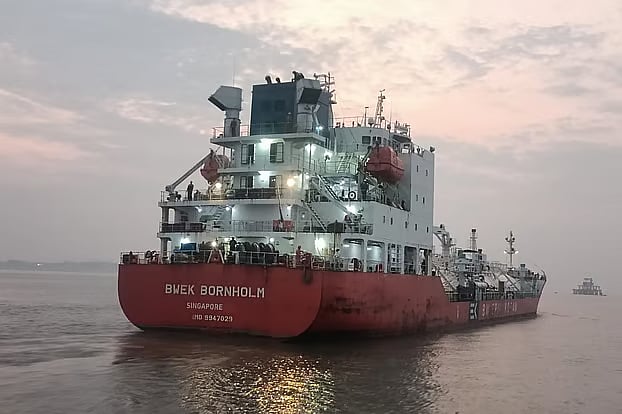
First LPG tanker arrives from war zone
Since the outbreak of war in the Middle East, no vessels have arrived in Bangladesh after crossing the Strait of Hormuz from the Persian Gulf. Two oil and gas tankers remain stranded in the Persian Gulf.
However, an LPG tanker has reached Sitakunda carrying liquefied petroleum gas from the Gulf of Oman, which is connected to Hormuz. According to shipping agents, this is the first LPG tanker to reach Bangladesh from the Middle Eastern war zone since the conflict began.
Shipping agent sources said the tanker MT BWEK Bornholm brought 3,800 tons of liquefied petroleum gas (LPG) from Oman. It is a relatively small LPG tanker. The consignment was imported by BM Energy (BD), a subsidiary of Smart Group.
Captain Moinul Ahsan, Executive Director of Smart Group, told Prothom Alo, “A large portion of LPG is imported from the Middle East. Since the war began, we have been in regular contact with suppliers to keep the supply normal. At our continued request, a supplier has sourced LPG from the war zone and shipped it to us.”
Humayun Kabir, head of Sea-Side Traders, the local agent of the tanker, said the vessel departed from Duqm port in Oman in the second week of March and first went to Sri Lanka. After partially unloading there, it arrived in Sitakunda and discharged the remaining LPG. The tanker left after completing unloading last Friday.
On 28 February, Iran retaliated following attacks by the United States and Israel, escalating conflict across the Middle East. Subsequently, Iranian forces declared the Strait of Hormuz closed. Security risks also increased in the Persian Gulf connected to the strait. On 3 March, a drone attack targeted an oil tanker near Duqm port in Oman.
Captain Anam Chowdhury, President of the Merchant Marine Officers’ Association, told Prothom Alo that the International Bargaining Forum (IBF) has declared the Persian Gulf, the Strait of Hormuz, the Gulf of Oman, Bab al-Mandeb, and the Red Sea as war zones.
Without Iran’s permission, no vessel can pass through Hormuz from the Persian Gulf. He added that as the region is now classified as a war zone, insurance companies have raised war risk premiums for vessels operating from Oman in the Persian Gulf, significantly increasing transportation costs.
Two tankers stranded
One of the stranded tankers is MT Libretha, which has been stuck since the start of the conflict after loading 62,000 tons of liquefied natural gas (LNG) at Ras Laffan port in Qatar. The other is MT Nordic Pollux, which was supposed to carry 100,000 tons of crude oil from Ras Tanura terminal in Saudi Arabia to Bangladesh.
According to vessel tracking service MarineTraffic, the Liberia-flagged MT Libretha is currently anchored off the coast of Qatar, while MT Nordic Pollux remains at anchorage near Ras Tanura port in Saudi Arabia.
Data from the National Board of Revenue (NBR) shows that in the first eight months of the current 2025–26 fiscal year, 80 per cent of crude oil, 65 per cent of LNG, and 51 per cent of LPG imports came from the Middle East.
Although a large portion of refined diesel is imported from various Asian countries, those countries also depend on Middle Eastern crude oil.
As a result, uncertainty over Middle Eastern supply remains, and it is unclear when the situation will stabilise.