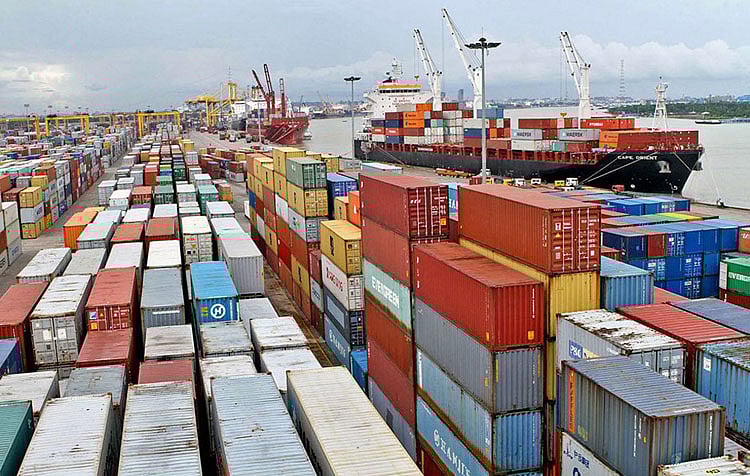
A notification imposing a new duty rate at the Chittagong port has been issued. The notification was issued in the early hours of Monday, which states the new duty fee will take effect from Monday.
Analysing the information given in the government notification, it has been found that the duty rate has been increased by 41 per cent on average as compared to the past.
The duty fee for container transport has been increased the most. From now on, the traders will have to bear an additional duty of Tk 4,395 per container (20 feet). The traders will have to carry the cost to get port services too.
The proposed duty was approved by the finance ministry on 24 July. The port users raised objections over the proposal to raise the duty rate by 41 per cent at once.
Later, a discussion was also held with the port users at the initiative of the shipping ministry. However, the notification was issued without taking the objection of the port users into account. As a result, the decision of the port authorities to increase the duty fee remains intact.
The main objection of the users was that increasing the duty by 41 per cent at one go will mount extra pressure on the consumers. The competitiveness of the export sector will decline.
Moreover, in the future, except for two terminals, all the port terminals will go into the hands of foreign operators. As a result, if duties are increased, foreign operators will be the main beneficiaries.
Speaking to Prothom Alo regarding this, International Business Forum Chattogram president and Bangladesh Garment Manufacturers and Exporters Association (BGMEA) director, SM Abu Taiyeb said, “The readymade garment (RMG) sector will suffer the most due to the additional duty.
This is because the export sector will have to pay additional duties once while importing raw materials in containers and again while exporting. In that case, extra duties will have to be paid twice on both raw materials and finished products, which is not logical in any way.
On the other hand, according to the government, this is the first time port duties have been increased since 1986. Even after the increase, the rates are still much lower compared to neighbouring countries.
The increased rate
The port authorities now collect a duty fee of Tk 11,849 per container (20 feet) on average. The port users will have to bear an additional cost of Tk 4,395 per container. As a result, the average duty per container will amount to Tk 16,243. This means duties are increasing by an average of 37 per cent per container.
Based on the port’s audited accounts for the 2023–24 fiscal year, this correspondent has calculated how much the duty per container will increase under the new rates. In the proposed structure, the exchange rate has been set at Tk 122 per US dollar. If the dollar rate rises, duties will also go up, as the port authority collects them in dollars.
The users also have to bear separate duty fees for container ship services. The cost will differ based on containers. For instance, the duty fee will increase by Tk 5,720 for import containers and Tk 3,045 for export containers.
The largest increase in container duties comes from the loading and unloading of containers from ships. Previously, the duty for handling a single container was USD 43.40. This has now been raised to USD 68, an increase of USD 24.60—equivalent to about Tk 3,000.
Previously, the average duty on containerised goods was Tk 1.28 per kg. With the new duties coming into effect today, Monday, an additional Tk 0.47 per kg will now have to be paid.
Almost all of Bangladesh’s exports by sea are carried in containers. Containers are also used to import industrial raw materials and valuable machinery. About 99 per cent of imports and exports by sea containers are handled through Chittagong port. As a result, users said the increase in container duties will have a significant impact on cargo transport.
In addition to containers, general cargo is also transported through the port. According to port estimates, once the proposed higher duties take effect, charges on all types of cargo will rise by an average of Tk 0.14 per kilogram. At present, Tk 0.35 is charged per kilogram. This means duties will increase by an average of 41 per cent.
Unlike containers, general cargo ships make very limited use of port facilities. For instance, most bulk carriers anchor offshore and transfer goods to smaller vessels. In the 2024–25 fiscal year, 59 per cent of all cargo handled through the port was discharged offshore.