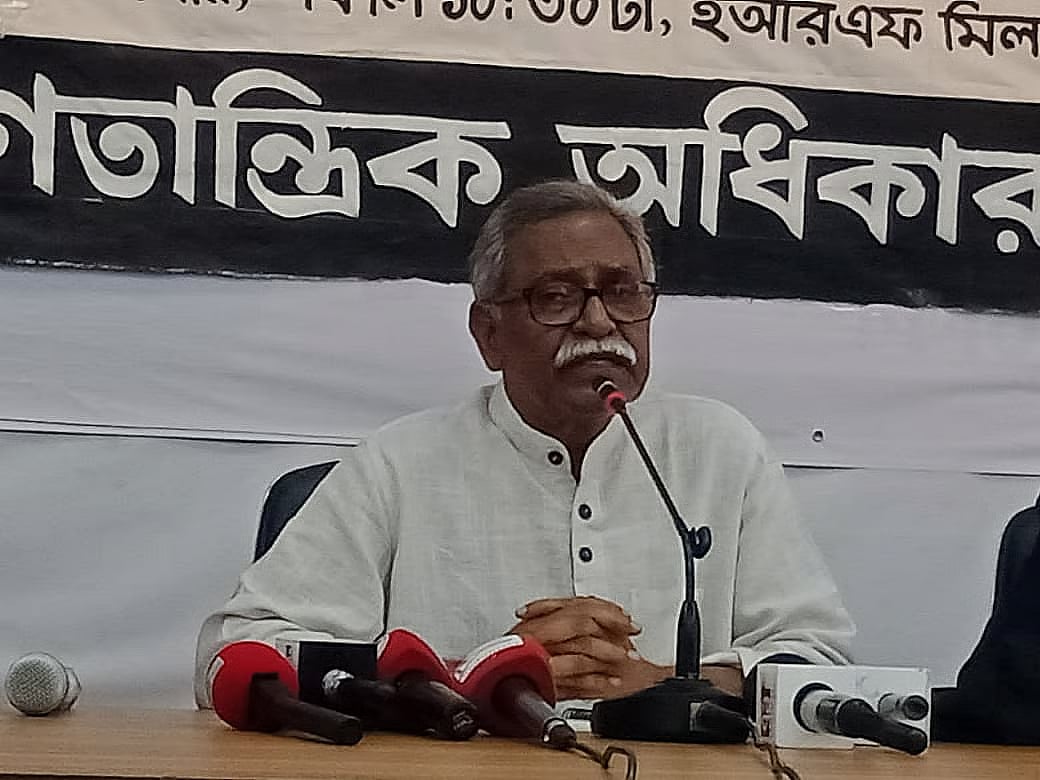
Bangladesh has no priority in US trade deal: Anu Muhammad
Economist Professor Anu Muhammad has said he sees no indication that Bangladesh’s interests have been prioritised in the trade agreement with the United States.
He called on the incumbent government to take necessary action against the deal and to hold those who signed it accountable.
Anu Muhammad made the remarks while presiding over a seminar titled “Why a Trade Agreement with the United States Could Be Dangerous for Bangladesh,” held at the Economic Reporters’ Forum auditorium in Bijoynagar, Dhaka at 10:30 am today, Friday.
Ganatantrik Odhikar Committee (Democratic Rights Committee) organised the event.
Anu Muhammad referred to the Bangladesh Nationalist Party’s (BNP) election slogan, “Bangladesh first”, and said that if Prime Minister Tarique Rahman genuinely believes in that principle, the government should take appropriate measures against the agreement and those who signed it.
He expressed disappointment at the activities of certain members of both the immediate past interim government and the current administration in relation to the deal before it came into effect.
According to him, what has so far been observed in Bangladesh regarding the agreement suggests that “the United States comes first”. He said this situation should change.
The economist warned that during the interim government’s tenure Bangladesh had been pushed into a “dangerous situation” through the agreement.
He also voiced concern that Khalilur Rahman, who had been involved with the deal, has now been appointed foreign minister by the BNP government. Khalilur Rahman has publicly described the agreement as a very good one.
“Just imagine,” Anu Muhammad said, “the person who calls such an agreement good is now Bangladesh’s foreign minister. He has even claimed that the BNP and Jamaat leadership knew about the deal.”
The economist argued that the BNP, now the governing party, should take a firm stance against the agreement. Its principal responsibility, he said, is to prove that Khalilur Rahman’s assessment is incorrect.
According to Anu Muhammad, the slogan “Bangladesh first” will become meaningless rhetoric if agreements contrary to national interests are signed without broad public discussion and approval in Parliament.
He also criticised the role of the interim government in relation to the agreement. During discussions on last year’s budget, he said, concerns had already been raised when the government indicated that Bangladesh would need to increase imports from the United States, including fish, meat and military equipment. At that time, the agreement had not yet been signed, and what he described as former US president Donald Trump’s trade “frenzy” had only just begun.
In his view, the interim government appeared even more enthusiastic about the agreement than the pressure coming from the United States.
Anu Muhammad alleged that the interim government had effectively begun implementing aspects of the deal even before it was formally signed.
The government’s interest grew so much that the agreement was eventually signed just three days before the national election, he observed.
He warned that the trade agreement with the US could have troubling implications for Bangladesh’s economy and national interests. Various provisions, he said, could have long-term effects on the country’s import and export policies, industrial sector and employment.
Bangladesh might be compelled to import and export certain products according to US requirements, potentially reducing the country’s policy autonomy, he warned.
The economist noted that the United States is one of the largest markets for Bangladesh’s ready-made garments. However, Bangladesh continues to face relatively high tariffs there. The United States has not extended the least developed country (LDC) trade preferences to Bangladesh, meaning Bangladeshi exports to the US currently face an average tariff of about 16 per cent.
He apprehended that the agreement could adversely affect agriculture and the rural economy, including sectors such as poultry, fisheries and dairy, where significant employment has been created.
Anu Muhammad urged that the agreement be debated in Parliament and assessed in light of national interests, economic realities and the views of all relevant sectors before any final decision is taken.
Anu Muhammad also referred to attempts during the interim government’s tenure to pursue an agreement over the New Mooring Container Terminal at Chittagong Port. He said there had been a degree of “frenzy” among certain individuals over the initiative.
Referring to the roles of former National Security Adviser Khalilur Rahman, Bangladesh Investment Development Authority (BIDA) executive chairman Ashik Chowdhury, the former chief adviser’s special envoy Lutfey Siddiqi, and former chief adviser Professor Muhammad Yunus, Anu Muhammad said all had shown interest in the agreement. However, he added, it ultimately did not materialise due to protests by workers.
The keynote paper at the seminar was presented by Professor Golam Rasul of the Department of Economics at the International University of Business Agriculture and Technology (IUBAT).
Other speakers included Supreme Court lawyer Jyotirmoy Barua, development economist Maha Mirza, and Mosahida Sultana, associate professor of accounting at Dhaka University.