A private-sector employee went to a bank branch in Karwan Bazar in the capital to urgently send money home to cover a relative’s medical expenses. At the branch, customers must use a Cash Recycling Machine (CRM) for transactions involving deposits of less than Tk 100,000.
The private-sector employee, speaking to Prothom Alo on condition of anonymity, said he inserted 100 of Tk 500 notes into the CRM to send Tk 50,000. The CRM rejected 36 of the notes because they had become too old. He had, however, withdrawn the notes from a branch of another nearby bank.
The incident is one example of how torn, damaged and worn-out banknotes circulating in the market are causing people considerable inconvenience.
Members of the public, businesses and bankers say a large proportion of the banknotes currently in circulation are very old.
Bangladesh Bank has failed to withdraw sufficient quantities of old notes and replace them with new ones in a timely manner. As a result, people have been forced to conduct transactions using these worn-out notes.
The problem is that many shopkeepers often refuse to accept notes that are slightly torn or excessively worn. Ticket machines on the metro rail reject such notes, while bank CRMs face the same problem. Many banks have now made the use of CRMs mandatory for deposits of less than Tk 50,000 or Tk 100,000.
People often do not have extra money on hand. Their only option is to rely on the old notes in their pockets. That is when they face trouble.
According to Bangladesh Bank sources, after the Awami League government was ousted in the July mass uprising, the central bank stopped releasing notes bearing the portrait of Bangabandhu Sheikh Mujibur Rahman.
However, it took much longer to print and introduce new notes with redesigned features. As a result, most of the notes currently in circulation are old. At the same time, the cost of printing banknotes has also increased.
People often do not have extra money on hand. Their only option is to rely on the old notes in their pockets. That is when they face trouble.
Who prints the money?
The central bank prints banknotes of Tk 10, 20, 50, 100, 200, 500 and 1000. These notes bear the signature of the governor of Bangladesh Bank.
Meanwhile, Tk 1, 2 and 5 are government notes, including coins, and bear the signature of the finance secretary. Bangladesh Bank, however, handles the printing of both types.
According to Bangladesh Bank data, the amount of money printed, or reserve money, stood at slightly more than Tk 4760 billion (476,000 crore) in June. Around Tk 3360 billion (336,000 crore) was held by the public, while the remainder was held by banks.
The Bangladesh Bank Order, or the law, gives the central bank the authority to print money. Bangladesh Bank sources said the design of banknotes also requires approval from the Prime Minister.
Meanwhile, at the beginning of each year, Bangladesh Bank invites expressions of interest through international tenders from potential suppliers of raw materials.
Printing of Tk 10 and Tk 500 notes is under way. The Security Printing Corporation (Bangladesh) Ltd will deposit the printed notes with Bangladesh Bank, after which they can be supplied to banks. There is a shortage of raw materials for the other notes as well.Arif Hossain Khan, executive director and spokesperson of Bangladesh Bank
It subsequently invites tenders from those interested companies to purchase the security paper, specialised ink known as intaglio ink, security thread and chemicals required for printing banknotes. Almost all of these materials have to be imported.
Currently, eight companies from France, the United Kingdom, Germany, Switzerland, the Netherlands, Spain, Italy and Indonesia are listed by Bangladesh Bank as suppliers of raw materials.
Bangladesh Bank sources said that even after the raw materials arrive, it takes around three months to print the notes. This is because Security Printing Corporation (Bangladesh) Ltd (SPCBL), commonly known as the mint, has limited printing capacity.
Why are there so many old currency notes in circulation?
Until the fall of the Awami League government on 5 August 2024, banknotes carried the portrait of Bangabandhu Sheikh Mujibur Rahman. After the party lost power, the printing of currency notes bearing the old design was discontinued.
Bangladesh Bank also stopped releasing the remaining old-design notes into circulation. It took a considerable amount of time to prepare designs for new currency notes, obtain approval for them and begin printing.
A shortage emerged during this period, and the crisis has yet to be fully resolved. New currency notes are now being released into circulation, although in quantities below what is required.
Bangladesh Bank said it has now stopped printing paper notes of Tk 2 and Tk 5. Metal coins of these remain in the vaults of Bangladesh Bank and commercial banks.
Customers are reluctant to take these coins from banks, while banks are also unwilling to handle them. Sources said Bangladesh Bank has been trying to increase the use of coins by keeping the printing of Tk 2 and Tk 5 paper notes suspended.
Notes of Tk 10 bearing the new design were not printed in the 2024–25 financial year. They were printed in the 2025–26 financial year and are now being gradually released into circulation.
There is a shortage of raw materials for printing Tk 20 and Tk 50 notes because the materials did not arrive in the country on time. As a result, printing of these notes has not yet begun.
Both newly designed and previously printed Tk 100 notes are currently being held in the vaults. The process of printing Tk 500 notes with the new design has begun, and the notes will soon enter circulation.
Arif Hossain Khan, executive director and spokesperson of Bangladesh Bank, told Prothom Alo that printing of Tk 10 and Tk 500 notes is under way.
He said the Security Printing Corporation (Bangladesh) Ltd will deposit the printed notes with Bangladesh Bank, after which they can be supplied to banks. There is a shortage of raw materials for the other notes as well.
He said, “We are encouraging greater use of digital transactions through Bangla QR. This will reduce the demand for and use of small amount cash. It will also reduce irregularities and corruption.”
Cost of printing different currency notes
The cost of printing banknotes has nearly doubled because of higher raw-material prices, increased transportation costs and the rise in the value of the US dollar following the outbreak of the Russia-Ukraine war. In some cases, a failure to plan in time meant that raw materials had to be imported by air on an urgent basis. This has further increased the cost of printing money.
According to Bangladesh Bank data, the amount of money printed, or reserve money, stood at slightly more than Tk 4760 billion (476,000 crore) in June. Around Tk 3360 billion (336,000 crore) was held by the public, while the remainder was held by banks.
When the Russia-Ukraine war began in 2022, the US dollar was worth Tk 85. It has now risen to Tk 124.
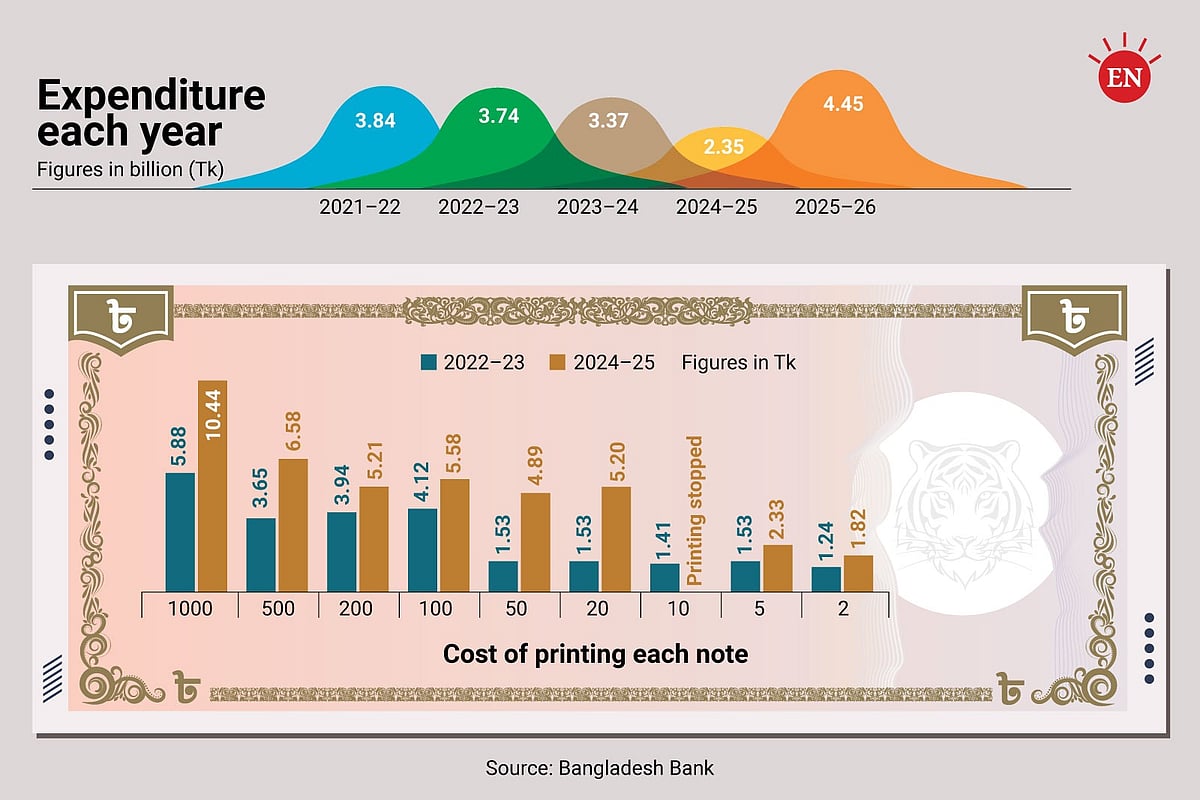
An internal report of Bangladesh Bank shows that printing costs have increased the most for Tk 20 and Tk 50 notes over the past five years. In the 2020–21 financial year, it cost Tk 1.58 to print a Tk 20 note.
By 2024–25, the cost had risen to Tk 5.20, meaning that the printing cost of the note increased by approximately 229 per cent.
Meanwhile, printing a Tk 50 note cost Tk 1.52 in the 2020–21 financial year. By 2024–25, the cost had surged to Tk 4.89, representing a 222 per cent increase in the printing cost of the Tk 50 note.
According to Bangladesh Bank sources, the printing cost is Tk 5.58 for a Tk 100 note, Tk 5.21 for a Tk 200 note, Tk 6.58 for a Tk 500 note and Tk 10.44 for a Tk 1000 note.
Printing a Tk 2 note would cost Tk 1.82, while printing a Tk 5 note would cost Tk 2.33.
We are encouraging greater use of digital transactions through Bangla QR. This will reduce the demand for and use of small amount cash. It will also reduce irregularities and corruption.Arif Hossain Khan, executive director and spokesperson of Bangladesh Bank
How much is spent in total each year?
Although the cost of printing each currency note has increased, Bangladesh Bank’s total expenditure has not risen at the same rate because it is printing less money than before.
A review of Bangladesh Bank’s annual reports for six years shows that the central bank spent Tk 3.4 billion (340 crore) on printing money in the 2020–21 financial year.
In 2024–25, the expenditure stood at Tk 2.35 billion (235 crore). According to unaudited figures for the 2025–26 financial year, the expenditure has reached Tk 4.45 billion (445 crore).
People familiar with the matter said that if sufficient numbers of banknotes had been printed, the expenditure would have increased further.
One of the people facing difficulties because of torn and damaged banknotes is Ramizul Islam, a mobile vegetable vendor in Mirpur-14 in the capital.
He told Prothom Alo, “Wholesale traders often refuse to accept torn notes. I do not even know where I should deposit these notes to have them exchanged.”