Most of the fish brought to Dhaka comes from Mymensingh. Ali Hossain, a fish trader from Trishal in the district has been transporting fish from there to wholesale markets in Dhaka for 15 years.
On Wednesday, Ali Hossain told Prothom Alo that he can carry about 40 maunds of fish in a truck using water-filled drums. Since the price of fuel oil was increased by Tk 20 per liter last Sunday, the truck fare has gone up by Tk 2,000.
Calculations show that the additional transport cost per kilogram is less than Tk 1.50. However, a visit to Dhaka's Mohammadpur Krishi Market, Town Hall Market, and Agargaon Taltola Market found that sellers are asking for Tk 20 to Tk 30 more per kilogram for farmed fish than before.
Chayan Chandra Das, a fish seller at Krishi Market, told Prothom Alo that they bring fish from the Mirpur-6 market in small trucks. The fare for those trucks has increased from Tk 1,000 to Tk 1,200. Wholesalers are also asking for higher prices than before. All these factors have pushed up fish prices.
Calculations show that the additional transport cost per kilogram is less than Tk 1.50. However, a visit to Dhaka's Mohammadpur Krishi Market, Town Hall Market, and Agargaon Taltola Market found that sellers are asking for Tk 20 to Tk 30 more per kilogram for farmed fish than before.
Following the hike in fuel prices including diesel, the cost of transporting products from farmers' fields to wholesale markets has risen. The cost of bringing products from various districts to Dhaka has increased, as has the fare for moving goods from wholesale to retail markets.
Analysis shows that the increase in costs at each stage has gone beyond what would normally be expected. Prices have risen by more than the actual increase in costs.
Overall, the impact has been visible in the markets, which has already been volatile since 2022. With prices staying high for four consecutive years, inflation has remained elevated and low-income people are in extreme crisis.
Economists say prolonged high inflation can push some people who are just above the poverty line back into poverty.
Khondaker Golam Moazzem, research director at the Centre for Policy Dialogue (CPD) was asked about the current condition of people. He said people were adopting various ways to cope because of prolonged inflation and limited job creation, including setting up roadside shops and driving battery-run rickshaws. In other words, informality in the economy is increasing.
On the other hand, many young people are becoming involved in crime. While speaking to Prothom Alo over phone, he was traveling by car from Banani to Mohammadpur. Stuck in traffic, he witnessed a snatcher trying to snatch a person's mobile phone right in front of him.
Golam Moazzem said people have not been in the grip of such high inflation for such a long time in the recent past. People are in crisis. The fuel price hike and the pay raise for government employees may further fuel inflation.
Due to high prices in the global market and various domestic reasons, the prices of daily essentials increased around 2007-2008. Prices were high at the beginning of the Awami League government's tenure that came to power in 2009. However, fuel and food prices in the global market began to fall quickly. The then-government benefited from this.
Analysts say that due to fuel and electricity prices, the production cost of goods will increase, which will also drive up prices. However, it is possible to reduce prices by taking product-specific measures in some cases. The government's relevant ministries are paying little attention to that.
Until the arrival of the COVID-19 pandemic in 2020, there was no major concern regarding inflation in the country. Prices rose during the beginning of the pandemic due to panic buying. The real crisis began in February 2022 after the Russia-Ukraine war started. Supply shortages emerged in the global market. Fuel and food prices increased.
At that time, the price of the dollar began to soar. Foreign exchange reserves began to decline. Inflation became unbridled. The Awami League government could not manage it properly at that time. Instead, the prices of gas, electricity and oil were increased repeatedly.
The economic situation deteriorated further due to unnecessary projects, money laundering and corruption. Later, the Awami League government was ousted in the July mass uprising on 5 August 2024.
However by then, the price of the dollar had increased from Tk 86 to Tk 118. Reserves fell from 48 billion to 26 billion dollars. That was only possible through strict import controls and deferring debt payments.
The interim government took office in August 2024. Economist Ahsan H Mansur became the Governor of Bangladesh Bank. This government halted the economic collapse, managed to stabilise the dollar rate and increased foreign exchange reserves but still could not keep inflation at a tolerable level. Interest rates were increased to curb inflation.
Then the BNP government assumed office on 17 February. Immediately afterward, the war in the Middle East began, which created a crisis in fuel supply and prices rose. That crisis is still ongoing. The government has increased diesel prices by Tk 35 per liter in two phases. Electricity prices were increased by an average of 17 per cent last June.
Analysts say that due to fuel and electricity prices, the production cost of goods will increase, which will also drive up prices. However, it is possible to reduce prices by taking product-specific measures in some cases. The government's relevant ministries are paying little attention to that.
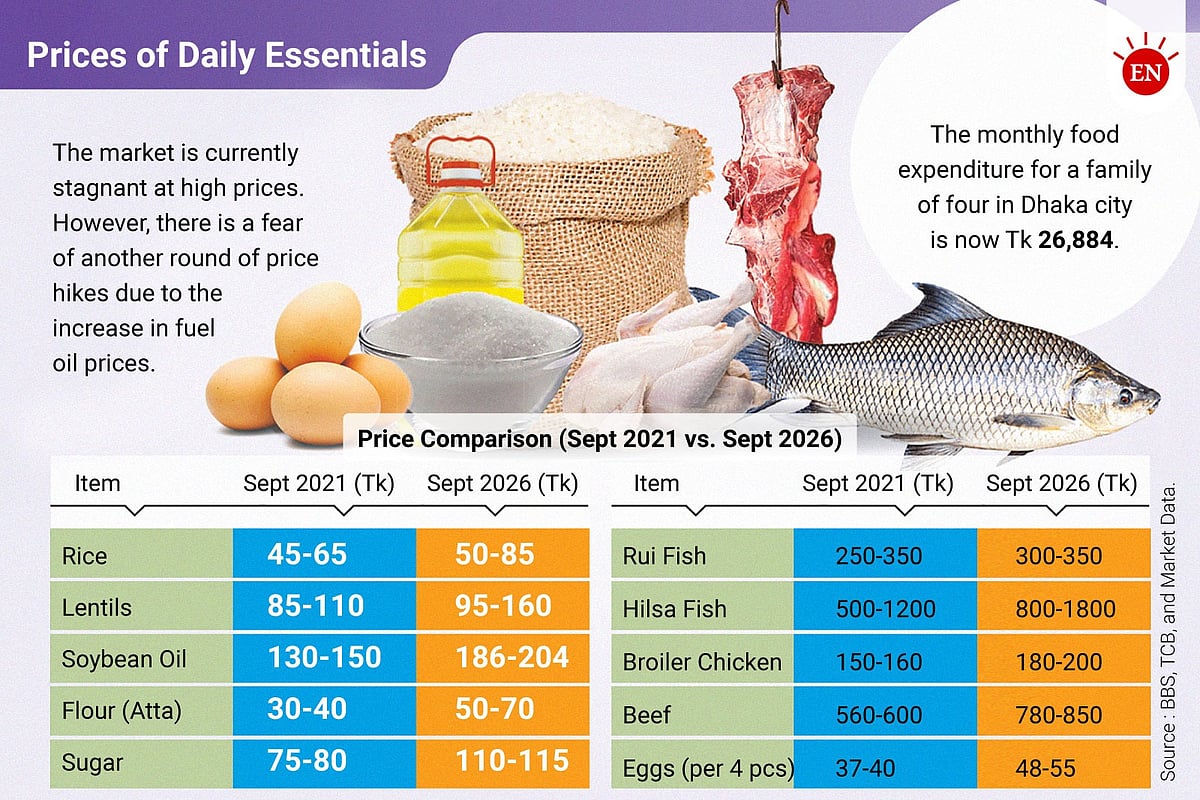
Prices of daily essentials: Then vs Now
Eggs are a major source of protein for low and middle-income families. Rowshan Ara, a resident of the capital's Shewrapara, needs at least 6 eggs every morning for her family. She occasionally cooks eggs for lunch and dinner as well. She said she has to buy an average of 250 eggs per month.
Before 2022, the price of a dozen of brown farm chicken eggs remained between Tk 90 and Tk 120 throughout the year. Now, it fluctuates between Tk 120 and Tk 160. Eggs were seen being sold at Tk 150 per dozen in three Dhaka markets yesterday. Rowshan Ara said her expenses on eggs alone had increased significantly.
Like eggs, broiler chicken prices are high as well at Tk 180-200 per kg. Beef has been out of reach for low-income people for a long time, at Tk 780-850 per kg.
Before 2022, the price of a dozen brown farm chicken eggs remained between Tk 90 and Tk 120 throughout the year. Now, it fluctuates between Tk 120 and Tk 160. Eggs were seen being sold at Tk 150 per dozen in three Dhaka markets yesterday. Rowshan Ara said her expenses on eggs alone had increased significantly.
Previous governments did not take any effective initiatives to reduce the prices of eggs, chicken and beef. The new government also lacks effective initiatives.
Analysts have been advising opening up imports by maintaining appropriate tariffs or allowing limited imports to protect farmers and reduce the prices of these three products. They have said that if there is no competition, the opportunity to charge high prices is created. No government has paid heed to this.
Commerce Minister Khandakar Abdul Muktadir told Prothom Alo, "Egg prices are a bit high. It always fluctuates by Tk 5 to Tk 10 per dozen. We sat down with the Poultry Association regarding this. We will sit again to investigate the cause."
He said, "The increase in beef prices has also come to our notice. We will soon sit for discussions with the Ministry of Fisheries and Livestock. We are working on it. I hope a solution will come."
Like eggs, broiler chicken prices are high as well at Tk 180-200 per kg. Beef has been out of reach for low-income people for a long time, at Tk 780-850 per kg.
When asked what initiatives have been taken to keep the prices of beef, chicken, and eggs at a tolerable level, the director general (acting) of the Department of Livestock Services, Md Shahzaman Khan, told Prothom Alo on 22 September that a committee was formed last week to reduce food prices.
Actions will be taken according to the committee's report once received. He said that if food prices decrease, production costs will decrease and if production costs decrease, the prices of everything will remain under control. He added, "Why do we only talk about eggs? Haven't fruit prices increased as well? Rice? Oil? We must think about the farmers and cultivators."
The director general termed the suggestion of creating market competition as a thought that would "destroy the industry." However, a 2024 study by the Bangladesh Trade and Tariff Commission (BTTC) indicates that the prices of day-old chicks, poultry feed and eggs are higher in Bangladesh than in India and Pakistan. The reason for this is providing "excessive" protection while keeping imports completely controlled.
Egg prices are a bit high. It always fluctuates by Tk 5 to Tk 10 per dozen. We sat down with the Poultry Association regarding this. We will sit again to investigate the cause.Commerce Minister Khandakar Abdul Muktadir
While the rhetoric of protecting marginal farmers is used to justify excessive protection, large corporations are the ones primarily benefiting. There are also allegations that policymakers benefits from them.
Onions and potatoes are perfect examples of how markets cannot easily be manipulated when supplies are adequate. Even toward the end of the season, onions are now selling at around Tk 50 per kg. There is little need for imports either. Potatoes, meanwhile, cost only Tk 25–30 per kg.
The government-fixed price of a 12kg liquefied petroleum gas (LPG) cylinder is Tk 1,585. In Dhaka, it is being sold for around Tk 2,000. Although this irregularity has continued for months, government agencies have been unable to take effective action.
In rural areas, LPG is available at prices slightly higher than the government-set rate.
What is the use of talking about all this. No one listens to us. Prices won’t come down either.Ansar Hossain, security guard
Different approach needed
Prices of various essential goods, including rice, lentils, edible oil and sugar, also remain high. The monthly food expenditure for a family of four in the heart of Dhaka city is now Tk 26,884. Rent and other expenses must be added to this.
But the minimum wage for workers in the garment sector, the country's top export sector, is Tk 12,500. The lowest salary for government employees under the new pay structure has been set at a little over Tk 36,000, including allowances.
Notably, the expenditure for a family of four was calculated based on the demand for products mentioned in the 2019 Urban Socioeconomic Condition Survey of the Bangladesh Bureau of Statistics (BBS) and current market prices of the TCB.
Analysts say that even though the salaries of government employees have increased, many people in the informal and private sectors are in a difficult situation. In addition to the strategy of increasing interest rates to make inflation tolerable, product-based initiatives are needed.
Market raids have not solved the problem in the past and they will not in the future. What is needed is to increase supply and competition. Otherwise, the benefits of the tax cuts given by the government in the budget will not be visible. Poverty will increase further.
Ansar Hossain works as a security guard at a house in Shekhertek, Mohammadpur. He is over sixty years old. He earns Tk 15,000. His wife earns about Tk 5,000 more by working as a part-time domestic worker.
When asked, Ansar Hossain told Prothom Alo that he has to be very calculating with his spending, yet he still has to ask others for help at the end of the month. He said, "What is the use of talking about all this. No one listens to us. Prices won’t come down either.”