Banking sector
We move from culture of loan default to culture of looting: Wahiduddin Mahmud
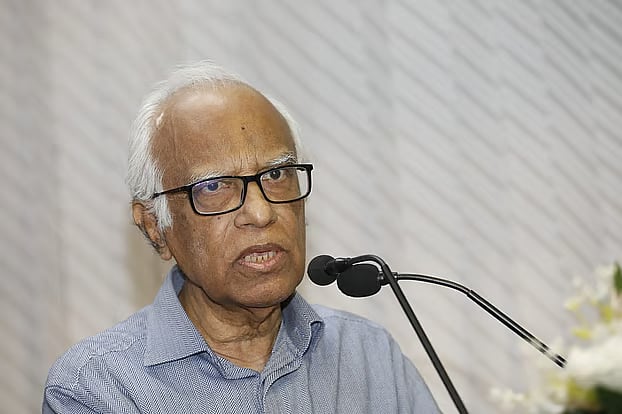
Wahiduddin Mahmud, former advisor for planning and education of the interim government, said that the country's banking sector first deteriorated due to the culture of loan defaults.
"Although we had moved away from the culture of non-performing loans, a new ''culture of banking loot'' emerged after 2010. This is why the financial sector is in such a bad state today," Wahiduddin Mahmud made these comments on Wednesday morning, during the inaugural session of the two-day annual banking conference organised by the Bangladesh Institute of Bank Management (BIBM) in Mirpur, Dhaka.
During his speech, Wahiduddin Mahmud shared his experiences on banking sector reforms.
He said, "To move away from the culture of non-performing loans, many rules and regulations were created and reformed with much effort. Alongside, discipline was restored by making rules. We were able to bring some private banks up to international standards. But after that, the culture of banking loot began, which is more severe. Money was taken from banks without any rules."
Wahiduddin Mahmud advised learning from past experiences in the banking sector.
He said, "We need to learn from the many years of experience in the banking sector. Why should we start learning anew? We had many debates in the past. Previously, we allowed banks to be established in the private sector without creating an adequate regulatory framework. What was the consequence of that? We saw that at the time, entrepreneur-directors drew loans of about one-third (equal to 35 per cent) of total deposits from the relevant banks."
Wahiduddin Mahmud stated that there should have been rules about whether a group or family could control multiple banks, which should come under ''anti-trust'' laws. He noted that there is still no antitrust or anti-monopoly law in place.
Influential persons close to political governments have always used state banks as centres for the distribution of undue privileges, according to Wahiduddin Mahmud.
He advised that if a political government wants to distribute benefits for political reasons, they should choose sectors that won't cause large economic damage to the country. However, it is entirely inappropriate to provide political patronage through the banking or financial sector. Political governments must understand this, as there is nothing Bangladesh Bank or bankers can do about it.
Wahiduddin Mahmud mentioned that the hasty approval of new banks after 2010, without proper vetting, led to their bankruptcy.
He explained that some bankrupt banks had accepted deposits from government institutions.
Wahiduddin Mahmud further stated that banks were even opened with teachers' salaries, welfare funds, and pension funds. Eventually, those banks became completely bankrupt, and poor teachers, MPO-listed teachers had billions of their pensions and welfare funds stuck. Those funds are still inaccessible.
Over the past 15 years, the excessive relaxation of regulations in the banking sector has led to the current situation, in Wahiduddin Mahmud's view.
He said, "Now, to rescue weak banks, some relaxation of regulations will again be necessary. But where is the guarantee that by relaxing regulations, we won't end up in the same bad situation as before?"
To overcome the current situation in the banking sector, Wahiduddin Mahmud suggested, "Banks should be given the opportunity to stand on their own feet. However, in doing so, we need to maintain adequate safeguards. Each case should be individually examined to ensure that funds reach honest, genuine entrepreneurs and businesses. If we cannot guarantee this, we will end up falling into the same old pit."
Other speakers are Md Kabir Ahmed, Deputy Governor of Bangladesh Bank; Abdul Hai Sarkar, President of the Bangladesh Association of Banks (BAB) and Chairman of Dhaka Bank; Jean Pesme, Regional Director for Bangladesh and Bhutan at the World Bank; and Masrur Arefin, Chairman of the Association of Bankers, Bangladesh (ABB), and Managing Director (MD) and Chief Executive Officer (CEO) of City Bank.
The keynote address was presented by Zaidi Sattar, Chairman of the private research organisation Policy Research Institute (PRI).