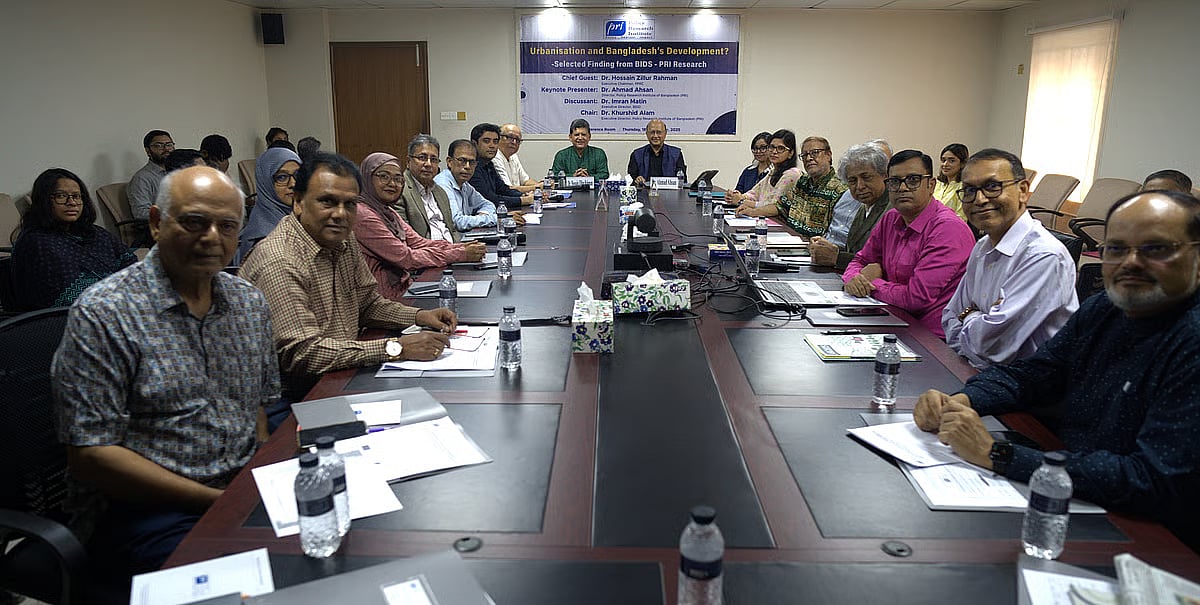
PRI seminar: Dhaka sees decline in productivity and employment growth
Dhaka, once regarded as the engine of national growth, is now seeing its productivity and employment growth slow sharply due to over-urbanisation.
Experts argue that without shifting the growth centre to other cities, the next phase of Bangladesh’s development will not be achievable.
Between 2010 and 2017, employment in Dhaka and other urban centres rose at an average annual rate of 4 per cent. But between 2017 and 2022, that figure slumped to just 0.8 per cent, with industrial employment entering negative territory.
These findings were presented at a seminar titled, Urbanisation and Bangladesh’s Development, organised by the Policy Research Institute (PRI) at its Banani office in Dhaka on Thursday.
The seminar noted that when more than 22 per cent of a country’s population lives in a single city, per capita income in that city tends to fall.
It was told in the seminar that Greater Dhaka is now home to 33 per cent of the country’s population, a hyper-concentration that is estimated to cost the economy 6–10 per cent of GDP.
Principal economist at the Policy Research Institute of Bangladesh (PRI) Ashikur Rahman observed that many development authorities were created for political reasons.
It was also pointed out in the seminar that with opportunities in the capital diminishing, factories are increasingly relocating outside Dhaka — but in an unplanned manner.
Speakers stressed the need for planned urbanisation, identifying areas such as Chattogram’s Karnaphuli, Khulna’s bypass region and Cumilla as viable alternatives.
Hossain Zillur Rahman, executive chairman of the Power and Participation Research Centre (PPRC), attended the seminar as chief guest, with Imran Matin, executive director of the BRAC Institute of Governance and Development (BIGD), as special guest.
Chattogram is also losing ground. It once housed the headquarters of the railway and navy, but those were relocated because of policy centralisation.Hossain Zillur Rahman, Executive chairman, PPRC
The session was chaired by PRI executive director Khurshed Alam, while PRI director Ahmad Ahsan presented the keynote paper.
The keynote highlighted that advanced economies typically ensure seven acres of open space per 1,000 residents. By contrast, Dhaka has virtually none. Khulna has a plan to provide two acres, and some other cities are also drafting similar initiatives.
The paper further observed that municipal bodies (pourashava) suffer from an absence of performance monitoring. Those operate under 40 separate authorities.
Following the seminar, speaking to Prothom Alo, Ahmad Ahsan said that the concentration of development in Dhaka over recent decades had cost the country significant GDP.
“If that growth had been distributed across other cities, GDP would have been considerably higher,” he noted.
Ahmad Ahsan argued that new growth centres could be developed within the next five to six years, adding that the government’s initiative to establish 100 economic zones had amounted to a waste of resources.
Political as well as economic decentralisation is essential. Yet the issue of devolving political authority is absent from discussions, even at the National Consensus Commission.Hossain Zillur Rahman, Executive chairman, PPRC
Hossain Zillur Rahman remarked that while many countries have megacities like Bangkok or Seoul, Bangladesh’s real challenge is that it has only one major city.
“Chattogram is also losing ground. It once housed the headquarters of the railway and navy, but those were relocated because of policy centralisation,” he observed.
The PPRC executive chairman pointed out that Dhaka’s Geneva Camp could serve as a valuable research site on land use. Diverse functions are managed there within a very small space.
For effective decentralisation, he said, local governments must be given not just responsibilities but real power.
Hossain Zillur Rahman further stressed that political as well as economic decentralisation is essential. Yet the issue of devolving political authority is absent from discussions, even at the National Consensus Commission.
Chairing the session, Khurshed Alam noted that the expansion of the readymade garment (RMG) sector had been accompanied by the growth of Gulshan, Banani and rising density. Later, when land became more readily available in Gazipur and Narsingdi, factories shifted there. Once-thriving industrial zones such as Sitakunda and Kalurghat in Chattogram have since lost ground, with activity redirected to Dhaka.
BIGD’s executive director Imran Matin warned that the dominance of a single city is raising the cost of both living and doing business.
“We need to examine whether Dhaka remains attractive because other cities lack comparable facilities, or simply because doing business in Dhaka is easier,” he stated.
In the open discussion, MM Siddiqui, CEO of Bangladesh Chemical, argued that despite perceptions, the cost of doing business in Dhaka remains the lowest in the country.
Principal economist at the Policy Research Institute of Bangladesh (PRI) Ashikur Rahman observed that many development authorities were created for political reasons.
The Chattogram Development Authority (CDA), he noted, was established to bypass the city mayor in the allocation of resources. Similar bodies were later formed in Gazipur and Khulna, often driven by political considerations.
Nonetheless, many towns outside Dhaka still lack the basic social amenities needed to sustain decentralisation, he pointed out.