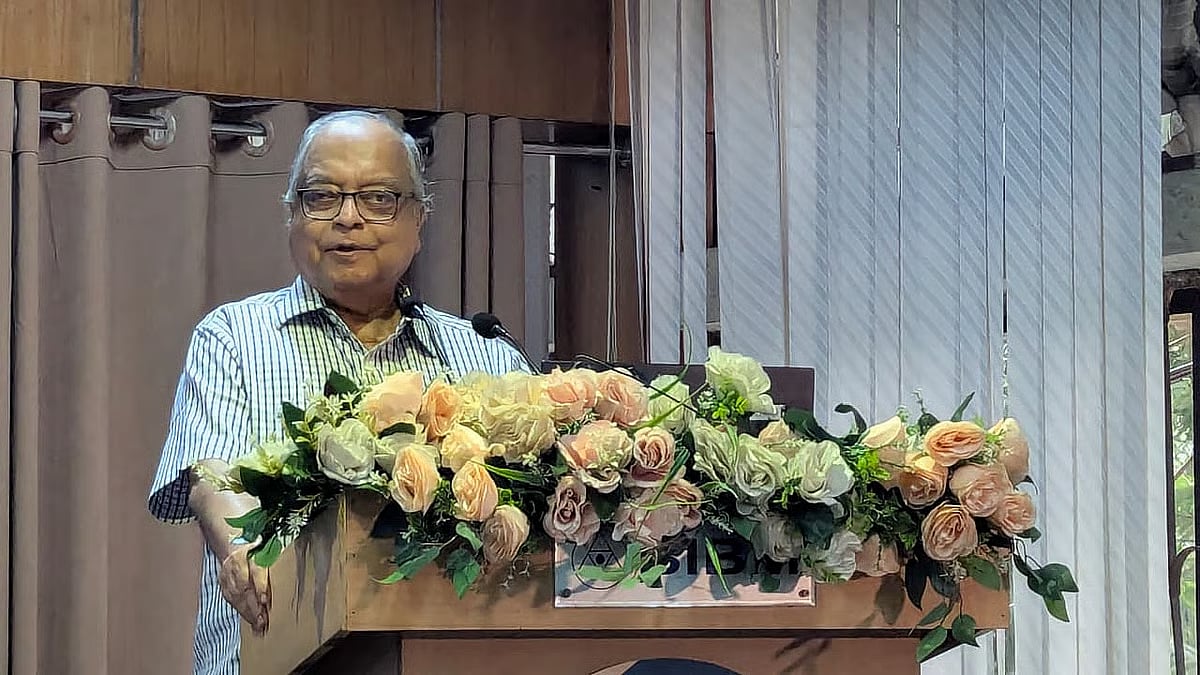
Economy may not just go off track, but fall into a river: Mahbub Ullah
National Professor Mahbub Ullah has said that the idea that the economy cannot be put back on the right track without accommodating oligarchs should not be encouraged.
“This time, the economy has gone off track. In the future, it will not merely go off track; it may even end up in a river. We must therefore be extremely cautious about such people,” he said.
Remarking that most banks are now on the brink of collapse, Mahbub Ullah said, “Bangladesh has turned into an exploitative state. Who does this system of exploitation serve? Not the general public, but a small group of wealthy and influential businesspeople and billionaires whom we call oligarchs. The state itself has created these oligarchs.”
Mahbub Ullah made these remarks while delivering a special guest address at the first session of the annual banking conference on Thursday, the final day of the two-day event organised by the Bangladesh Institute of Bank Management (BIBM) in Mirpur, Dhaka.
Barkat-e-Khuda, a former professor of economics at Dhaka University, presented the key-note paper while BIBM Professor Md Ahsan Habib delivered welcome speech.
Speaking at the event, National Professor Mahbub Ullah said, “Our banking sector is extremely weak and fragile. It is on the verge of extinction. This is an extremely unfortunate situation for the people and economy of Bangladesh.”
Remarking that most banks are on the brink of collapse, Mahbub Ullah said, “If we had followed market principles, most of these banks would have disappeared by now. But we are trying to keep them afloat through various means. I do not know how effective these efforts will be in keeping these banks alive.”
Mahbub Ullah believes the crisis of confidence is the biggest problem facing the banking sector.
“So many irregularities have taken place in the banking sector that most people have lost faith in the banking system. Despite this severe crisis of confidence, some banks are performing well and being managed properly. Perhaps we can learn from these four or five banks what needs to be done to improve the sector,” he said.
The national professor said the banking sector had now become entirely oriented towards the government, with little attention being paid to the private sector.
“As a result, the private sector is being deprived of credit, and a huge burden of debt will accumulate in the future. I do not know how the government will repay the instalments and interest on that debt,” he said.
Mahbub Ullah said, “We talk about privatising industries and banks. But, unfortunately, the rulers at the highest levels of power in this country have never considered the state to be the property of its people. They have treated it as their personal property or an empire from which they could distribute favours and benefits to their own supporters, relatives and close associates. That is the fundamental problem.”
He added, “Unless you can resolve this problem, unless you can change the nature of a state controlled by a handful of ambitious people and turn it into a state that belongs to ordinary citizens, no progress is possible.”
Conflicting pressures in the banking sector
Former Dhaka University economics professor Barkat-e-Khuda said the banking sector was currently facing a peculiar contradiction. While some weak and Shariah-based banks were suffering from acute liquidity shortages, the banking sector as a whole was holding a record amount of idle or excess liquidity.
By June 2026, excess liquidity in the banking sector had exceeded Tk 4 trillion, setting a record and marking a 39 per cent increase from the previous year, he said.
Barkat-e-Khuda identified three major reasons behind the abnormally high volume of non-performing loans: political influence and weak governance; lenient policies and repeated concessions for loan restructuring; and sluggish credit growth in the private sector.
He said money laundering and widespread financial embezzlement had severely damaged the banking sector.
An estimated Tk 5 trillion had been embezzled through fictitious loans and corruption, he said. Between Tk 2.5 trillion and Tk 3 trillion had been siphoned abroad by influential political and business syndicates.
Bank directors and oligarchs had manipulated regulations to extract money from various banks without providing adequate collateral or demonstrating any intention of repaying the loans, he added.
An interconnected network involving politicians, corrupt bank chairmen and managing directors had completely bypassed banks'' internal risk-control mechanisms, Barkat-e-Khuda said.