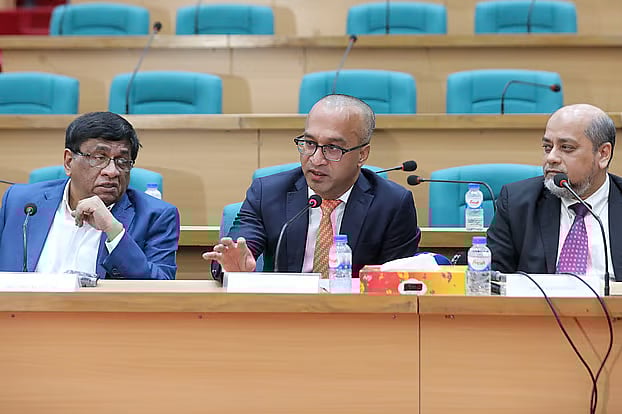
Banking sector’s Tk 11 trillion in loans problematic: Masrur Arefin
The Managing Director of City Bank, Masrur Arefin, remarked that S. Alam had singlehandedly destroyed the entire banking sector. He said, “Just as a single individual can destroy a bank, conversely, even one or two honest directors are enough for a bank’s success.”
Masrur Arefin made these comments at the panel discussion on “Banking Sector: Crisis, Reform and Regulation” held today, Sunday at the Nawab Nawab Ali Chowdhury Senate Bhaban auditorium of Dhaka University.
At the event, Masrur Arefin further said that the total volume of loans in the country’s banking sector is Tk 18 trillion (Tk 18 lakh crore), of which nearly Tk 11 trillion (Tk 11 lakh crore) is in a distressed state. At present, Bangladesh has 60 banks. Excluding foreign banks, there are 50 local ones. Among them, roughly 40 banks are of poor quality. About 15 of these are being described as outright “zombie banks.” Half of these banks have been outright plundered.
The discussion was jointly organised by Dhaka University, the University of Asia Pacific (UAP), and Germany’s OTH Amberg-Weiden. At the time, a draft research paper was presented in the keynote by Mahmud Osman Imam, Dean of the Faculty of Business Studies at Dhaka University. Pubali Bank Managing Director Mohammad Ali and Bank Asia Managing Director Sohel RK Hussain also spoke at the event. Teachers and students of Dhaka University, as well as stakeholders from the banking sector, were present.
Keynote
Presenting the keynote paper, Mahmud Osman Imam said that financial sector reform is complex and costly. Just as there are some good banks in the country, there are also zombie banks. In these zombie banks, the default loan rate exceeds 90 per cent of total disbursed loans. To reform the banking sector, Bangladesh Bank must be granted effective independence.
In reality, the major plundering in the banking sector took place under anonymous names, not due to legitimate shareholding.Masrur Arefin, MD, City Bank
Emphasising the amendment of the Bank Company Act, Imam further said that no more than two directors from one family should be allowed on a bank’s board. The tenure of board members should be reduced from 12 years to 6 years. In addition, the chairman and executive chairman of a bank’s board should come from outside the owners. This would increase transparency and accountability in bank management.
What the speakers said.
In the panel discussion, City Bank Managing Director Masrur Arefin said that the draft Bank Company Act stipulates 50 per cent independent directors. “Why should even good banks have to comply with this rule?” he asked. The draft also states that a family may hold a maximum of 10 per cent shares in a bank, and that the definition of “family” includes various types of relatives. But in reality, the major plundering in the banking sector took place under anonymous names, not due to legitimate shareholding.
At present, 12 banks are practically bankrupt, unable to return depositors’ money. The question is, what did the rating agencies say? What has the Anti-Corruption Commission done? What do the central bank’s audit reports reveal?Sohel RK Hussain, MD, Bank Asia
Pubali Bank Managing Director Mohammad Ali remarked that the crisis in the banking sector has not yet passed. He said that in December 2024, the amount of defaulted loans stood at Tk 3.45 trillion. By March it had risen to Tk 4.2 trillion. As of June 2025, defaults are expected to increase by another Tk 1.5 trillion. In this way, defaulted loans are reaching 30 to 40 per cent of total disbursed loans. Alongside this, banks are facing a liquidity crisis, leaving many depositors unable to withdraw their money when needed—one of the sector’s gravest problems.
Bank Asia Managing Director Sohel RK Hussain said that, in addition to independent directors and management, the central bank’s whistleblowing policy must be strengthened. Likewise, the accountability of rating agencies must be increased. “At present, 12 banks are practically bankrupt, unable to return depositors’ money. The question is, what did the rating agencies say? What has the Anti-Corruption Commission done? What do the central bank’s audit reports reveal?” He added that it is often heard that bank managers, fearing job loss, were forced to acquiesce to irregularities.
Sohel RK Hussain further said that the independence of the central bank must be ensured not just on paper, but in practice. The state-owned banks—responsible for major irregularities—must also come under the central bank’s direct and effective control. It must not stop at inspections; Bangladesh Bank must have the power to take immediate and tough action when irregularities occur.