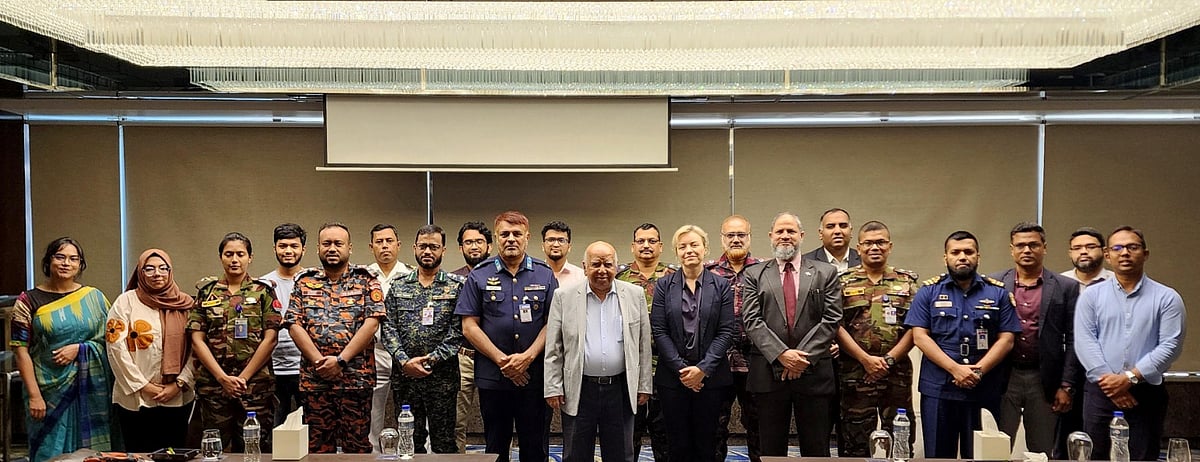
BIPSS workshop
Climate change and security: Potential instabilities in Bangladesh
Bangladesh Institute of Peace and Security Studies (BIPSS) organised a workshop under the European Union-funded project “Climate Change & Security: Potential Instabilities in Bangladesh”. The workshop, “Water Insecurity and Climate-Induced Displacement in Bangladesh: Security Challenges and Policy Responses,” was held on 21 October 2025 at Hotel Renaissance, Dhaka.
The event brought together distinguished policymakers, members of the security sector, researchers, academicians and young professionals to deliberate on one of the most pressing non-traditional security challenges confronting Bangladesh today, reports a press release.
The workshop featured two expert-led sessions followed by interactive discussions and tabletop exercises. Session 1, titled “Hydro-Climatic Stressors and Displacement in Bangladesh: Emerging Risks and Consequences”, was conducted by Sumaiya Binte Selim Subha, Researcher and Programme Coordinator at the International Centre for Climate Change and Development (ICCCAD).
The session explored key environmental drivers such as floods, riverbank erosion, drought and salinity intrusion, and their implications for internal displacement and community vulnerability.
Migration patterns in Bangladesh, Emerging risks of Climate induced displacement, loss and damage, policy adaption etc. were also discussed.
Session 2, titled “Strategic and Security Dimensions of Water Insecurity and Climate Migration in Bangladesh”, was led by Commodore Syed Misbah Uddin Ahmed, Director General of the Bangladesh Institute of Maritime Research and Development (BIMRAD).
This session examined the broader national and regional security dimensions of climate-induced migration, including border management, maritime implications and institutional coordination for resilience.
The session highlighted important topics like strategic dimensions of water insecurity, linkage between human security and internal displacement etc.
Participants underscored the need for integrated policy responses linking water management, climate adaptation and national security frameworks.
The discussions emphasised strengthening institutional preparedness, enhancing inter-agency collaboration and fostering partnerships between government, academia and civil society to build long-term resilience.
In his closing remarks, BIPSS President Major General ANM Muniruzzaman (Retd.) stressed the importance of water security and urged policymakers to adopt integrated and forward looking strategies that combine effective water governance and human security frameworks.
The event concluded with a call to advance cross-sectoral cooperation in addressing the humanitarian and strategic challenges arising from water insecurity and climate-driven displacement.