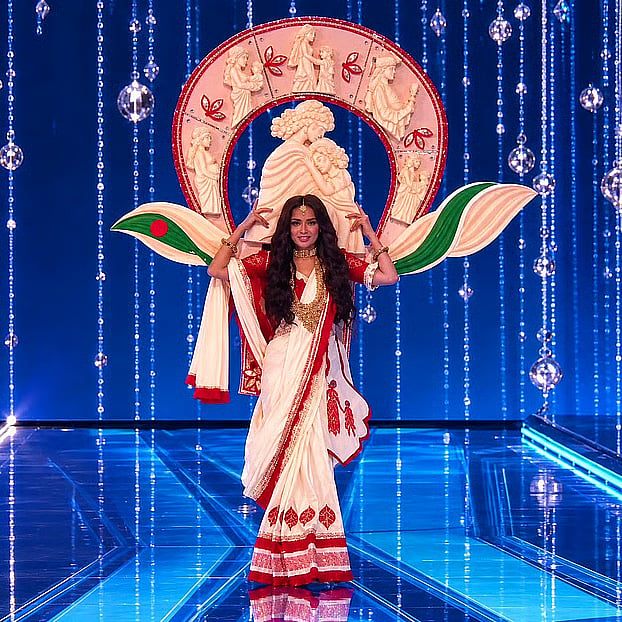
Mahi wears khadi sari in Miss Universe, celebrates motherhood and motherland
The 75th Miss Universe competition is underway in Puerto Rico in the Caribbean, with actress Samira Khan Mahi representing Bangladesh. She took to the stage for the national costume round at 5am Bangladesh time on 22 November.
Mahi’s national costume, designed around the theme of motherhood, had been revealed the day before. Wearing a red and white sari, a traditional outfit closely associated with Bengali women, she walked onto the stage with confidence, presenting a glimpse of Bangladesh through her attire.
A story of motherhood woven into Cumilla khadi
Mahi’s sari was made from Cumilla khadi fabric and designed by designer Bishwajit Mazumder. Bishwajit and his team also created the circular artwork worn on Mahi’s back, inspired by the theme of motherhood.
Bishwajit said, “We had very little time to design the sari. I had only three days. I spent the first two days developing the theme and creating the circular artwork celebrating motherhood, which Mahi carried on her back today. The sari itself was made in just one day.”
The international stage of Miss Universe offers an opportunity to showcase a country's culture and identity. Bishwajit said he chose to highlight motherhood with that in mind.
He said people also refer to their homeland as their mother, so he sought to connect the idea of mother and motherland. The circular artwork on Mahi’s back depicted a woman’s journey from childhood to becoming a mother and in the final stage of her life, finding refuge in her daughter’s embrace. Through the artwork, he sought to portray a story of affection and love passed down through generations.
Bishwajit said the sari was made from 16 yards of cotton khadi. To ensure Mahi could walk comfortably on stage and wear it with ease, the sari was pre-stitched into a ready-to-wear outfit. The border featured embroidered water lilies in a traditional kolka motif, while the sari also incorporated block-print designs.
Traditional jewellery inspired by Bengali mothers
Mahi paired the sari with gold-toned jewellery. Although gold jewellery is traditionally worn across much of South Asia, her collection drew particular inspiration from traditional Bengali ornaments.
The jewellery was designed by Tanwy Kabir, owner and designer of jewellery brand Canvas. She, too, had only seven days to complete the collection. During that time, nine artisans collectively spent 880 working hours crafting the pieces.
Tanwy said, “The traditional ornaments worn by mothers in our region in the past — Sita haar, kantha haar, bala and kantana jhumka — inspired this collection through their familiar designs, elegance and emotional significance. Through each piece, I wanted to revisit our roots, heritage and the emotions intertwined with the adornment of our mothers.”
Each piece was handcrafted by artisans with meticulous attention to detail. Beyond preserving the tradition of Bengali jewellery, Tanwy said she also wanted to showcase the skills, artistic sensibilities and craftsmanship of local artisans through the collection.
Mithila arrives in Puerto Rico with the national costume
As Mahi was selected Miss Universe Bangladesh 2026 at the last moment, she could not take her national costume with her. Her friend and Miss Universe Bangladesh 2025 Tanjia Zaman Mithila took charge of preparing the costume and accessories.
Speaking from Puerto Rico, Mahi said, “Mithila apa thought of the national costume, just as she did with everything else. Having a friend and elder sister like her meant I could manage and organise so much despite having so little time.”
Mithila arrived in Puerto Rico a day before the national costume round, carrying the outfit with her. All the elements of the costume were made in Bangladesh. To make it easier to transport, the circular artwork on Mahi’s back was constructed in nine separate pieces. The artwork depicting motherhood was made using wood, foam, fabric and shola.
Combining indigenous khadi, water lily motifs, traditional jewellery and the story of motherhood, Mahi’s national costume brought together Bangladesh’s culture, craftsmanship and emotional heritage in a single presentation.