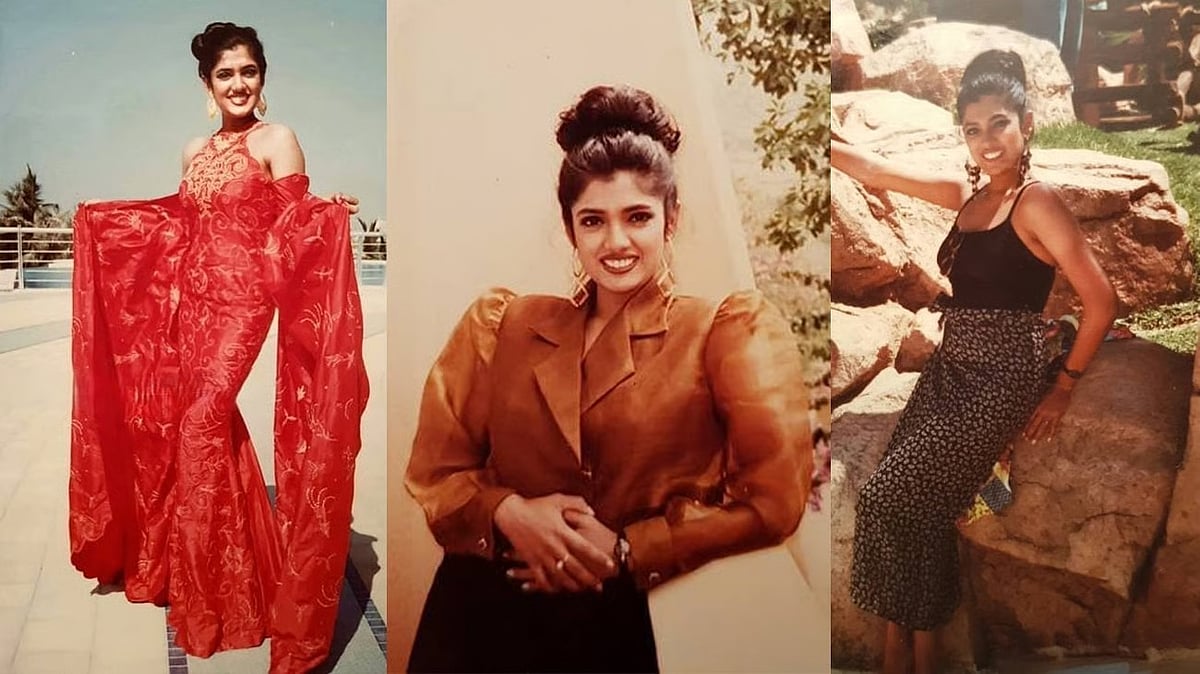
Where is actress Sathi now, first Bangladeshi representative at Miss World pageant
She was the first contestant selected to represent Bangladesh at the Miss World pageant and won a National Film Award for her acting. Then, she suddenly disappeared from the spotlight. She has been away from the film industry for 20 years. Sathi Bilkis Yasmin is now busy in the corporate world. She recently spoke to Prothom Alo about her journey nearly three decades ago, her entry into and departure from the film industry, and her life today. Monzur Kader spoke to Sathi.
It was 1994. Sathi Bilkis Yasmin was watching the Miss World pageant on television at her home in Gulshan, Dhaka. While watching the competition, she was scolded by her mother for not concentrating on her studies. Jokingly, she told her mother, “You won't let me watch television. One day, you will see me participating in it myself.”
It was mostly said in jest. But the following year, her mother saw those words come true. Sathi participated in the Miss World pageant as the first contestant selected to represent Bangladesh.
She subsequently acted in films, won a National Film Award and participated in international film festivals. Her life took several turns. But eventually, she stepped away from the acting world that had brought her the most recognition. Today, she is known as a corporate professional and serves as the managing director of an organisation.
She is rarely seen at gatherings related to acting or cinema. However, all her memories of the entertainment industry remain a wonderful chapter of her life.
Speaking about different chapters of her life, Sathi told Prothom Alo how she got the opportunity to participate in the Miss World pageant, why she entered films and why she eventually stepped away from acting. The conversation also touched on her present life, past achievements and some advice for women of the younger generation.
From her mother’s scolding to the Miss World stage
In 1994, Sathi was preparing for coaching after completing her A-level examinations at an English-medium school in Dhaka. She lived in Gulshan. One day, she was watching the Miss World pageant on television at her home in Gulshan. Aishwarya Rai was among the contestants. Seeing her daughter watching television, her mother, Yasmin Matin, told her to sit down and study. Sathi jokingly replied that one day she, too, would be seen on the Miss World stage.
The following year, an advertisement in a newspaper reminded Sathi of those words. A London-based organisation was going to organise the ‘Miss Bangladesh’ pageant in Dhaka. Interested candidates were asked to send their CVs. Sathi asked her mother whether she could apply. Her mother directly told her that she had no idea about modelling. But Sathi wanted to give it a try.
Sathi is the eldest of three sisters. Her younger sister, Saba Reza, took a few photographs of her at their Gulshan home. There was no professional makeup or special preparation. She took the pictures wearing just a little lipstick and mascara. She also wrote why she wanted to represent Bangladesh.
After being shortlisted, she was invited for an interview. To prepare, she studied the history of Bangladesh, the situations in different countries and general knowledge.
Sathi says, “As far as I can remember, the interview lasted nearly an hour and was held at a Chinese restaurant in Moghbazar. I was asked questions on various topics, ranging from the history of Bangladesh to the prime ministers of different countries. It felt like I was sitting for a general knowledge test. A person named Mr Danesh Ahmed had come from London to conduct the interview. A few local people were also present, but I cannot recall everyone's names at the moment.”
In 1995, the final round of the ‘Miss Bangladesh’ pageant was held at Hotel Isha Khan in Dhaka. However, Sathi Yasmin's experience of stepping onto the competition stage was not easy. She became frightened after seeing so many people from backstage.
Recalling that day, Sathi says, “I told my mother I would not go in front of so many people. My mother reminded me that since I had come this far, I had to fulfil my wish before returning home.”
Sathi eventually stepped onto the stage and answered the judges' questions. At one point, she was selected as ‘Miss Bangladesh’. This opened up the opportunity for her to represent Bangladesh at the Miss World pageant.
Sathi said Bangladesh did not have much international recognition at the time. Abroad, the country was largely associated with issues such as poverty and floods. But she wanted to introduce the world to Bangladesh's rich culture, educated people and the talents of its women. For her, the pageant was not merely a platform to showcase beauty but also an opportunity to present her country to the world.
The judges at that year's ‘Miss Bangladesh’ pageant included journalists Rahat Khan and Shafik Rehman, writer Syed Shamsul Haq and singer Yasmin Mushtari.
Aishwarya on stage, Nelson Mandela in the audience
The Miss World pageant was held in Pretoria, South Africa, in 1995. Among Sathi's memories of participating in the competition, meeting Nelson Mandela remains a special chapter.
As the names of representatives from different countries were being announced one after another on the pageant stage, Sathi had the opportunity to shake hands with Nelson Mandela. At the time, Mandela was the president of South Africa. He asked her about Bangladesh's then prime minister, Khaleda Zia, and the situation in the country. This surprised and delighted Sathi. A globally recognised leader taking an interest in her country was a particularly meaningful experience for her.
During the conversation, Sathi also mentioned that Mandela's life and struggles had inspired her. His journey from a prolonged struggle to leading his country taught her how important patience, courage and a commitment to serving people are in achieving great things.
Sathi also met Bollywood legend Amitabh Bachchan at the Miss World pageant. She had watched his performances since childhood. Seeing the star in person initially left her somewhat overwhelmed. Later, Amitabh asked her what she would do for her country if she won the Miss World crown.
Sathi told him that she wanted to work for children. However, she added that one person alone could not bring about major changes; the government, society and different stakeholders would have to work together. According to here, Amitabh liked the answer.
At the Miss World pageant, Sathi also met Aishwarya Rai, who had won the Miss World crown in 1994. She has an amusing memory of that encounter, too.
Recalling the incident, Sathi says, “At one point, I found myself face to face with Aishwarya Rai. She told me, ‘I was watching you from a distance. You looked just like Sushmita Sen. You have a lot of resemblance to her.’ Hearing this from Aishwarya was quite inspiring for me because Sushmita Sen was one of my favourites. Back then, my friends and acquaintances would tell me, ‘You look like Sushmita Sen.’”
The contestants' outfits and styling for the Miss World pageant also required special preparation. Sathi's mother, Yasmin Matin, took major responsibility for selecting designs and choosing suitable outfits. Roksana Salam, a designer associated with the London-based organisation, also designed some of her outfits. Even after all these years, Sathi remembers those dresses.
Entering the film industry and eventually stepping away
After returning home from the Miss World pageant, Sathi received many offers to act. However, she had no formal training in acting. Initially, she was not interested in working in films either. Her maternal grandfather, MA Matin, was a friend of filmmaker Ehtesham. Ehtesham wanted Sathi to act in films. Eventually, she entered the film industry at his encouragement.
Sathi viewed acting opportunities as a way to gain different experiences in life. She believed that life was a one-time opportunity and that one should embrace new possibilities when they arise. She did not want to confine herself to a single identity.
Sathi had another purpose behind entering the film industry. She wanted Bangladeshi films to gain international recognition and hoped to change people's negative perceptions of the country's cinema. She felt that Bangladeshi films deserved the same artistic recognition that Indian films enjoyed. She also wanted to establish the idea that women from educated families could enter the film industry.
Sathi acted in several films. Her debut film, directed by Ehtesham, was Pordeshi Babu, in which Ferdous was her co-star. She subsequently acted in Abbajan and Bir Soinik with Manna, Anyayer Protishodh with Rubel, Boro Malik with Shakib Khan, and finally Aha!.
For her performance in Bir Soinik, directed by Delwar Jahan Jhantu, she won the National Film Award for Best Supporting Actress. Sathi considers receiving such recognition for her acting a major achievement.
After she won the award, her mother told her, “You have won the National Film Award. What more could you ask for!”
Sathi, too, considers it a significant recognition. In her view, the National Film Award is not merely recognition of an acting performance; it is also a way for the state to honour an artist's work.
Her final film appearance was in Aha!, directed by Enamul Karim Nirjhar. The film received appreciation from audiences interested in unconventional stories and filmmaking beyond mainstream commercial cinema.
Sathi also attended film festivals in Dubai and Turkey with Aha!. She remembers meeting artists from different countries at those events.
However, Sathi also encountered certain limitations while working in films. She found it difficult to adjust to the shooting environment and work with film crews. The uncertainty over whether audiences would accept a film also concerned her. She believes that, at the time, there was considerable negative discussion surrounding the film industry.
Sathi wanted to maintain a clean public image and avoid getting involved in controversies. She said she received sincere support from directors, producers and co-actors while working in films. However, she did not want to pursue acting as a profession.
Busy with corporate life now
After participating in the Miss World pageant and working in films, a new chapter began in Sathi's life. Her father, Morshed Reza, wanted her to join the family business. As the eldest child, expectations were high. Her father had also arranged an office for her.
Sathi said she always received support from her family. She embraced opportunities to take on different kinds of work at different stages of her life. For her, gaining new experiences was more important than confining herself to a particular identity. Gradually, she established herself in the corporate world. She is currently serving as the managing director of an organisation.
Sathi said stepping away from films does not mean that chapter of her life has lost its value. Rather, both the Miss World pageant and her acting experience taught her many things.
Sathi says, “You have to embrace the opportunities life offers, but you should never make a single achievement your entire identity.”
Nearly three decades ago, the young woman who represented Bangladesh on the Miss World stage still cherishes those memories. At the same time, she has built her own identity in her present career.
Building an identity matters more than winning a crown
Sathi's advice to women of the younger generation is that no title should become the limit of their identity. Instead, they should use it as a platform to move forward. Winning the Miss World crown or any other pageant can be an achievement in life, but it is not everything.
She said women should dream bigger, educate themselves and build their own identities. Becoming financially and mentally strong is equally important. They should not be afraid to enter spaces where they initially feel out of place. Sometimes, they have to step into such spaces even before they fully believe in their own abilities.
Drawing on her own experience, Sathi said, “My real journey in life began after I put the crown aside. Participating in the Miss World pageant was an achievement, but everything I did afterwards gave me opportunities to look at life in new ways.”