Toronto screens become a stage for protest
The stars are there. So are the red carpets and the early Oscar talk. But another theme has emerged in the first few days of the 51st Toronto International Film Festival. Films questioning power, inequality and established systems are drawing attention.
The subjects are wide-ranging. They include Elon Musk’s enormous influence, the justice system’s treatment of survivors of sexual violence, disability rights, war, migration and the legacy of Palestinian scholar Edward Said.
So, the red carpet is not the only story in Toronto. Films like ‘Being Heumann’, ‘Black Sunflowers’, ‘Edward Said: Between Worlds’ and ‘Prima Facie’ have already brought pressing social and political issues to the screen. Alex Gibney’s much-discussed documentary ‘Musk’ joins that list on 14 September.
The debate around ‘Musk’
Oscar-winning documentary filmmaker Alex Gibney’s ‘Musk’ was scheduled to have its North American premiere at 3:20 pm local time on 14 September at Scotiabank Theatre, Cinema 1. The film had its world premiere at the Venice Film Festival.
Running for nearly four hours, the documentary examines Elon Musk’s economic, technological and political influence.
Speaking to Reuters in Toronto, Gibney said the film is not simply a portrait of a billionaire. He also wants to raise questions about the extraordinary concentration of power in the hands of a small number of people in the technology industry.
The documentary was initially planned as a film of about two hours. It grew longer as Musk’s political role and influence expanded. The film covers his businesses, including Tesla and SpaceX, his acquisition of Twitter, and his growing political influence.
Musk has strongly criticised the documentary. Gibney, however, has said its material was checked against multiple sources and reviewed by independent fact-checkers and lawyers.
‘Musk’ has another TIFF screening scheduled for 11:50 am on 17 September at Scotiabank Theatre, Cinema 13.
Putting the justice system on trial
Another kind of power comes under scrutiny in ‘Prima Facie’. The film had its premiere at Roy Thomson Hall at 5:45 pm on 13 September.
Directed by Susanna White, it is adapted from Suzie Miller’s acclaimed stage play. Cynthia Erivo plays Tessa, a successful criminal defence lawyer.
Tessa is used to defending men accused of sexual offences. Her perspective changes after she is sexually assaulted by a colleague and has to face the same justice system as a complainant.
Erivo told Reuters in Toronto that she hopes the film will encourage more discussion about sexual violence, consent and the justice system.
Another screening of ‘Prima Facie’ is scheduled for 6:45 pm on 18 September at Scotiabank Theatre, Cinema 3.
Has Hollywood changed since ‘CODA’?
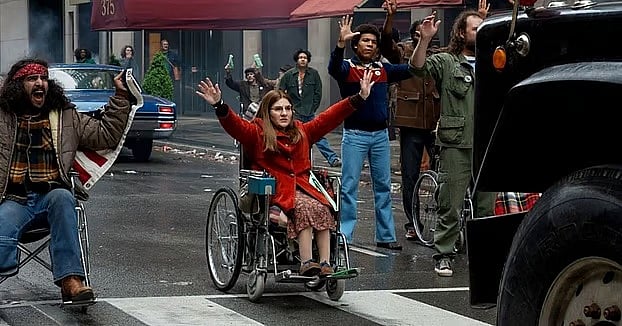
The trend was visible from the festival’s opening film, ‘Being Heumann’. Its world premiere at Roy Thomson Hall on 10 September opened this year’s TIFF.
The film is directed by Siân Heder, whose ‘CODA’ won the Academy Award for Best Picture. Her latest work tells the story of Judy Heumann, a pioneering American disability rights activist. British actor Ruth Madeley plays Heumann.
A key part of the film focuses on the historic 1977 protest led by Heumann and other disability rights activists at a federal building in San Francisco. The sit-in lasted 26 days. It helped pressure the US government to implement Section 504 of the Rehabilitation Act of 1973, a landmark provision against discrimination based on disability.
Heder believes Hollywood has still not changed as much as many had hoped after the success of ‘CODA’. For ‘Being Heumann’, she cast disabled performers in many of the film’s key roles.
From Ukraine to Edward Said
The pattern extends beyond these three films. It is particularly visible in this year’s TIFF Docs programme.
The section features 21 documentaries from 20 countries. Eighteen are having their world premieres at the festival.
James Marcus Haney’s ‘Black Sunflowers’ looks at the human cost of the war in Ukraine. It had its world premiere at Scotiabank Theatre at 6:45 pm on 11 September. A second screening took place there at 6:25 pm on 13 September. A third is scheduled for 18 September.
‘Edward Said: Between Worlds’, directed by Mayken Baird, explores the life, ideas and legacy of Palestinian intellectual and literary critic Edward Said.
Its first TIFF screening took place at Scotiabank Theatre, Cinema 13, at 6:10 pm on 12 September. It screened again at Cinema 6 at 8:50 pm on 13 September. Another screening is scheduled for 1:15 pm on 20 September at Cinema 7.
This year’s TIFF Docs programme opened with Rebeca Huntt’s ‘Rapinoe’, a documentary about US football star Megan Rapinoe. The film had its world premiere on the opening day of the festival.
The section also includes Sine Plambech’s ‘Rescue’, about migration across the Mediterranean; Afsaneh Salari’s ‘Tehran, Under the Skin’, which looks at Iran’s beauty industry and the lives of women; and Barbara Kopple’s ‘Union Town’, about labour organising in New York.
‘Rescue’ will screen at 12:15 pm on 15 September at Scotiabank Theatre, Cinema 14. ‘Union Town’ is scheduled for 2:45 pm on 15 September at Cinema 2, with another screening at 12:40 pm on 20 September at Cinema 10.
A festival of nearly 300 films
Nearly 300 films are part of this year’s TIFF. Chief Programming Officer Anita Lee has said the festival wants to reflect the complexities of the world today and create room for different stories and perspectives. She has also noted the growing interest among younger audiences in films from outside mainstream Hollywood.
The 51st Toronto International Film Festival began on 10 September and runs through 20 September. Screenings continue across Toronto on 14 September at venues including Roy Thomson Hall, the Royal Alexandra Theatre, the Princess of Wales Theatre, TIFF Lightbox and Scotiabank Theatre.
Along with ‘Musk’, the day’s programme includes ‘Wild Horse Nine’, ‘Back in Black’, ‘Nosotros’, ‘Iron Boy’, ‘All About Corinne’ and ‘Alpha Gang’.