Endangered mammals: A struggle for survival without forests
About a decade ago, a solitary langur was spotted in a bamboo grove in Chowgacha of Jashore at dawn. It sparked curiosity—how had it strayed nearly 50 kilometres from Keshabpur? The animal that moves from tree to tree quickly became a source of fascination for local residents.
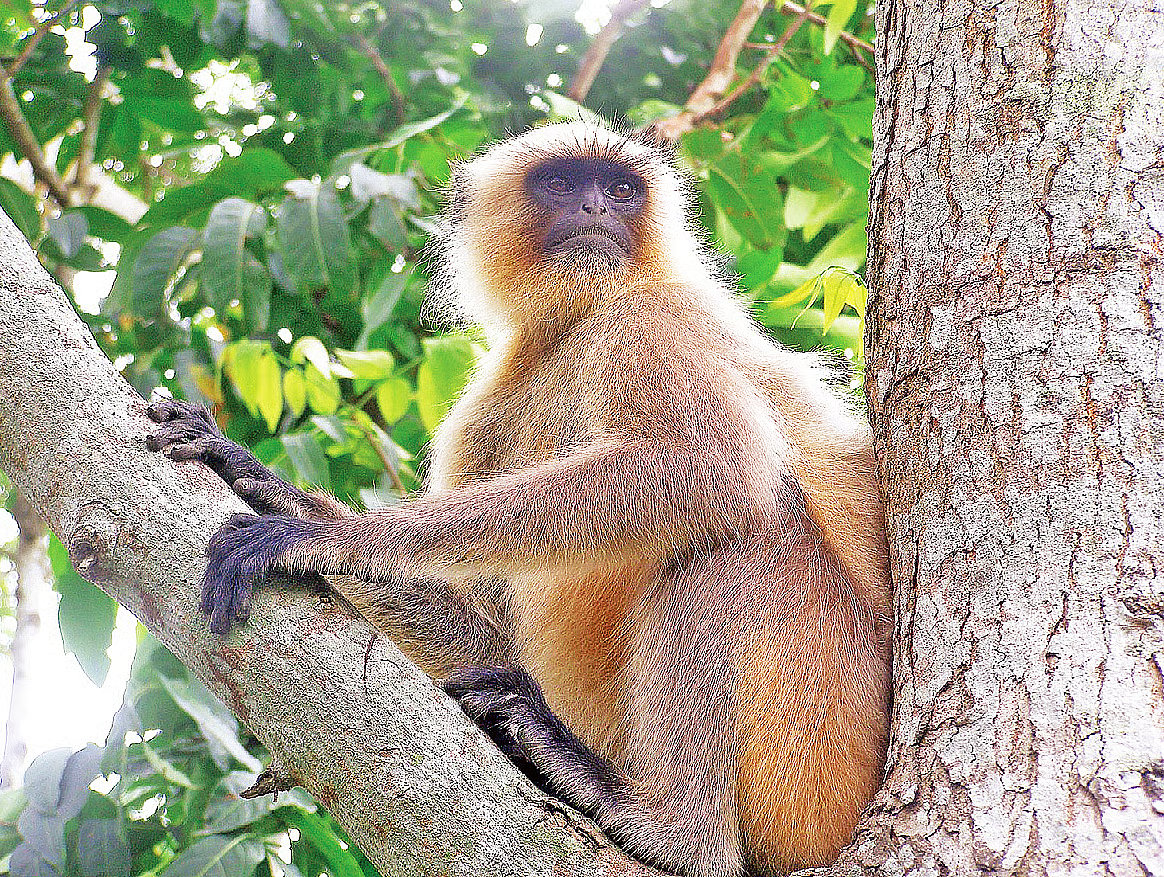
This primate, known in Bangla as hanuman, is referred to in English as the “Northern Plains Grey Langur”, “Common Langur”, or “Bengal Sacred Langur”. Of the three species of langur found in Bangladesh, only this one inhabits a few villages in Keshabpur and Monirampur of Jashore; the other two are forest dwellers. According to the International Union for Conservation of Nature (IUCN) Red List, they are classified as endangered.
In South Asia, the distribution of this Langur is largely confined to the region between the Ganges River and the Brahmaputra River. Beyond Bangladesh, they are found in various states of India and also in Nepal. In India, they inhabit not only areas near human settlements but also several forested regions.
In Keshabpur and Monirampur, these langurs have lived alongside human settlements for generations. According to an 1867 Delhi Gazette account, a Hindu pilgrim once settled along the banks of the Jalangi River with a pair of langurs. It is believed that today’s populations in these areas descended from that pair. The Jalangi River originates from the Padma in Murshidabad and flows into the Bhagirathi River—roughly 200 kilometres from Jashore.
During a past research visit to Keshabpur, I observed that although food and habitat are scarce, conflict between locals and langurs remains relatively limited. Despite occasional damage to crops and fruits, a degree of compassion towards the animals still persists among residents.
Langurs are slender, with long limbs, exceptionally long tails, and strong hindquarters—features that make them well adapted to arboreal life. They can leap 20 to 30 feet between trees, even while carrying infants clinging to their chest or back. On the ground, they move quadrupedally like other four-legged animals.
Their bodies are covered in greyish fur, while the face, palms, and soles are black. The langurs observed at Corbett Tiger Reserve in India appeared somewhat lighter in colour. Body length ranges from 18 to 31 inches, while tails can measure 32 to 112 inches. Males weigh between 17 and 20 kilograms, females between 10 and 16 kilograms. They can give birth at any time of the year, usually producing one offspring annually.
Their social structure is particularly striking. Langurs live in groups averaging around 13 members, though some groups may include up to 20. A dominant male leads a group consisting of several females and their young. This male does not tolerate the presence of other adult males and expels maturing males to maintain dominance.
Encounters between groups often lead to clashes, led by the dominant males. During such clashes, they leap aggressively, shake branches, bare their teeth, and issue threatening gestures.
Relations with local communities remain largely peaceful, although the animals can be wary or even aggressive towards strangers. Overall, however, there is no strong hostility towards them in Keshabpur.
With forests gone, their survival now depends almost entirely on human-modified environments. Despite crop losses, local people’s empathy has so far sustained this coexistence. Yet, as food and habitat shortages intensify, how long this fragile coexistence can endure remains an open question.
* MA Aziz, Professor, Department of Zoology, Jahangirnagar University.