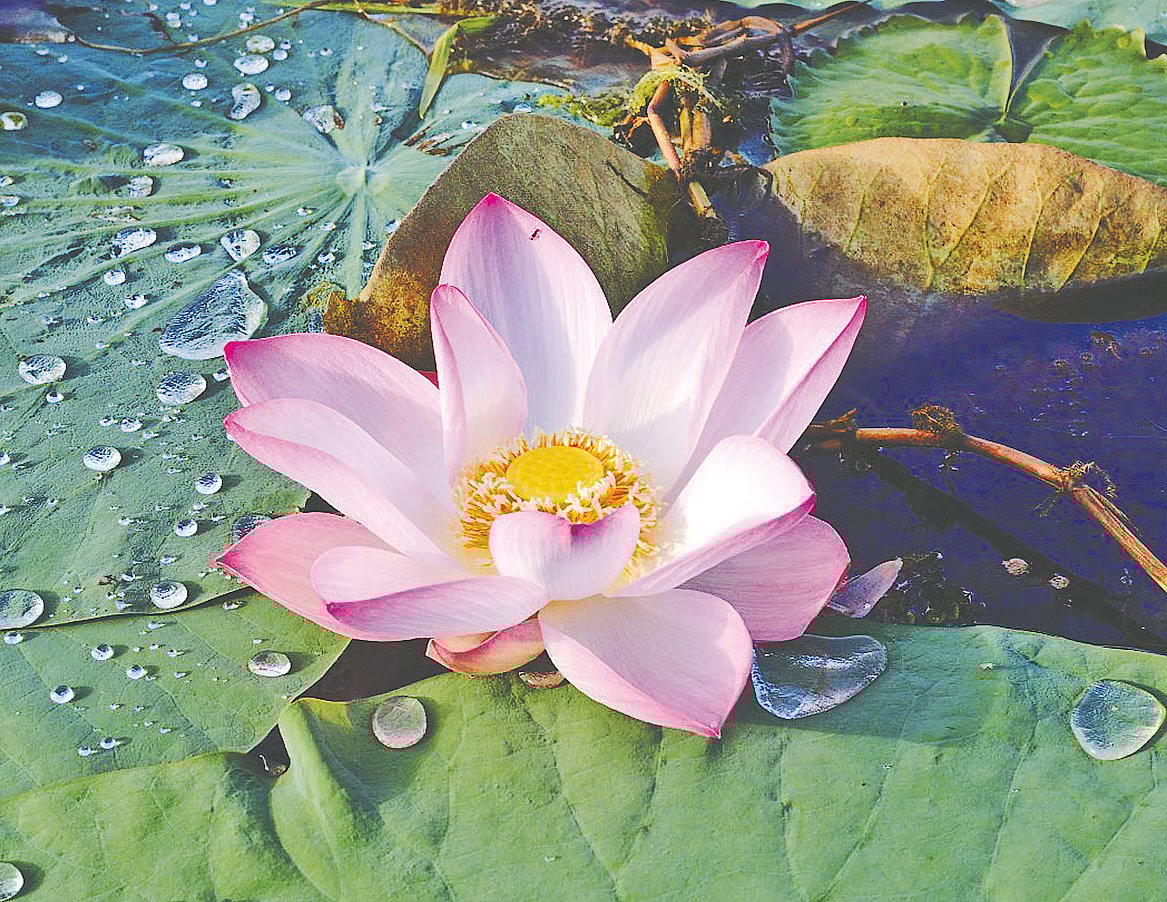
Lotus flowers absorb pollution, but are disappearing
The lotus, a symbol of beauty and purity, adds charm to wetlands, yields honey, and even has food value. Yet scientists, botanists, and climate experts say this remarkable plant is far more than just ornamental—it is one of the world’s most ancient and ecologically valuable species.
The lotus is exceptionally efficient at absorbing carbon dioxide, the gas most responsible for global warming, outperforming most other aquatic plants.
Beyond carbon absorption, the lotus can also purify heavy metals like lead, copper, fluoride, and nitrate from water. Its presence in a waterbody often indicates good water quality. Research around the world has shown that where lotuses grow, the level of dissolved oxygen (DO) tends to be high—making the waters healthier for aquatic life.
Today, the use of lotus in food, medicine, and cosmetics is growing rapidly. The combined global market for lotus seeds, extracts, tubers, and leaves is now worth over 250 billion taka (about 2.3 billion USD).
Indian poet Sunil Gangopadhyay once wrote in his famous poem Keu Kotha Rakheni about searching “the whole world” to bring 108 blue lotuses for his beloved Baruna. Inspired by that romantic image, we too went in search of the flower and its fading habitats.
It was a late morning in mid-autumn when we reached Tangail, a district once famous for its lotus-filled wetlands. The ponds and lakes of Kalihati upazila used to bloom with lotuses, but now they tell a different story. We roamed through Paikra Beel, Charan Beel, Nokil Beel, Kumar Beel, and Singuli Beel—once vibrant with color, now overrun by water hyacinths. Not a single lotus in sight.
In one of those waterbodies, called Satbeel, a boatman named Majnu Shah told us, “Lotuses used to bloom here, but not anymore.”
Further exploration led us to Nandai Beel in Dhangra village under Nagbari Union. Cutting through mats of hyacinths and other aquatic plants, we finally saw a few floating lotus leaves—but very few flowers. “Fish farming is done here now,” explained boatman Azizul Islam. “There used to be lotuses all around, but now they survive only in small patches. To farm fish, people pull out the plants.”
Azizul, now in his sixties, reminisced about his childhood: eating mashed lotus leaves, snacking on lotus seeds, and watching others sell lotus honey in the local market. The sight of colorful lotuses once blanketed the beels, but those days are gone. “Now you might find only four or five flowers if you’re lucky,” he sighed.
Despite its ecological and economic value, the lotus is losing its natural habitat in Bangladesh. Wetlands are shrinking, and fish cultivation is replacing natural aquatic ecosystems. While many countries around the world are investing in research and conservation of lotus, in Bangladesh such studies remain rare.
Renowned botanist and Dhaka University professor Dr. Rakhhari Sarkar believes this ancient flower could play a key role in tackling climate change. “The lotus is not merely a symbol of beauty,” he says. “It’s a silent ally of our climate. If we don’t protect it now, we’ll lose one of nature’s finest gifts.”
In Naogaon’s Manda upazila, Andhashura Beel once spanned 750 bighas and was a major lotus habitat. Two years ago, the local administration leased the beel to a fish farmer from Rajshahi’s Tanore upazila. He uprooted all lotus, singara, nika, and other aquatic plants with machines. Only a few lotus plants now survive in the northern side of the beel near Chaubaria market, where some flowers still bloom — drawing visitors who come to admire them.
“The Lotus Effect”
Professor Wilhelm Barthlott of the Department of Botany at the University of Bonn in Germany conducted groundbreaking research on the lotus plant. In 1997, he and a colleague published a landmark paper titled “Purity of the Sacred Lotus, or the Self-Cleaning Properties of Biological Surfaces.” In the study, they explained the lotus leaf’s remarkable water-repellent and self-cleaning abilities. The research showed that nano- and micrometric wax structures on the surface of the leaf create superhydrophobicity—a property that allows it to clean itself naturally.
This phenomenon later became known as the “Lotus Effect.” The discovery inspired scientists to develop durable, dirt-resistant paints, roof tiles, and other materials modeled after the lotus leaf’s unique surface structure.
In 1999, Barthlott and his team introduced Lotusan, the first self-cleaning paint on the market. The invention earned him the German Environmental Award and the Philip Morris Research Award.
When contacted by Prothom Alo via email, Professor Barthlott said, “The lotus is a very fast-growing plant with a unique air circulation system. All green plants help reduce temperature, but fast-growing species like the lotus are the most effective.”